[ad_1]

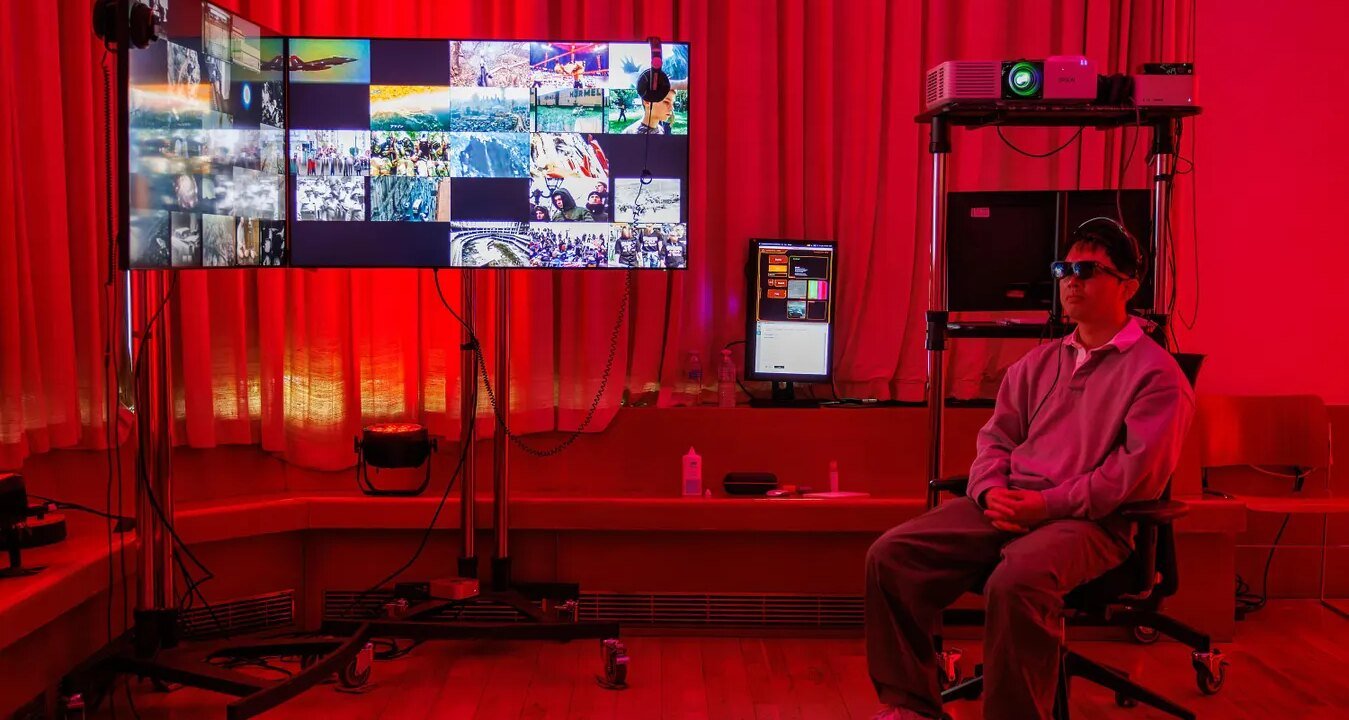
Purgatory Edit by Ali Akbar Mehta, Digital Intimacies, Late at Tate Britain, Curated by Hervisions.
Courtesy Dan Weill and Hervisions
In an era of incessant image production and reproduction, how does cultural relevance emerge? Who dares sift through presently developing tendencies to spotlight artists whose work is lightyears ahead of the curve, contextualizing it alongside comparable avantgarde explorations of the past? Who ventures to filter innovation from novelty?
Enter the curatorial studio.
Case in point: synthesis, a studio founded by Giorgio Vitale in 2017, which launched with a mission to elevate AR and VR, modes of expression Vitale felt weren’t adequately represented in the artworld ecosystem. Since inception, synthesis has curated career-augmenting shows for artists the likes of Nancy Baker Cahill, Yehwan Song (FeralFile), and Cibelle Cavalli Bastos (SXSW).
Cibelle Cavalli Bastos, A Picture Can’t Take Me (left), AES+F, Turandot 2070, Lynx Avatar (center) and Lovers I (right), I KNOW exhibition, Curated by synthesis for Feral File.
Courtesy of the artists and synthesis gallery
As Vitale explained via exclusive conversation with Forbes: “Our goal was to create a context where artists working with immersion were taken seriously, both conceptually and materially. It wasn’t just about hanging screens and headsets on white walls; it was about crafting environments that honored the specificity of these practices while inviting broader conversations about how technology shapes identity, perception, and society.”
synthesis launched because it recognized mediums that required further critical attention but, from here, evolved. Most recently, Vitale curated Material Poetry for HEK Basel, proposing a lineage of the genre in the process. From the performative poetics of budding artist Franziska Ostermann to the foundational work of Eduardo Kac, this exhibition exemplifies synthesis’ role in nurturing emerging artists while collaborating with well-established names.
Play Puzzles & Games on Forbes
As Vitale affirmed: “When we place someone like Kac next to Ostermann, we’re not inviting comparisons but encouraging viewers to think about continuity and rupture.”
Can you hear me? by Franziska Ostermann, 2021, part of Material Poetry, Curated by synthesis gallery for HEK BASEL.
Courtesy of the artist
A show like Material Poetry builds two types of bridges: one between legacy new media institutions and dynamically evolving modes of expression and another between artistic practices at different stages of development. Each is equally important.
HERVISIONS, a curatorial studio founded by Zaiba Jabbar in 2015 to address the flagrant absence of femme-identifying voices in the art and tech world, began as a way to amplify these underrepresented voices while creating alternative systems of visibility, challenging the traditional white-cube-centric view of how and where art should be experienced.
Indeed, both HERVISIONS and synthesis cite a desire to overturn the dominance of the white-cube exhibition in their approach, privileging non-traditional presentations of artworks, such as when HERVISIONS released a mobile-friendly video game in partnership William Morris Gallery in 2023 or when synthesis showed Cahill’s work at the former airport in Berlin’s Tempelhofer Feld in 2021 as part of a public arts project.
When I spoke to Jabbar for Forbes, she reminisced about her studio’s origins: “I hoped to carve out space for a different kind of future, one where speculative thinking, intersectional feminism, and digital aesthetics could meet on equal terms.” Since then, she’s helped amplify the reach of artists like Gabriel Massan, Danielle Braitwaite Shirley and Joséfa Ntjam.
Nina Davies, Bionic Step, presented as part of the Digital Intimacy programme at Late at Tate Britain. Curated by Hervisions.
Courtesy of Dan Weill and Hervisions
Recently, HERVISIONS staged a special iteration of Late at Tate Britain’s art and tech program, Digital Intimacies, transforming the museum into an affective landscape peppered with the works of artists like Alex Quicho, Chia Amisola, Nina Davies, and Romy Gad el Rab in ways that privileged “the confusion, the glitch and the beauty of love, loss and connection.”
A major takeaway, Jabbar cites, is the realization of “how vital it is to protect that sense of immediacy and openness within institutional contexts. People aren’t just receptive to it, they’re hungry for it. I’m excited to keep building on this model. Whether through nomadic formats, durational gatherings, or layered commissions, I want to continue creating curatorial experiences that centre risk, emergence, and relationality.”
Another recent exhibition that privileged risk and emergence is The Second Guess: Body Anxiety in the Age of AI, curated by Anika Meier and Margaret Murphy for HEK Basel. Intended to celebrate the ten-year anniversary of the historic show Body Anxiety, The Second Guess also included a commercial component that sought to fund the production of an exhibition catalogue.
Emi Kusano, Algorhythm of Narcissus, AI-generated video, The Second Guess: Body Anxiety in the Age of AI, 2025.
Courtesy of the artist and The Second Guess
There was so much interest in the exhibition from artists, journalists and even collectors that Murphy and Meier transformed The Second Guess into a curatorial collective to continue their mission. They also partnered with the Tezos Foundation and OBJKT platform to present future editions of select artworks.
The Second Guess is focused on presenting the work of envelope-pushing female and non-binary artists while helping bring the historic work of trailblazers such as LaTurbo Avedon and VNS Matrix (who coined the term “cyberfeminism”) to the blockchain.
As Meier mentioned: “We aim to create meaningful exhibitions and projects that respond to today’s fast-changing art world. Especially now, when doomerism seems to be everywhere, we want to explore what it means to be human and what it means to be an artist in the age of AI.” Their chief focus is publishing a catalogue that will document their work, with each exhibition occupying space as a chapter. With an unannounced museum exhibition in the works, this young initiative is proving impactful.
Addie Wagenknecht, The Perfect Women, Computational, 2024, The Second Guess: Body Anxiety in the Age of AI.
Courtesy of the artist and The Second Guess
A marked throughline of Meier and Murphy’s first exhibition was “the radical emergence of social media,” a new dynamic with which contemporary artists – and the artworld ecosystem at large – must grapple. Their most recent endeavor saw them bring similar themes to Basel, where they presented at the Digital Art Mile.
The gallery-as-curatorial-studio model is certainly not new. LA-based EPOCH Gallery, founded by curator, educator, and artist Peter Wu, functions most frequently as a virtual gallery space but also produces in situ exhibitions, as in CATALYST, which they presented at Honor Fraser Gallery in 2023.
With Wu’s keen curatorial eye, it’s no surprise that entire exhibitions have been acquired by institutions: the LACMA recently acquired their 2022 exhibition ECHOES. EPOCH has also opened their doors to guest curators, notably April Baca and Katie Peyton Hofstadter. When Nora N. Khan and Andrea Bellini were invited to curate the Moving Image Biennial for the Centre d’Art Contemporain Genève, EPOCH then created a virtual representation of this exhibition.
A RADIANT FUTURE, featuring work by Claudia Brăileanu, Ceren Su Çelik, Chris Coleman, Harriet Davey, Sophie Kahn, Parag K. Mital, nouseskou, and Yoshi Sodeoka; Curated by Peter Wu+.
Courtesy of EPOCH
TRANSFER, whose founding members include curators Kelani Nicole, Regina Harsanyi, Wade Wallerstein alongside artists Lorna Mills, Carla Gannis, Rosa Menkman, Huntrezz Janos, and Eva Papamargariti, also traverses the commercial and institutional axis skillfully, adding a crucial and often-overlooked element: assistance with the conservation of time-based media works. What’s more, in 2022 they curated wwwunderkrammer, an exhibition of Carla Gannis’ work for the Perez Art Museum. Then, a few years later, they helped secure the private sale of one of Gannis’ major works, The Garden of Emoji Delights. TRANSFER and EPOCH exemplify the ways curatorial studios can help artists build collector bases and secure institutional acquisitions, which can prove fateful in the long-term financial viability of daring artistic practices.
Meanwhile, early players like Studio as We Are, founded by Jess Conatser, helped bring digital art into the home, curating collections for Infinite Objects, which creates stunning screen-based displays collectors can flaunt in their living rooms.
Artists, too, can drive the vision of curatorial studios. Fakewhale, whose founding members include artists Sky Golpe and Jesse Draxler, brings about physical and virtual exhibitions but also provides compelling criticism, penning articles that help amplify the stories their exhibiting artists are writing.
It’s Dark Inside, Evelyn Bencicova, 2019
Courtesy of the artist and synthesis gallery
As Vitale eloquently puts: “Curatorial studios have a kind of nimbleness and closeness to artists that big institutions often can’t match. We can walk alongside artists as their practices evolve, offering curatorial frameworks while their work is still taking shape. We create spaces where experimentation is embraced, while resisting the flattening effect of trends—making sure younger artists don’t just ‘surface’ briefly but are rooted within the larger conversations they’re actively shaping.”
synthesis’ upcoming projects, one of which involves Norwegian duo ONLY SLIME, performative motion-capture, and speculative digital worlds, certainly exemplify such “nimbleness.” Be sure to catch it during October ’25 at HAU (Hebbel am Ufer) in Berlin.
When it comes to curatorial studios, no rules are written, giving them the freedom and flexibility to be bold.
Still from Wild Wired! Rewilding Langthorne Park, a mobile-friendly game and interactive web experience by HERVISIONS. Commissioned by William Morris Gallery, 2023.
Courtesy of HERVISIONS
Disclaimer: As a digital artist, I’ve participated in exhibitions curated by several of the curatorial studios presented in this article.
[ad_2]
Source link