
[ad_1]
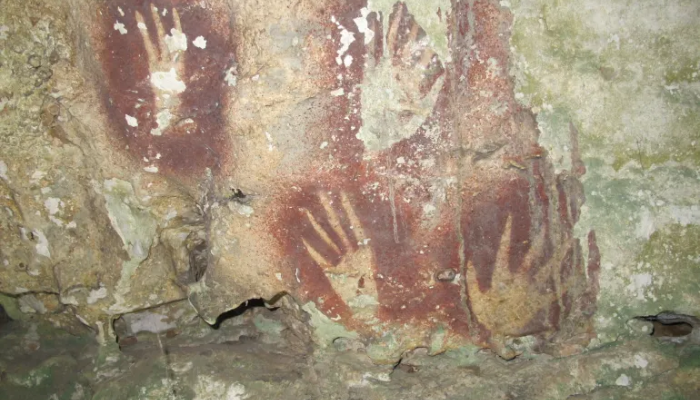
This undated image provided by Maxime Aubert shows handprints with sharpened fingertips in the Maros region of Sulawesi, Indonesia. [Ahdi Agus Oktaviana & Maxime Aubert/AP Photo]
Archaeologists say they have identified the oldest known cave painting in the world, a stencilled outline of a human hand made almost 68,000 years ago on a remote Indonesian island. The discovery reshapes what scientists know about the origins of art and symbolic thought.
The handprint was found on the limestone walls of Liang Metanduno cave on Muna Island, off south-eastern Sulawesi. It was created by placing a hand against the rock and blowing pigment around it, leaving a negative outline. Researchers say the fingers were later reshaped to look pointed, suggesting deliberate symbolism rather than a simple mark.
Read also: Eighteen startups in hunt for $1bn Unicorn valuations
The painting was dated to at least 67,800 years old using uranium analysis of thin mineral layers that formed over the pigment. By measuring how uranium decayed over time compared with thorium, scientists were able to set a clear minimum age for the image.
“This is the oldest hand stencil we know of anywhere in the world,” said Maxime Aubert, archaeological scientist at Griffith University in Australia and a lead author of the study published in the journal Nature.
Read also: At least 8 Nigerian soldiers killed in Boko Haram attack in Borno
“The finger tips were carefully altered, which tells us these people were thinking beyond simple representation.”
The find was made by Adhi Agus Oktaviana of Indonesia’s National Research and Innovation Agency, who has searched caves across the region since 2015. The ancient hand lay beneath much newer cave art, including a painting of a rider on a horse alongside a chicken, showing the site was used repeatedly over tens of thousands of years.
Read also: UK decline Trump’s invitation to join global board of peace in Gaza over Putin’s presence
Experts say the discovery adds weight to evidence that early humans reached the wider Australia and New Guinea landmass known as Sahul far earlier than once believed. It also challenges the long held idea that art and abstract thinking first emerged in Ice Age Europe.
“Our ancestors were not only great sailors,” Adhi said. “They were also artists.”

[ad_2]
Source link