[ad_1]
Woodcuts, lithography, screen printing, letterpress, etching, linocuts—all of these (and more) are printmaking, “the medium of the reproducible,” as Kayla Hall describes it.
Hall is a member of the University of Georgia Printmaking Student Association and the local Black Artists Alliance. Artists from both organizations, including Hall, will exhibit their own printmaking works alongside Atlanta-based artist Jamaal Barber during “Home & Family: A Printmaking Exhibit” at the Taylor-Grady House from Feb. 6–28 in honor of Black History Month.
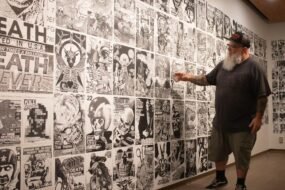
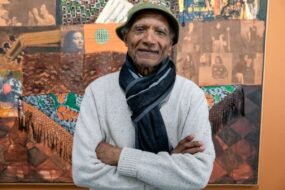
Barber began his artistic career as a painter, but focused his work on printmaking after viewing a screenprinting demonstration at a local art store in 2013. His printmaking works are vibrant, highly textured, layered and bold with themes that center around “the anger, the pride, the pain and the triumph of Black life.” His works can be seen illustrated in the Pulitzer Prize-winning book The Underground Railroad by Colson Whitehead. “Unity is a big part of his artist’s practice and philosophy,” says Hall. “He has this holistic world view of, anybody’s a maker.”
The exhibition has offered the student artists the opportunity to learn from Barber and interpret the theme of home and family for themselves through various mediums of printmaking. The setting itself also offers a unique opportunity for both the artists and those viewing the art in a historic setting.
“When you come through the door, you will hear me say ‘welcome home,’” said Dan Roberts, executive director of Taylor-Grady House at Landmark Commons. “As a gallery, it’s one of the few places you can actually sit down… it really just prompts you to slow down, to really look at the work, to really look at the architecture, and question where this once was, where we are now, and what this has the capability of being.”

It’s a fitting sentiment for the circa 1844 Greek Revival home, once the residence of Henry W. Grady, an Athens-born journalist and leading voice of reconciliation in the post-Reconstruction “New South.” In an 1886 speech, Grady proclaimed, “There was a South of slavery and secession; that South is dead… a South of union and freedom; that South, thank God, is living, breathing, growing every hour.” Today the home is an event venue, art gallery and house museum with a mission “to be an open door for all to experience an inclusive history through education, preservation and hospitality.”
The experience of viewing modern art, especially works by Black artists, within the context of the house’s history allows for reflection in ways that a modern art gallery cannot. “A brown-skinned Black person like myself operating in this space would look much different than I am now, you know? So I think that, in itself, it’s a radical consideration,” says Hall.
The history of the form itself resonates with Hall, too. “Printmaking has one of the longest histories… woodcuts being one of the earliest forms,” explains Hall. “To have this historic artform within a historic home… and the fact that we are combining folks across various demographics, history, storytelling, all around the central theme of home and family is very poignant, now more than ever.”
That earliest form of printmaking, woodcut relief, goes back at least 1,000 years to China with images carved into wood planks, pressed into ink and transferred to paper. Before the method of woodcut relief, there were proto-printmaking techniques using carved bronze and stone on clay and silk. While both methods transfer an image to another surface, these older methods were intended for use by officials, religious institutions and the elite classes. The reproducibility and the reaching of the masses was and remains an essential part of printmaking. “It’s also one of the mediums that allowed for everyday people to begin to acquire art,” says Hall.
The medium has evolved with technological innovation of printmaking methods, the most well known form being Gutenberg’s typesetting and letterpress system in 1440, which led to the mass production of books. The system would seem painstakingly slow to us today, but the 15th century technology was truly revolutionary in its ability to reproduce and disseminate information far faster than the handwritten manuscripts of scribes. For Hall, this form of printmaking is a meditative process. “Setting something by type, the way in which you type on a word document, I’m doing that by hand… So there’s this attentiveness, delicacy, care and exactitude that printmaking requires… the intimacy is really what I love.”

Printmaking’s connection to Black history has been an inspiring piece of the exhibition, too. Hall notes the ties to early Black newspapers and literature, artists of the 1940s–1960s like Elizabeth Catlett, and activist groups like the Black Panther Party using printmaking as a means of unification and reaching the masses through art. Hall hopes that the art on display during “Home & Family” will also inspire guests to consider what home and family means to them.
Several events will be held, including an opening reception and artist talks. An artist talk with Jamaal Barber will be held Tuesday, Feb. 3 at 5:30 p.m. at the Lamar Dodd School of Art. The opening reception at the Taylor-Grady House will be held Friday, Feb. 6 from 5:30–8 p.m. The Taylor-Grady House will also host a student artist talk on Thursday, Feb. 19 at 7 p.m. and a Printmaking for Children workshop on Saturday, Feb. 21 at 2 p.m.
For more information, visit taylorgrady.com.
Like what you just read? Support Flagpole by making a donation today. Every dollar you give helps fund our ongoing mission to provide Athens with quality, independent journalism.
[ad_2]
Source link