[ad_1]
Sir Isaac Lowthian Bell, ironmaster, Philip Webb, architect, and William Morris, Arts & Crafts artist, were not the most obvious of friends — but collaborate they did on a grand country home.
Newcastle-born Bell studied sciences at Edinburgh University, and then travelled to and studied in Germany, Denmark, and at the Sorbonne in Paris — before returning home to Geordie shores to take up a job at his father’s iron and chemical works. As early as 1843, he began experimenting with ironstone, a natural, iron-rich stone found across the Cleveland Hills, on the north-west edge of the North York Moors. His experiments paid off because ironstone was a pivotal raw material of the Industrial Revolution. He and his brother inherited his father’s company in 1845, and the pair set about building more and more blast furnaces in order to extract russet-red ‘gold’ from their ever-growing number of mines.
Bell, who, alongside the ironworks business, went on to be director of the Forth Bridge and North Eastern railway companies, a magistrate, a Fellow of the Royal Society, an officer of the Légion d’Honneur, a sheriff, mayor and alderman of Newcastle, and an MP for both North Durham and The Hartlepools, amassed a huge fortune. And he decided to spend some of it on a North Yorkshire country estate, commissioning friend Philip Webb to design the home.

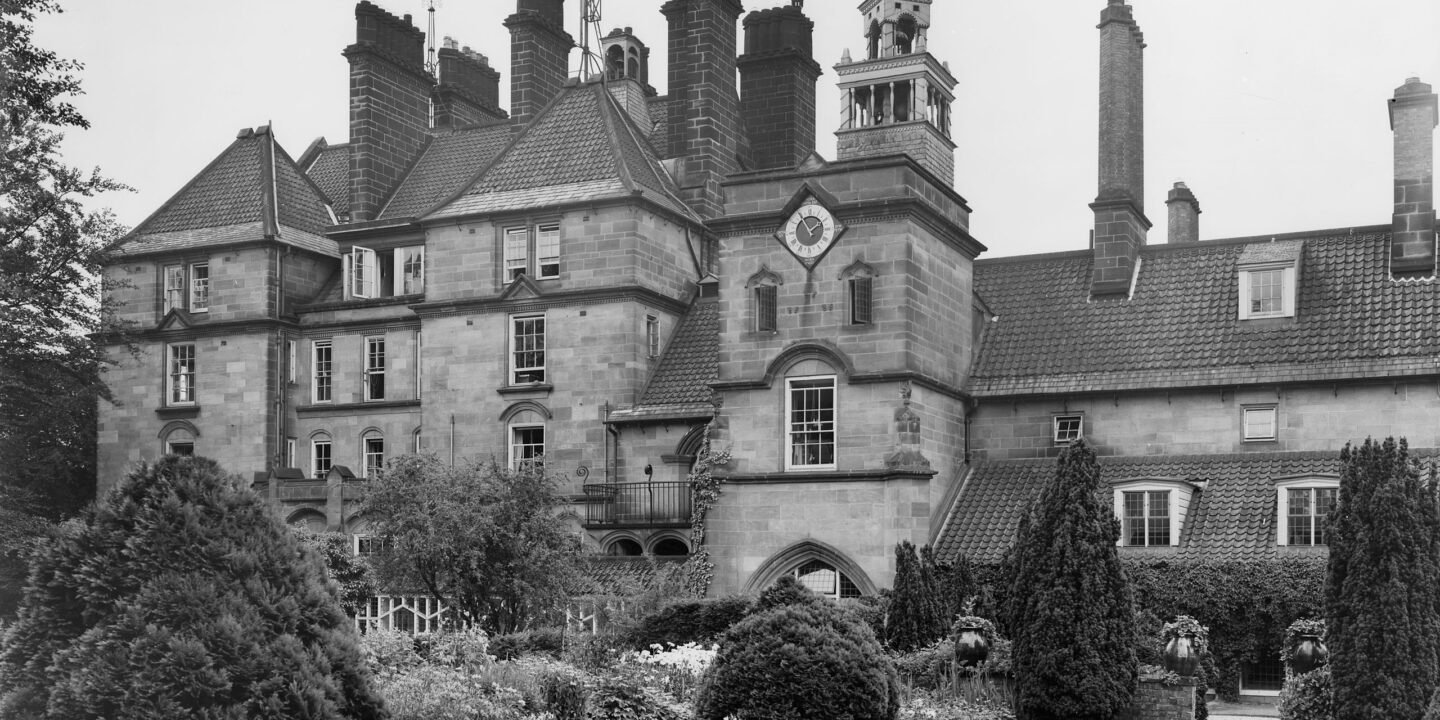
Webb’s assistant George Jack’s additions to the property: the common room, left, and the long gallery.
(Image credit: Country Life Image Archive)
In 1915, Country Life’s Lawrence Weaver described Rounton Grange: ‘I say significance, rather than beauty or charm, because with all my deep reverence for the work of Philip Webb, I feel that its keynote is to be sought rather in its sincerity and grasp of essentials than in beauty achieved.’
The property stood, in places, some five stories high, a design feature employed by Webb and Bell so that they would not have to fell various mature trees growing on the site. Webb’s original floorplans show a photographic room — installed for Bell who took an interest in the emerging art form.
However, it wasn’t just Bell who took an interest in the design and aesthetics of his new home. Over the course of eight years, his wife, Margaret, and one of their daughters, Florence, painstakingly hand-sewed large tapestry friezes inspired by Chaucer’s translations of The Romaunt of the Rose to the designs of William Morris and Edward Burns Jones. The tapestries hung above the panelling in the dining room. The ceilings of the same room were decorated by Morris.
Margaret died in 1886, one year after Bell was made a baronet, around the same time that his love for Rounton appeared to wain.

The dining room with tapestries executed by Margaret and Florence Bell — and a ceiling decorated by William Morris.
(Image credit: Country Life Image Archive)
On Webb’s advice, in 1898, Bell purchased Mount Grace Priory in nearby Osmotherley and set about refurbishing it in Arts and Crafts style. When he died at the age of 88, six years later, his will stated he was worth £768,676 (a colossal £81.8 million in 2025). One of his sons, Sir Hugh Bell, inherited Rounton and Mount Grace Priory.
The junior Bell set about modernising Rounton, alongside George Jack, Webb’s understudy. They added a common room and a long room (a gallery-type space), but like his father before him, Hugh appeared to favour Mount Grace.
He died in 1931, closely followed by his own son, Marcus, meaning the family were hit with two crippling sets of death duties that made maintaining the upkeep of two houses impossible.
Reports in the Newcastle Chronicle, dated to 1940, claim that Rounton Grange had been unoccupied for 16 years and in a terrible state when requisitioned by the War Office as a home for disabled evacuees from the at-risk areas of Gateshead and Tyneside. It also moonlighted as a prisoner of war facility and was in such a bad state by the end of the War that the Bell descendants decided to put it on the market. It failed to sell and was offered to the National Trust who agreed to take it on the basis that it came with an endowment. None was available.
A noticed that it was scheduled for demolition appeared in Country Life in 1953. A year later it had largely vanished, bar a walled garden, park and a few out houses. Today, the former is home to a nursery specialising in dark plants. The park at East Rounton remain historically significant thanks to ongoing restoration efforts.
The Country Life Image Archive contains more than 150,000 images documenting British culture and heritage, from 1897 to the present day. An additional 50,000 assets from the historic archive are scheduled to be added this year — with completion expected in Summer 2025. To search and purchase images directly from the Image Archive, please register here.
[ad_2]
Source link