[ad_1]
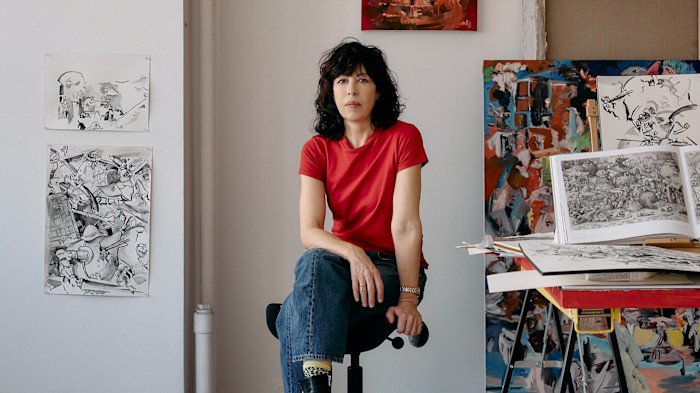
In 1998, Cecily Brown made a painting of ecstatic bodies dissolving into blurry flesh-hued abstraction called “The Girl Who Had Everything”. As, it seemed, did she. Not yet 30, a Londoner relocated to New York, she was the virtuoso of her generation: her distinctive, opulent, flickering canvases breathed new life into both abstract painting and highly erotic figuration. A brilliant, original talent, she is also smart, serious, modest, instantly likeable, with striking looks. Charles Saatchi bought “The Girl . . . ”. Brown’s prices soared — “High Society” (also 1998) fetched $9.8mn last November — and in 2023 came the accolade of a Metropolitan Museum show.
One thing, extraordinarily, has been missing: recognition from a London public institution. So it is unsurprising that when I meet her ahead of the Serpentine Galleries’ Cecily Brown: Picture Making, her first words are, “I’m a nervous wreck.”
Her next — she has just arrived from New York — is the exile’s lament: “England for me is my childhood, so it’s always a jolt and disconnect when I come. Walking in the park [Kensington Gardens] is like a jigsaw puzzle: if you don’t see a jogger in hideous shorts, it could be the 1960s. I think I’m in a Ladybird book. I don’t think England is a Ladybird book, but part of my brain does. If I ever lose my mind, the world is just going to turn into a jigsaw puzzle.”

Chic in yellow with gold jewellery and coiled dark curls, Brown looks untired and youthful (“it’s the New York tweakment”). She “doodled all the way on the plane. I’m blessed to be a workaholic — it’s taken me 25 years to be anywhere near where I want to be technically. I’m drawing all the time. If you don’t, you fall off.”
The Serpentine show is largely new work inspired, loosely, by Kensington Gardens: trees, grassy expanses, lake, glimpsed, suspended between representation and free gestural marks. In “The Serpentine Picture”, the glassy gallery itself half-emerges from flurries of long, luminous strokes. The group “Nature Walk”, anchored by a log across water, a motif taken from a jigsaw, ranges from the festive “Nature Walk with Nymphs” to the fiery “Nature Walk with Paranoia” and gorgeously dissonant “Nature Walk with Hysterical Sky”.

“I kept worrying it was too pretty and bucolic, but there’s a fairly obvious darkness and menace,” Brown says. Working in New York, “I had the park in my head. Everything is memory, layers of remembering and forgetfulness.” That slippage — “to catch something in the act of becoming something else” — is her rich, chaos-risking tightrope act.
“I find it harder and harder to keep up with myself,” she says. “Painting happens very quickly; often I don’t know if it’s working, when you are in the flow. I hardly ever stop and look at what I’m doing; it’s very automatic while I’m painting. I don’t look until later. Anyway, what do I know if it’s good enough?”
It is. The grandest pieces, the vibrant, frayed landscapes-as-abstractions “Froggy would a-wooing go” and “Little Miss Muffet”, fluid as water, light as air, whipped through with a sense of movement and impermanence, reach an impressive maturity and authority without sacrificing the turbulent brushstrokes and conflict inherent in her compositions. Brown is celebrated for her bravura, teeming, highly worked “all-over” surfaces, with echoes of abstract expressionism’s flux and improvisatory energy. Here, she aimed for “the sweet spot where they’re not overly frenetic. They are frenetic, but not so that you don’t want to look at them!”

They have the conviction, immediacy, rhythm of nursery rhymes — which are, Brown emphasises, “scary”. Nursery rhymes, though, are also joyful, exuberant, as Brown expresses in lively drawings based on them and children’s books. She hopes these drawings, more simply figurative, “are pathways into the paintings”.
They are also giveaways of the nostalgia imbuing this show: for England; childhood; her mother, novelist Shena Mackay (“she wrote very visual prose that’s inseparable for me from the mother she was, her love of nature and respect for animals and trees”); and for her own paintings. The Serpentine doesn’t have space for a retrospective — Tate, where are you? — but early sex-in-nature pieces “Bacchanal” and “Couple”, flirtatiously suggestive without being explicit, and chosen after curator Hans Ulrich Obrist told her that “the park has this great nightlife”, are reminders that flesh and pastoral are Brown’s constants.

When the lender withdrew “Teenage Wildlife” (2003), Brown painted a new couple fusing into foliage, “Terry and Julie”: “Using a lyric [The Kinks’ “Waterloo Sunset”], once you have it in your head, the Proustian trigger gives the tone — not literally, there no sunsets or bridges, everything is an equivalent. We live in a made-up world of books and paintings and music.” “Terry and Julie” is sober, delicate, resigned as the song’s lonely narrator watching a couple meet at the station, disappear across “the dirty old river”.
“There’s something about the early work that you’ll never get back, because you were doing it for the first time; there’s a youthful exuberance. You can’t fake doing something for the first time, the sense of adventure and discovery,” Brown says. These days she is trying to simplify: “I’ve reduced my palette to red, yellow and blue. I’ve become a technology nerd. I’d been trying to get a way to slow down; mixing my own colours does that.”
She has long captivated the market, and can take her time. “I’ve been unbelievably lucky. I was connected, I had a massive advantage” [her father was art critic David Sylvester]. Nevertheless, “I feel I’m inadvertently a maker of luxury goods, now watches and cars are in auctions with contemporary paintings. It’s the billionaires! Millionaires are fine. It’s the grossness and greed. I feel incredibly guilty and culpable being part of it.” She stresses the exhibition title: “It’s about making something. So much of the art world is about the product, not the process.”

A fresh departure is a meltingly lovely still life, “Hurry Up Please It’s Time” (2025), reworking the fish on the sand in Turner’s “Sun Rising Through Vapour: Fishermen Cleaning and Selling Fish” via Lucian Freud’s appropriation. Brown’s painting is “about the school of London. It feels so different, I want to get away from my tics, my all-overness. It’s from real life, the ’80s pub call.” She mimics the Cockney “Hurry up please, it’s time! Ain’t you got no home to go to?”, though “I’m told they don’t say it any more”, she adds.
The phrase appears in TS Eliot’s “The Waste Land”; is this another allusive layer? Brown is wary: “I know everyone hates Eliot — it’s problematic, I do understand — but I love him. I’m not a political person, but when we were young we were so into Bacon and Freud. Bacon used Eliot all the time.” I launch into defending Eliot. She cuts me off: culture wars are no-go. For the first time, I feel the impact of America.
Back in 1998, Brown quoting Bacon quoting Eliot, said: “The death of Bacon has made it easier (for me) to make paintings which use the only subjects worth painting — birth, copulation and death.” Is that still her subject? “I don’t think anything changes. ‘Nature Walks’, we call it a walk, but nature is a battleground, brutal; you can’t separate the violent and the beautiful.”
From the start, ignoring 1990s conceptualism and suspicion of painting, Brown sought what she calls “convulsive beauty”. She has magnificently achieved it; this will be a triumphant homecoming show.
‘Cecily Brown: Picture Making’, Serpentine South gallery, March 27-September 6

Find out about our latest stories first — follow FT Weekend on Instagram, Bluesky and X, and sign up to receive the FT Weekend newsletter every Saturday morning
[ad_2]
Source link