[ad_1]
Your forthcoming exhibition Echoes of Now brings together works from different phases of your practice. What guided your selection?
The selection was guided by my interest in bringing together works that, despite being created at different moments, still seem to speak to one another across time. They share an inner thread, a quiet continuity.
How do you see the dialogue between your earlier explorations and your more recent sculptural inquiries?
I see that dialogue as something almost organic. Earlier works often contain the seeds of later developments, even if I wasn’t fully conscious of them at the time. Looking back, I notice a persistence of questions that return in different forms. The more recent sculptures may be more distilled, but they remain deeply rooted in the past.
You often move between classical echoes and contemporary experimentation. What draws you to this tension between tradition and innovation?
That tension feels inevitable. Tradition is not fixed or distant; it is a living language we inherit and reinterpret. I’m drawn to it not out of nostalgia, but because it offers a depth of reference – in subject, in style, in sensibility. My work emerges from engaging with that background.
Many of your works hover between figuration and expression. How do you navigate that boundary?
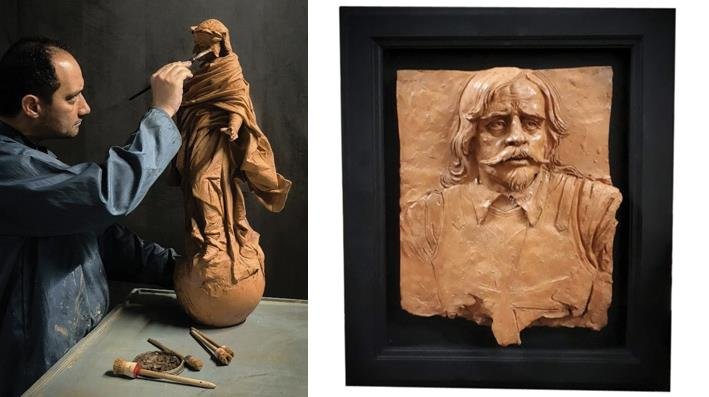
It isn’t something I consciously set out to define. It shifts during the process and depends on the material. At times, the figure in terracotta asserts itself clearly; at others, as in the case of white ceramics, it dissolves into fragments.
Do you begin with a clear vision, or does the form emerge through the act of making?
Sometimes I begin with a clear vision that I try to realise in material. But I also allow the process to unfold and guide the work. There is a certain magic in making something that cannot be predetermined. Often, I let the work lead me, even if it takes me somewhere unexpected. In those moments, the composition emerges organically.
Exhibiting in the newly-restored Baroque Oratory of the Immaculate Conception is a powerful context. How does this space influence the way you see your works?
Working with the Jesuits’ Church Foundation has been a delightful experience. They offered me the stunning Baroque interior of the Immaculate, whose history and atmosphere create a silent counterpart to the works. The space encourages a slower, more contemplative engagement. In that setting, the sculptures seem to absorb and reflect the surroundings, becoming part of a larger dialogue. Some of them even speak the same language – movement, drama, contrast – so synonymous with the Baroque spirit.
Did the history and ambience of the Jesuit Church shape the way your works are displayed?
Very much so. The history and ambience of the church inevitably influenced the arrangement of the works, which feel responsive to the space, almost as if they were created for it. There is a sensitivity in the way the pieces are allowed to breathe within that context. I also worked with my old friend and colleague Lawrence Coleiro, who was instrumental in building the set I designed specifically for this exhibition. Together, we created an elegant setting with a sense of drama.
What do you hope viewers will carry with them after encountering your work in this setting?
I hope viewers leave with a sense of having experienced something – not only by entering this oratory, but by seeing a collection of diverse works created over many years by the same mind and hands, at a time when AI and 3D printing were not yet part of daily life.
Would you like to comment on working with Prof. Paolo Giansiracusa as curator? Did his perspective reveal anything new about your work?
Working with Prof. Giansiracusa has been both natural and enriching. We collaborated on my last exhibition at Muża, Pathos, two-and-a-half years ago. There is a shared history and understanding that allows for honesty in dialogue. His curatorial perspective brought a new consciousness to my work – one that bridges the ancient world with today. He understands my research as a Mediterranean artist, connecting the ancient past with the Christian world and its narrative.
After this exhibition, what would you like to do next?
This exhibition is, in many ways, a prelude to my upcoming book, which I am working on intensely in the hope of publishing this year. It will bring together my most significant works, both in public and private collections, forming a comprehensive reflection on years of sustained effort.
It also marks a moment of transition. We are entering an era shaped by AI and 3D printing, where artistic production is rapidly shifting. I feel a strong urgency to gather and present this body of work created before these technologies became pervasive – as a kind of testament. These works belong to the closing of an epoch in which the artist relied fundamentally on the dialogue between mind and hand. I see myself standing at the threshold between two eras, and this book, together with the exhibition, is a way of preserving that passage for future generations.
In the end, Echoes of Now is not only a gathering of works but a gathering of time – a sculptor pausing to listen to the conversations his own hands have carried across decades. In the quiet of the oratory, those echoes find their place.
Echoes of Now
3 May – 7 June at the Oratory of the Immaculate Conception, Jesuits’ Church Complex, Merchant Street, Valletta.
Opening hours: Mondays to Saturdays from 9am to 4pm and Sundays from 9am to 12.30pm
For further details visit www.chrisebejer.com
[ad_2]
Source link