[ad_1]
Sung Tieu’s installations often appear austere; cold, manufactured surfaces reject the gaze, and the work assumes an almost passive-aggressive bureaucratic neutrality. Although the artist frequently integrates her own family history, shaped by her Vietnamese heritage and her father’s migration to the GDR in the eighties and her own in 1992, by then to reunified Germany, her subjective lens or artistic presence seems conspicuously absent from the work one encounters in an exhibition space. Nevertheless, the historical rigor of her research and the systemic intelligence with which Tieu observes her surroundings is extraordinarily generous. Beneath the restraint of normativity, she traces a dense architecture of encoded relations.
This broader understanding of architecture is crucial to Tieu’s work, as it proposes that contemporary space is no longer defined primarily by walls but by operational logics and infrastructures that organize movement and behavior. Tieu articulates these structures that govern everyday life, focusing on blank or seemingly empty spaces and the codes of conduct through which regimes of access and mobility are produced. This gesture is exemplified in a series the artist started in 2020, which examines administrative forms used in asylum and immigration procedures. One variation shows the forms framed behind glass, the questions manipulated to highlight their indiscreetness, and the surfaces drawn over with the moves of a chess match from 1926. The works were produced for a 2020 exhibition at Haus der Kunst, Munich, titled “Zugzwang” — a chess term describing a position in which a player is forced to make a disadvantageous move, reflecting how bureaucratic systems compel decisions under pressure with limited or no favorable options. In another variation, titled Grid, Form (2022), Tieu removed all writing from the forms, leaving only lines and boxes. In a series titled Numeric Analysis (2022), she then eliminated the remaining graphics and quantified the forms themselves, measuring the space occupied by bars, blocks, boxes, and cells. Within the bland architecture of the DIN A4 sheet there remained an inappropriately small space to fit in an asylum applicant’s life story. This version of the work highlights these blank spaces as a plaster relief, making the documents’ abstraction of human lives even more tangible. The modest gesture of removal exposes the opacity of these empty spaces as something akin to the latent space of institutional power: a domain of hidden relations and operations that structure outcomes without appearing directly. This field includes administrative decisions, technological mediations, and colonial residues, all compressed into minimal aesthetics.
Tieu continues this exploration of physical space in her exhibition “In Cold Print” (2020), in which she divides the exhibition space at Nottingham Contemporary into vertical compartments by slotting steel fences between concrete pillars, directing and interrupting the movement of viewers through space, ultimately leading to a dead end. The resonance with immigration processes is palpable; the cultural hegemony of minimal sculpture forms a direct link to the dehumanizing design of border controls. The absence of traditional exhibition wayfinding systems speaks to the quiet hostility of defensive architectures designed for exclusion. In Tieu’s work, however, architecture is rarely monumental or iconic. Instead, it quietly resists the conventions of exhibition design. Rather than staging or framing an artwork, it operates within a register akin to latent space. In machine learning, latent space contains the compressed dimensions of meaning beneath the surface of data. Tieu’s installations produce a comparable condition of partial visibility. Confronted with glare, fragmentation, and procedural delay, the viewer is asked to decode the spatial grammars through which perception becomes entangled with the administrative rhythms that quietly regulate mobility.
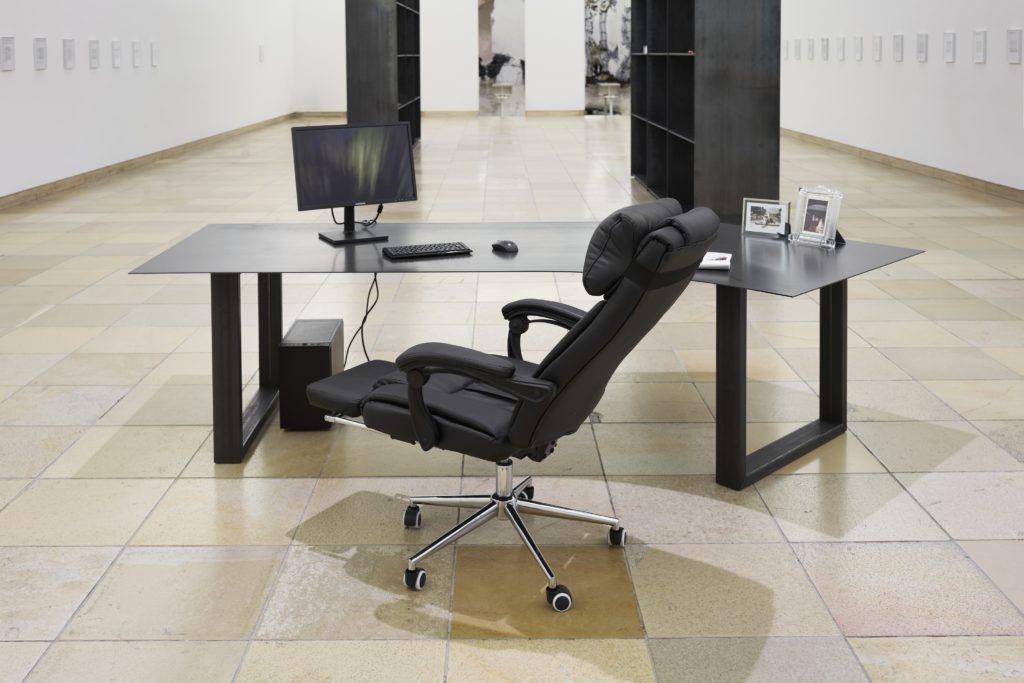
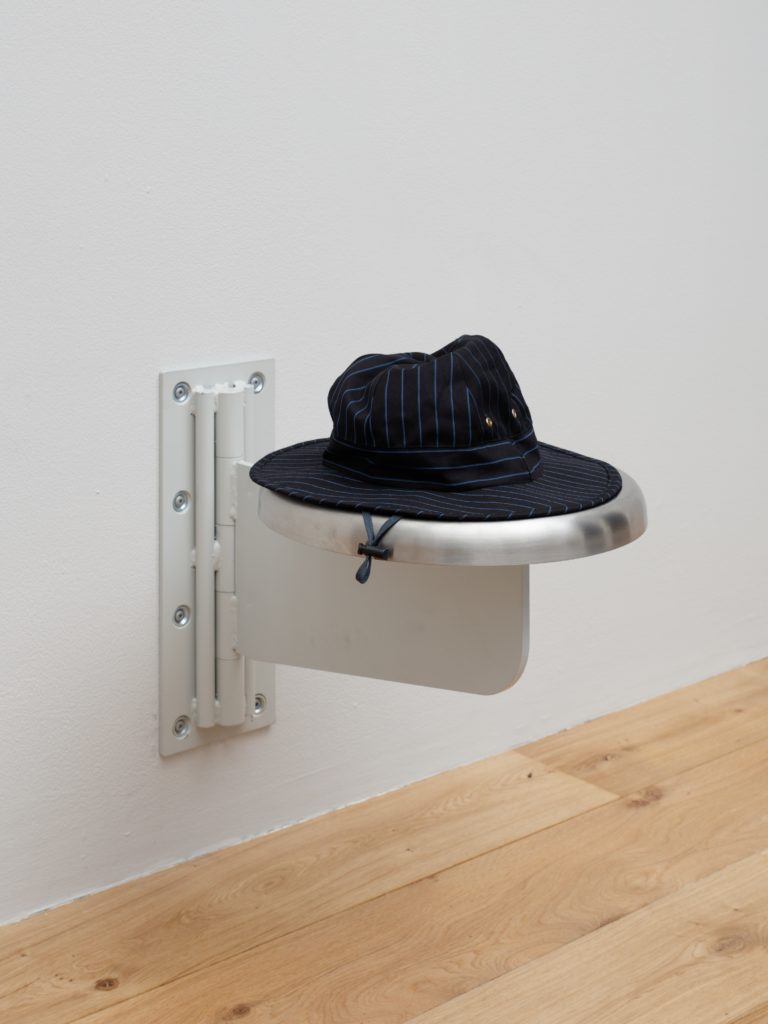
Tieu draws our attention to these empty spaces through her exhibitions, incorporating labyrinthine wayfinding, prefab furniture systems, and other standardized architectural elements. While apparently mundane, these interchangeable, frictionless elements are loaded with architectural intent — they imagine how space might instruct bodies to sit, stand, move, or pause. They are not just sculptural but instead operational. The blank space of a polished, stainless steel stool sets in motion a spatial script: smooth, durable, and resistant to comfort, the stool regulates behavior, prescribing how long bodies may remain and under what conditions they may inhabit the space. In this sense, the works function less as objects than as systems of calibration, tuning the visitor’s body to the subtle frictions through which bureaucratic authority operates.
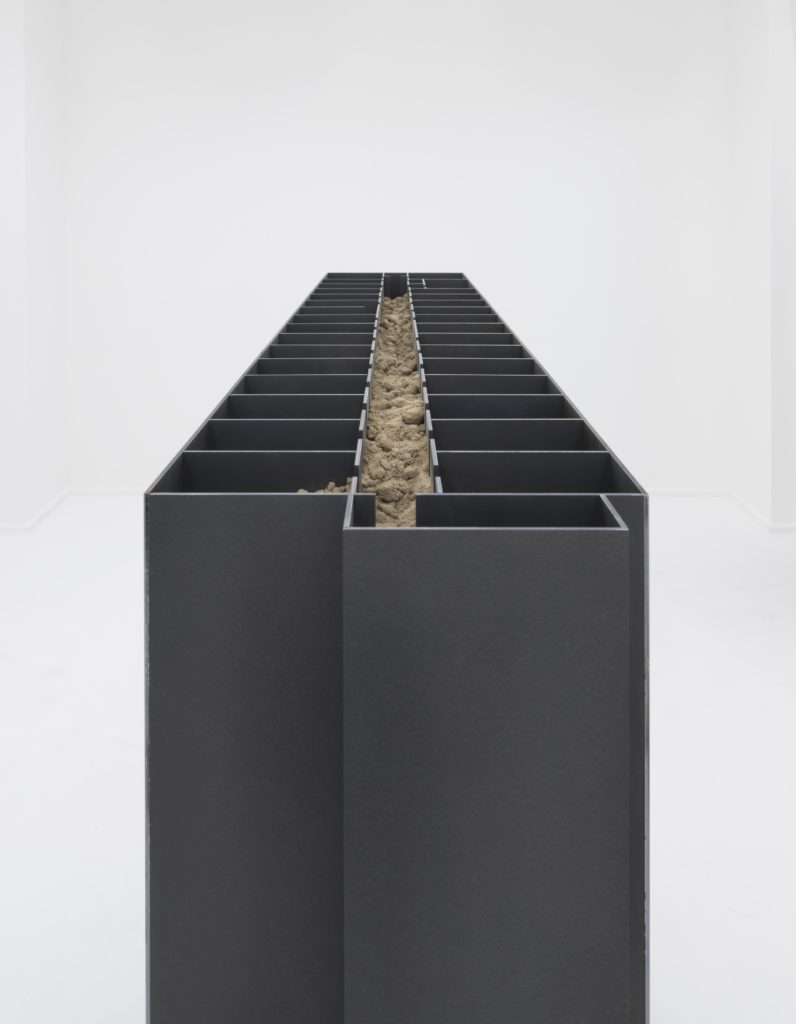
This becomes particularly evident in a series of works based on building floor plans, in which architecture is reduced to diagrams that further examine the prescriptive logic embedded in spatial organization. The monolithic sculptures are dark and heavy, executed in cold-rolled black steel. Among these diagrams is her former home, titled after the address: Block G (Gehrenseestraße), (2023). Situated on the outskirts of Berlin, the buildings were intended as barracks and then repurposed as a housing complex for predominantly Vietnamese contract workers in the GDR. Its one-thousand units accommodated over four thousand workers in standardized spaces of around four persons per room.
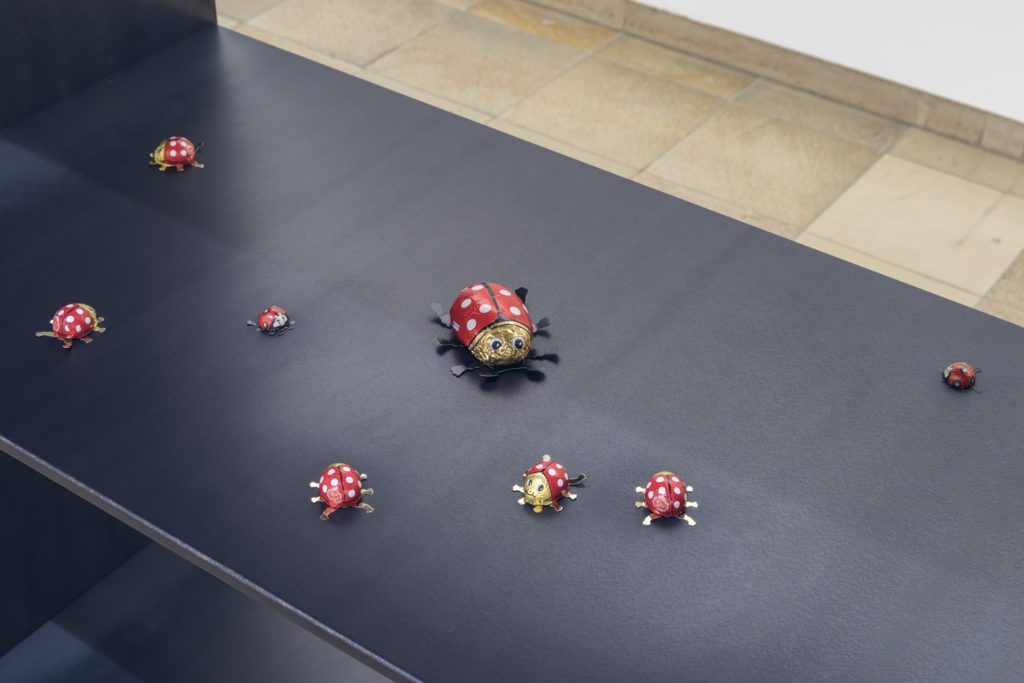
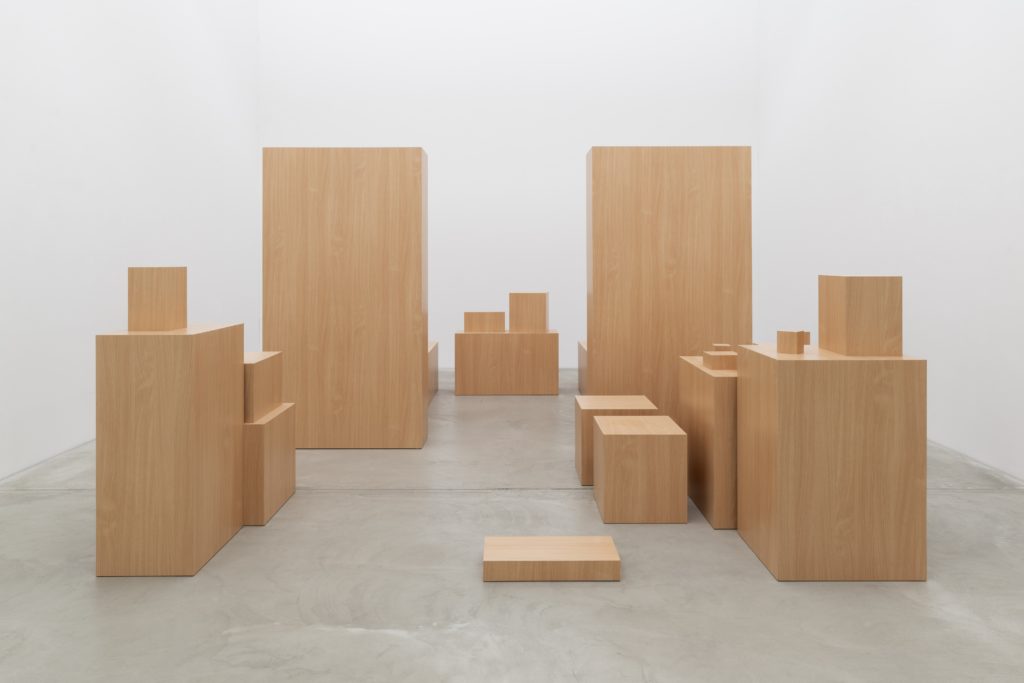
Tieu views prefabricated architecture as a palimpsest of state control. The blank spaces of the floor plan are filled with sand, as if to absorb successive regimes of surveillance, containment, and displacement. In Room 208 (2023), first shown at Kunst Museum Winterthur (2023), Tieu reconstructed at 1:1 scale the interior of the sixteen-square-meter room she shared with her mother and her mother’s friend on Gehrenseestraße in Berlin’s Alt-Hohenschönhausen, casting the space provided as witnesses to bureaucratic violence. The painstakingly precise reconstruction, of the room’s floor plan, complete with woodchip wallpaper and kitchen appliances modified into cubic shapes from laminated wood, conveys the constraints of fitting life into such fixed spatial parameters. These deliberately mundane and cheap material choices shift focus toward space as something not only material, but also procedural and habituated. Here, and even more pointedly in her exhibition “Civic Floor” (2022) — first shown at at MUDUAM Luxembourg (2022); it then travelled to MIT List Visual Arts Centre (2023); it then travelled to Oakville Galleries (2024); and then to Southern Alberta Art Gallery Maansiksikaitsitapiitsinikssin, Lethbridge, Alberta (2024) — the audience encounters space as instruction: a matrix of potential movements that precedes physical occupation. Tieu’s works demonstrate how bureaucracy can exceed its administrative function and assume architectural form, giving rise to environments with clear socio-political dimensions. Prompted by the planned demolition of the sixty-three thousand- square-meter Plattenbau complex, which has stood abandoned since 2002, Tieu has organized tours to the site on Gehrenseestraße since 2023. These walks conceptually revisited her early collaborative works such as Troi Oi (2014) and Subnational Enterprise (2015) by intertwining lived experience and collective memory with the material realities of the standardized environment, while foregrounding the human body as a “unit” of spatial experience.
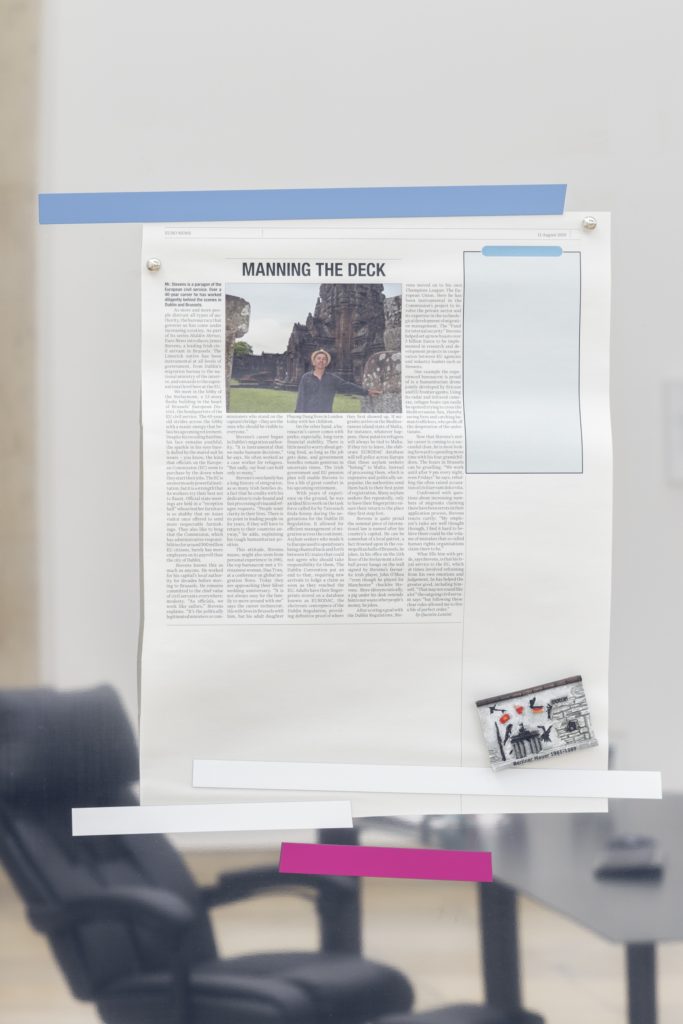
Hamburg / Beirut; Trautwein Herleth, Berlin; and Haus der Kunst, Munich. © Sung Tieu, 2026.
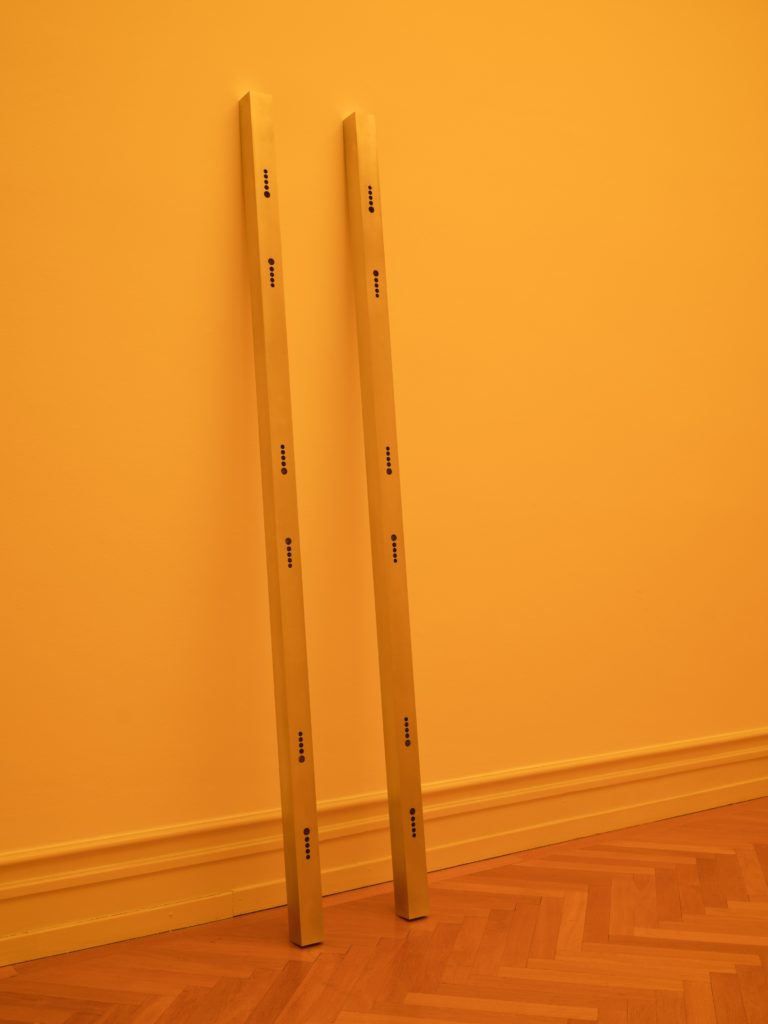
This attention to the body becomes central in projects such as “Perfect Standard” (2024) at Trautwein Herleth, Berlin, and the later sculptural series Corrective Measures (2025), in which Tieu turns to measurement as an extractive technology. Aluminum rulers based on measurements of the artist’s own body — e.g., shoulder span, foot, finger — reference the imposition of the metric system in nineteenth-century French Indochina. By focusing on the arbitrariness of scale, Tieu underscores how measurement and its unification function as a technological abstraction: converting bodies into units, landscapes into grids, and time into segments. In doing so, it produces comparability, enabling the administration of extraction. Tieu’s rulers appear as artifacts of epistemic violence. They hover between instruments of precision and tools of biopolitical regulation — mechanisms through which bodies are rendered measurable, comparable, and governable. They expose how technological rationality is historically entangled with colonial domination. At the same time, the works establish a dialogue between early modern mercantile systems and contemporary digital infrastructures. Measurement can be understood as an early data protocol, a precursor to algorithmic standardization. In the context of Tieu’s work, however, the latent space is not computational but historical. The metric system operates as an invisible architecture that continues to structure how bodies and territories are perceived, measured, and governed.
Across a number of administrative interventions, Tieu treats bureaucratic language as sculptural material. One example is the letter-based work For Nguyễn Văn Tú (2025), which documents Tieu’s participation in a competition to design a commemorative sculpture for Nguyễn Văn Tú at the site of his death in a public space in Berlin’s Marzahn-Hellersdorf district. Nguyễn Văn Tú was a Vietnamese contract worker killed by a right-wing extremist in 1992 — an incident that received widespread media attention and became a lasting point of reference in the short-lived public memory of post-reunification racist violence.
Tieu’s proposal, written with her collaborators, outlined the racist structural conditions embedded within the competition itself. The work is presented as a series of engravings reproducing the letters that contest the parameters of the competition, and Tieu’s dismissal from it. They are displayed as a series of engravings, foregrounding the bureaucratic procedures through which the commissioning institution operates — through hierarchies, permissions, and administrative latency. In a later intervention, Tieu frames the exhibiting institution itself as a programmable system by staging the process of appointing a member to the KW Institute for Contemporary Art (KW-Kunstwerke) Berlin’s institution’s board. The entire written communication is engraved in mirrored stainless steel — an inscription that makes the text deliberately difficult to read. What these documents conceal ultimately reveals the systemic nature of hegemonic opacity. Tieu’s installations do not merely critique such conditions; they model them spatially, exposing how power resides in formatting, filtering, and deferral.
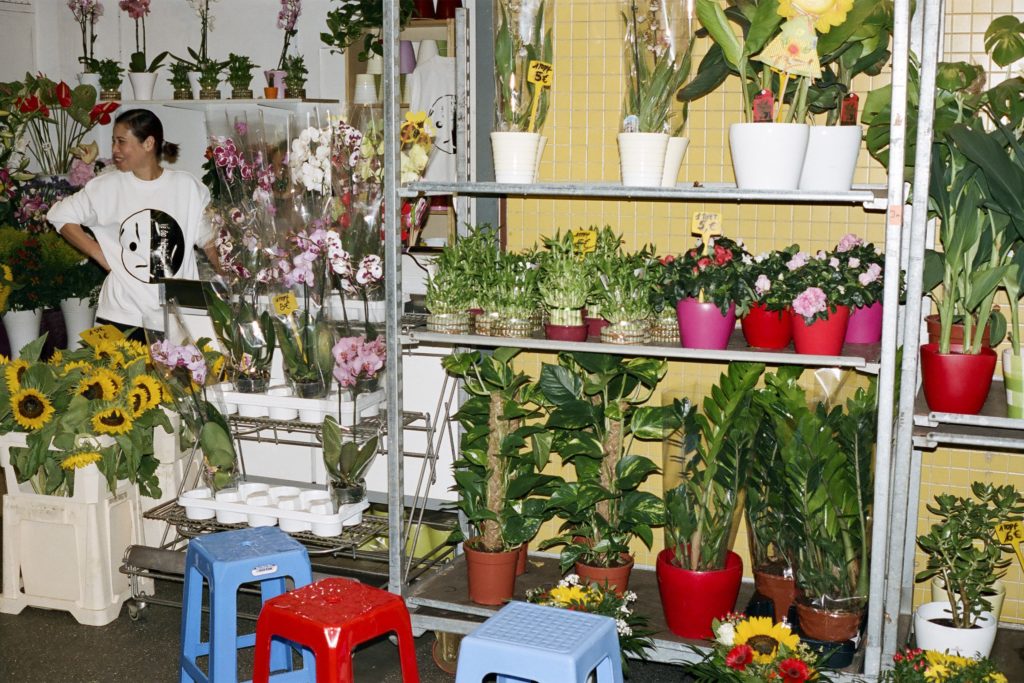
Courtesy of the artist; Emalin, London; Galerie Sfeir, Semler Hamburg /Beirut; and Trautwein Herleth, Berlin. 2014.
Photography by Ilya Lipkin. © Nhu Duong and Sung Tieu, 2026.
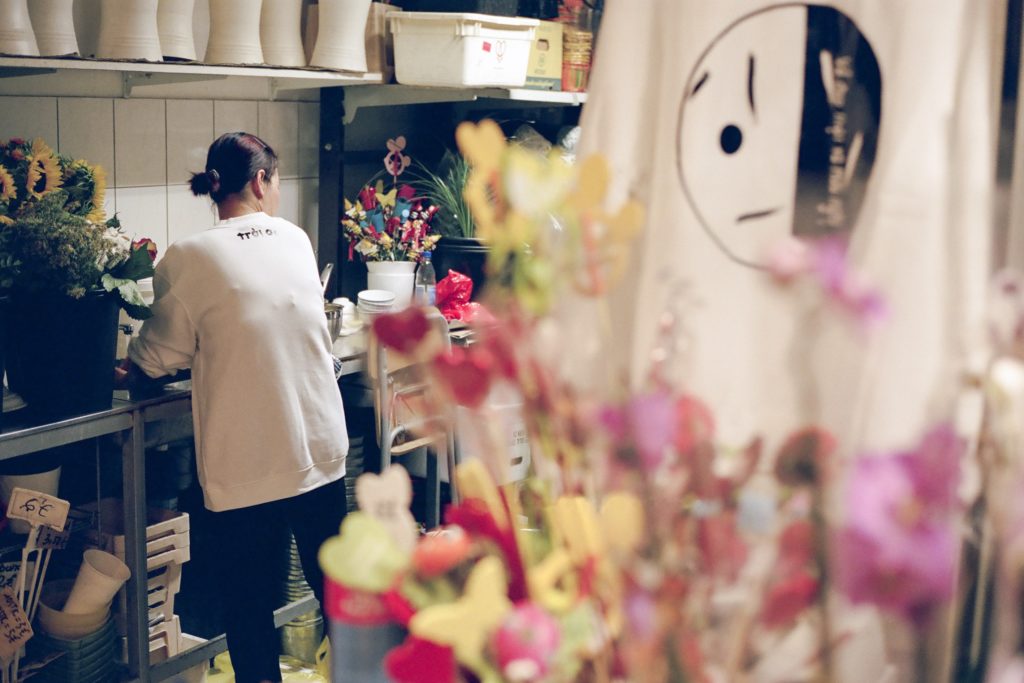
Courtesy of the artist; Emalin, London; Galerie Sfeir, Semler Hamburg /Beirut; and Trautwein Herleth, Berlin. 2014.
Photography by Ilya Lipkin. © Nhu Duong and Sung Tieu, 2026.
Unspeakable Compromise #2 (2025) further explores technological mediation through a sequence of silkscreens. Archival photographs documenting Vietnamese contract workers and post-reunification racial violence are transferred onto stainless steel plates. The halftone prints obscure the images: looking “directly” from the front dissolves the motifs into grainy patterns. Sidelong squinting, however, reveals figures selling cigarettes or evading the authorities. This format highlights the image’s fugitive quality and suggests that historical awareness depends on understanding how institutional and spatial conditions shape the perception of what is perceived as legal or illegal. The viewer must accept incomplete legibility. In this way, the work stages a politics of interface — what becomes visible depends on orientation, light, and distance.
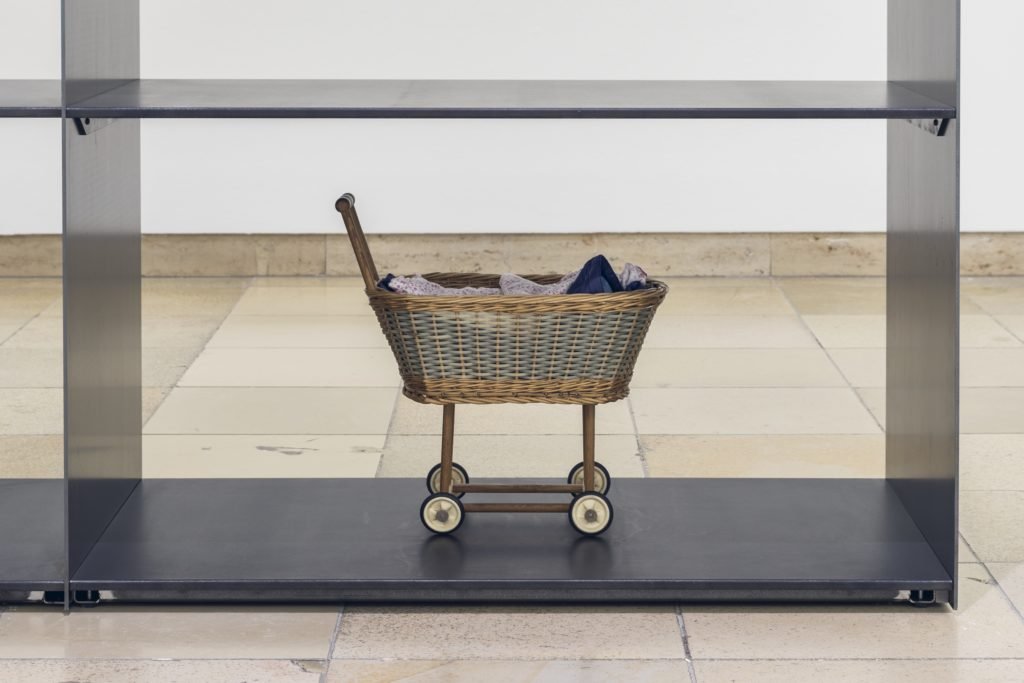
In digital systems, latent space organizes information through compression. Data is not lost but encoded. Tieu’s reflective surfaces enact a similar compression of historical trauma. The violence of 1992 does not disappear; it becomes embedded in the material logic of display and the viewer’s body becomes part of the processing system. What Tieu demands is an ethics of looking that resists the promise of clarity. Perhaps not surprisingly, this insight could not be derived from exhibition views, which do not reproduce the menacing soundtracks of her exhibitions. Tieu is an expert in aural architecture — a spatial practice in which sound is used to shape atmosphere, orientation, and the viewer’s bodily experience of space. Across her installations, sound operates as an underlying system that structures perception without ever fully revealing its source or nature. Visitors encounter encoded signals that must be reconstructed through movement and listening. From early works such as Song for Unattended Items (2018), an eleven-channel sound installation hidden in abandoned bags filled with the artist’s own belongings, or Loveless (2019), a seven-channel sound piece emitting from fast food containers, Tieu employs sound as a dispersed and often concealed presence.
These works incorporate psychological warfare tactics, kitchen alarms, slamming gates, and the hum of fluorescent lights. In more recent installations, such as Public Waste, 2025, sound continues to act as an elusive yet structuring force, constituting the exhibition space as a terribly blank space.
Compiled from field and archival recordings, these sounds introduce a creeping atmosphere of anxiety. What remains absent becomes as significant as what is heard, opening a blank space in which historical truth can emerge, but only obliquely.
[ad_2]
Source link