[ad_1]
When we pulled up in front of the seafoam green and yellow Tropi Shack in the southern coastal town of Guayama, Puerto Rico, Cristina Muñoz Laboy was standing out front, waving and flashing a big smile. Her partner stood next to her, their young daughter in his arms.
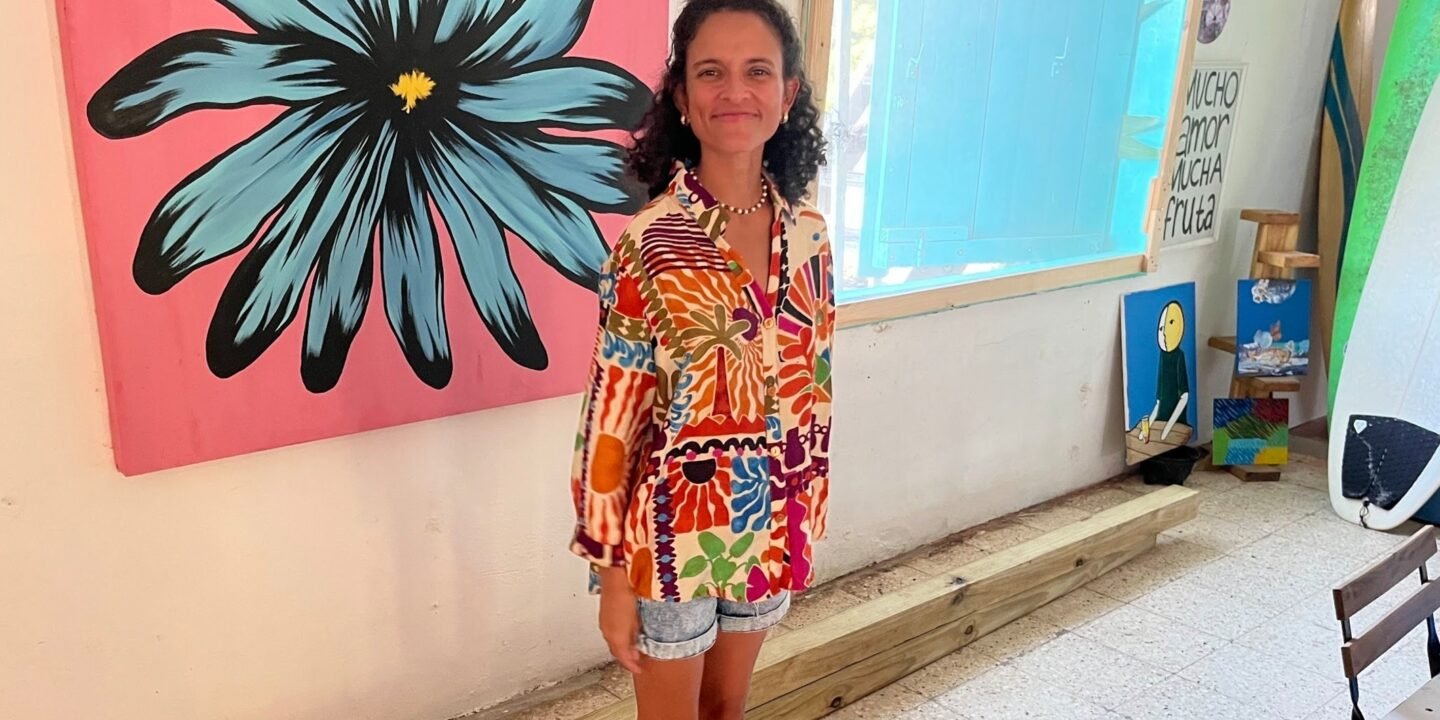
Bathed in salty air, we stepped inside the building, which functions as a surf shop, art studio, workshop space, and bar. Upbeat Puerto Rican music played from speakers, and art made by both Cristina and past visitors covered the walls and tables. Glass jars papered with collages and topped with lights made charming upcycled lamps. In the back corner, surfboards leaned against the wall.
We were here for a Jardín Reuso Creativo (Creative Reuse Garden) workshop with Cristina, a local artist best known for her series of paintings Flora pa’l Corazon, meaning “Flowers for the Heart,” which depicts the endangered flora of Puerto Rico and has led to collaborations with brands like Ford, Absolut Vodka, Levy’s, and Walmart. For the next couple of hours, we sipped coconut-infused cocktails and made collages from a collection of used books and magazines on recycled glass vessels, with Cristina looking on, as we learned more about her work.
Then, and later virtually, I asked Cristina about her art, surf shop, and creative reuse workshop.
Zanny Merullo: How did you get started as an artist?
Cristina Muñoz Laboy: Since I was a child, I’ve been interested in creative activities. I enjoyed cutting-and-pasting projects and any projects that involved art in one way or another. It was when I was in college that I decided to pursue my art and started painting intentionally to see if it was something I could monetize.
ZM: What inspired you to focus on plants and flowers?
CML: Around 2017, I was painting flowers because I liked them, but I wanted to do something with meaning. And that’s when the question came to me: Were there any endangered flowers in Puerto Rico? Because I had heard about animals, but not plants. In Puerto Rico, there are actually more endangered plants than animals. So, for me, that was a huge surprise, and I said: “OK, that’s what I want to do.”
When I started my creative project, I focused on using social media as a tool and portfolio. That was my way of knocking on doors.
ZM: Has conservation always been important to you?
CML: When I started Flora pa’l Corazón, I immersed myself in the topics of conservation and nature and its diversity. It wasn’t that I didn’t care before, but I just didn’t think about it that much. I didn’t study anything related to botany, but I did study visual arts, and that creative foundation is what allowed me to see the possibilities and find inspiration in endangered flora.
ZM: When did you start Jardín Reuso Creativo, and how did the idea come about?
CML: When I connected with my partner in 2019, he had a beachwear line, and we did a collaboration with my flowers on his clothes. And then we continued collaborating because we just connected. That’s also why this is about art and surfing — because it has the best of both our worlds in one space.
We started Tropi Shack in 2023. From day one, our business has been completely aligned with caring for nature. Since we’re located right across from Pozuelo Beach, we envisioned creating a place where art, surfing, and nature could converge. I wanted to manage a space that, beyond serving coffee or beer, would allow people to come and casually explore their creativity. That’s why in 2024 we incorporated Jardín as a core element of our project.
Beyond being an art experience, I wanted it to focus on creative reuse, so that those who visit us have the opportunity to choose a discarded object or waste as their canvas and transform it with art to give it a second life.
ZM: You mentioned that some of the materials available in the workshop had ended up on the beach. Can you tell me more about the problem of plastic waste in Puerto Rico?
CML: Puerto Rico faces a structural and environmental crisis in solid waste management that has intensified in 2025 and 2026. Plus, a law banning single-use plastics came into effect in 2024, but the implementation of fines was postponed until January 1, 2027. Landfills are overflowing, too much waste is being generated, and the recycling rate is less than 10%. There’s a lot to be done.
That’s why one of the possibilities in the Jardín experience is to use plastics rescued from the beach and the six-pack rings from craft beers at our bar, so that people can create colorful mosaics and/or add three-dimensionality to collages. It may seem small, but using these plastics to create art in our space means that they won’t end up in the trash or the ocean.
ZM: What’s next for you, Tropi Shack, and Jardín Reuso Creativo?
CML: I’m gradually getting back into my postpartum creativity, finding balance and rhythm between creating and mothering. With my floral project, I set out to work on a monthly series this year. I don’t want to use black to add details as I usually do — I’m stepping out of my comfort zone and exploring color. As for Tropi Shack, we’re working to expand the structure to guarantee the security of this project so that it can continue to grow and impact the community.
Both with my floral work and with Tropi Shack, I want to affirm that it’s possible to live, educate, learn, and resist through art in Puerto Rico.
[ad_2]
Source link