There’s more to the Arts and Crafts movement than William Morris wallpaper patterns.
In its upcoming lecture series, Heroines and Heroes of the Arts and Crafts Movement, the Victorian Society invites expert speakers to delve into the life and works of Philip Webb, Gertrude Jekyll, Sir Edwin Lutyens, Phoebe Anna Traquair, May Morris, Christopher Whall, Margaret Macdonald & Rennie Mackintosh — covering astonishing architecture, handcrafted metalwork, jewellery, textiles, stained glass, books and gardens. Drawing on new research, the lectures also highlight the often-neglected role played by women in the movement, which remains of direct relevance to architects, artists and designers today.
Here, five of the speakers choose a moment of Arts and Crafts Beauty in, or created in, London.
1. St George Cabinet, Philip Webb and William Morris, V&A South Kensington – chosen by Max Donnelly
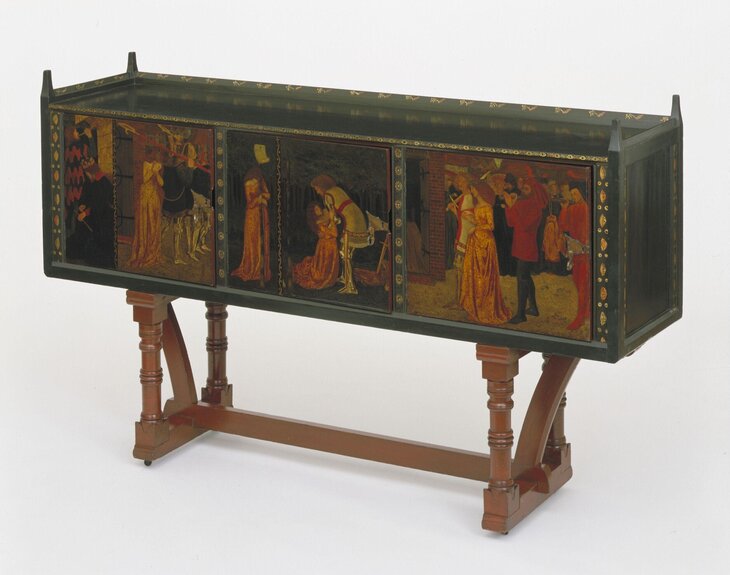
Designed by Philip Webb, with doors painted by William Morris, the St George Cabinet is one of the star attractions in the Britain Galleries at V&A South Kensington. Its medieval-inspired design and iconography can be compared with some of the interior decoration at Red House, Bexleyheath, which Webb had recently designed for William and Jane Morris, who are depicted as the legendary figures of St George and the princess respectively. Webb’s radical design, uncompromisingly sturdy and simple by Victorian standards, was neither understood nor appreciated by viewers of the cabinet when it was displayed in a corner of the Medieval Court of the 1862 London International Exhibition, with one visitor mocking such furniture as fit only ‘to furnish a barn’.
Max Donnelly is talking about Philip Webb on Wednesday 28 January
2. The Hill Garden, Hampstead, Thomas Mawson — chosen by Caroline Ikin
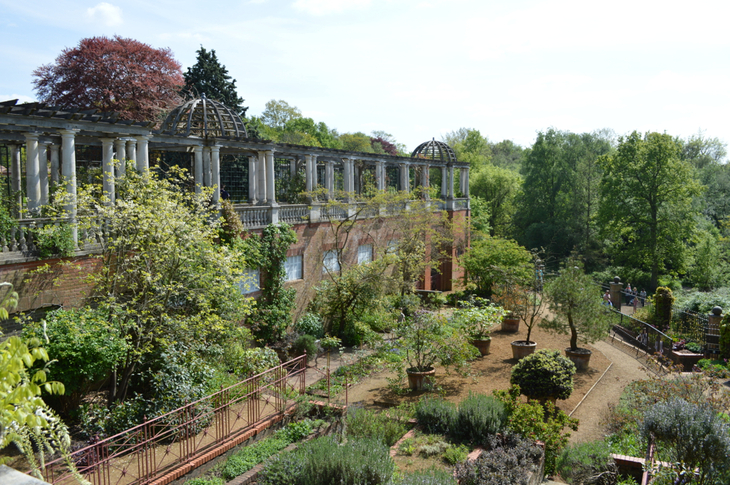
The Hill Garden on the edge of Hampstead Heath was created for wealthy industrialist Lord Leverhulme by Thomas Mawson, landscape architect and author of The Art and Craft of Garden Making. The main feature of the garden is an impressive stone pergola, built in 1905 and later extended. It’s raised on a brick colonnaded plinth, offering views across the heath along its 200-metre length. Arts and Crafts gardens often featured a pergola, which provided an architectural framework softened by a tumble of climbing plants such as roses and honeysuckle, favoured by garden designers including Gertrude Jekyll. The Hill Garden pergola has recently been added to Historic England’s Heritage At Risk Register and urgent conservation work is needed to ensure the long-term preservation of this iconic example of Arts and Crafts garden design.
Caroline Ikin is talking about Gertrude Jekyll on Wednesday 4 February
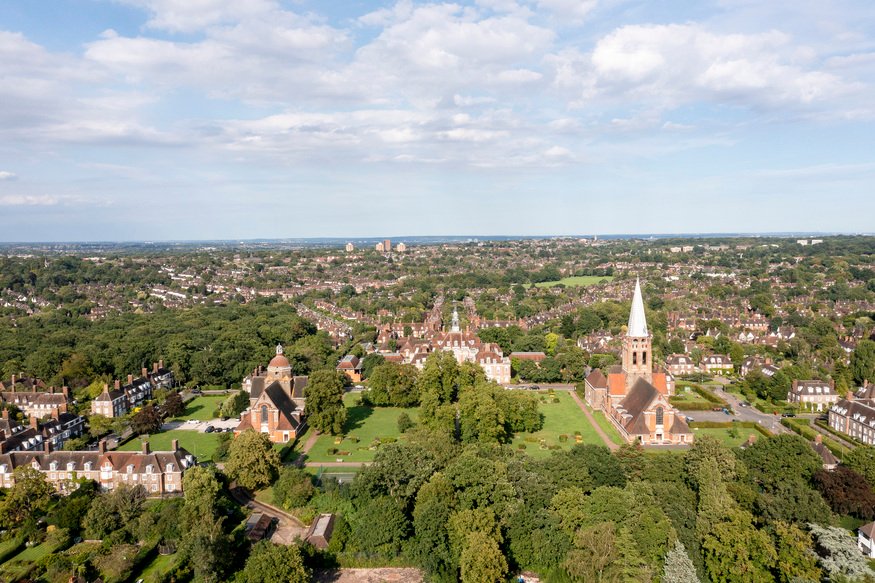
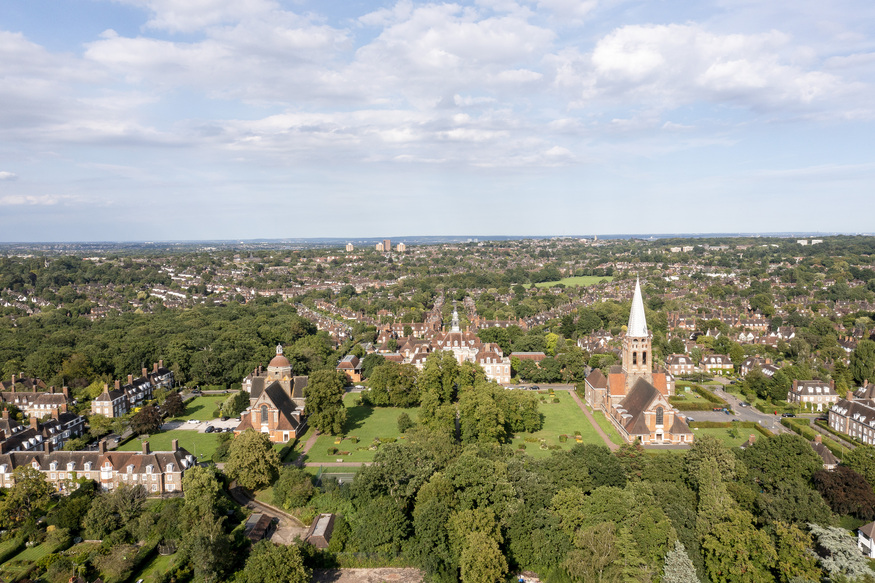
3. St Jude on the Hill, Hampstead Garden Suburb (1908-20), Sir Edwin Lutyens — chosen by Clive Aslet
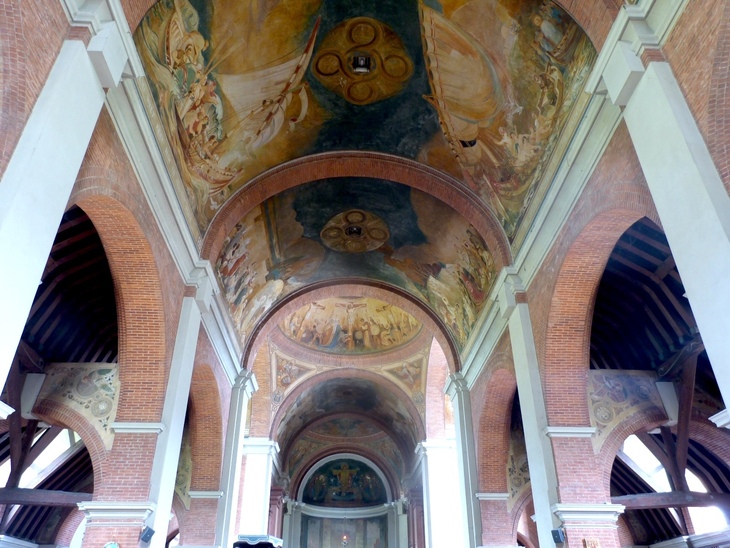
In August 1907 Sir Edwin Lutyens was approached by a solicitor about a commission for Henrietta Barnett — made rich from the proceeds of Rowland’s Macassar Oil — to design a central square for her development, Hampstead Garden Suburb. One of two churches to be sited on there, St Judes was initially designed in an Italianate style Lutyens dubbed ‘Byzantine-cum-Nedi’ (Ned being his nickname), but Henrietta disapproved and the realised design, with an immense sweep of roof, complete with dormers poking out of it, was purely Arts and Crafts, akin to Lutyens’ many works in his home county of Surrey.
Clive Aslet is talking about Sir Edwin Lutyens on Wednesday 11 February
4. The Love Cup, Phoebe Anna Traquair (On display in Room 91, V&A) — chosen by Elizabeth Cumming
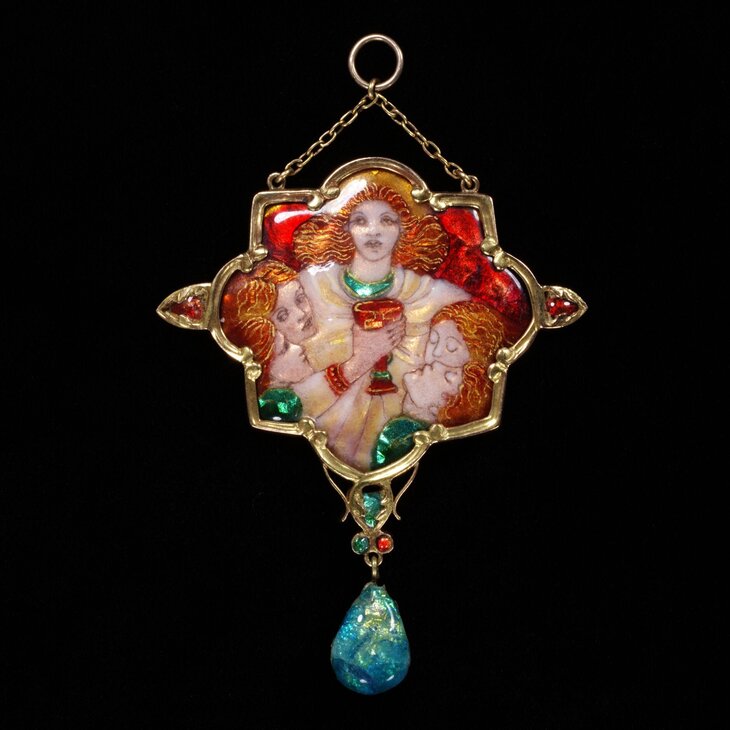
This exquisite jewel from 1907 miniaturises a detail in the decoration of the mortuary chapel of the Royal Edinburgh Hospital for Sick Children chapel which Phoebe Traquair had painted some 20 years earlier. Irish-born and educated, she was a major figure in the Arts and Crafts movement in her adopted city of Edinburgh. In the last decades of the 19th century she had focused on mural painting, embroidery and manuscript illumination, only taking up art enamelling in 1901. As with her other crafts, she relished the considerable challenges of the medium and it was the one for which she was best known in London. She made more than 200 pieces, all illustrative and drawn from Christian or classical subjects and deeply influenced by the beauty she found in Pre-Raphaelite art.
Elizabeth Cumming is talking about Phoebe Anna Traquair on Wednesday 25 February
5. Rose and Lattice, May Morris – chosen by Lynn Hulse
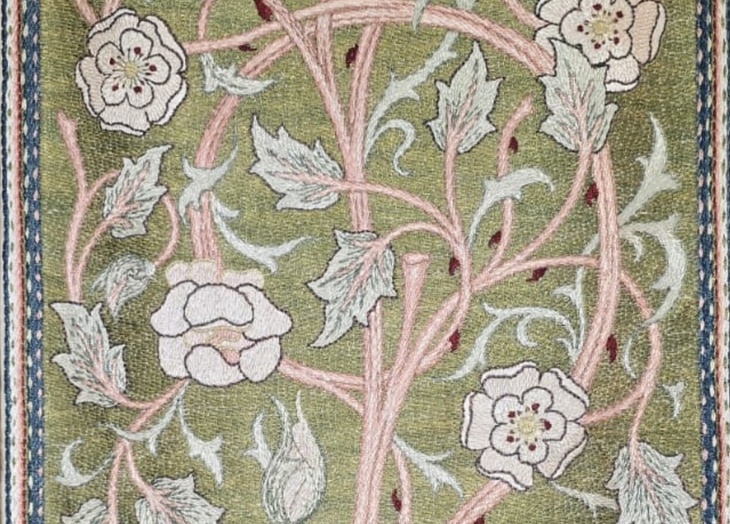
Among the works explored in my lecture is Rose and Lattice or Rose trellis, a decorative screen panel designed by May Morris and embroidered in the late 19th century by Maria Louisa, Baroness de Brienen. The design was first published in 1888 in the Victorian periodical The Century Guild Hobby Horse. Four years later, a revised version stitched by May herself appeared in Ellen Masters’ The Gentlewoman’s Book of Art Needlework. An expert on embroidery, Masters praised the panel as ‘a veritable poem embodied in needlework… The tout ensemble is nearly perfect and shows that Miss Morris has imbibed much of the true spirit, following the example of conscientious execution, set by the old experts in the art’. The design features richly patterned floral borders at the top and bottom, set within a lattice framework. At its centre is a rose tree with intertwined stems, accompanied by Persian-style tulips and fritillaries. De Brienen’s version closely follows the colours and embroidery techniques described in Masters’ book. The panel is currently on display in the exhibition Beauty of the Earth: The Art of May, Jane & William Morris at The Arc, in Winchester. Rose and Lattice was almost certainly designed and worked in London.
Lynn Hulse is talking about May Morris on Wednesday 11 March.
The Victorian Society’s lecture series, Heroines and Heroes of the Arts and Crafts Movement, takes place both online and in person from 28 January-11 March 2026. Book talks individually, or watch all seven lectures for the price of six.
Monies from ticket sales goes to support the work of the Victorian Society, campaigning for Victorian and Edwardian Built Heritage.