FtaEssex, its places, spaces and communities, has been enhanced over hundreds of years by many fine examples of traditional crafts and skills, executed by skilled artisans.
Thatched roofs and intricate pargeting (the skill of creating freehand or moulded plasterwork) on many beautiful buildings are just two of the wide spectrum of crafts that have shaped the county’s landscape and history.
The national charity, Heritage Crafts, has warned that many traditional skills and crafts are now endangered, and some that have been part of our heritage for centuries could be lost forever.

Funding from the Salter McKinlay Charitable Fund, established with Essex Community Foundation (ECF) in 2014, is helping to preserve at-risk skills across the county. The fund provides grants of up to £2,000 through the Heritage Crafts’ Endangered Crafts Fund, which was launched in 2019 to help endangered crafts survive.
Each year, Heritage Crafts publishes a Red List to highlight just how many traditional crafts are in danger. In 2025 it listed 71 as critically endangered and 94 as endangered. Crafts classified as critically endangered are those at serious risk of no longer being practised.
This includes crafts with a shrinking base of craftspeople, those with limited training opportunities or low financial viability, or crafts where there is no mechanism to pass on the skills and knowledge.
‘The Red List underscores the urgent need for greater investment and support to safeguard these skills for the next generation,’ says Daniel Carpenter, Executive Director of Heritage Crafts.
‘Reversing this decline would represent not just the continuation of skilled trades, but also a significant boost to the UK’s cultural heritage and countless opportunities for future innovation.
‘As a result of this alarming threat to our cultural heritage, Heritage Crafts set up its Endangered Crafts Fund in 2019.’

Keeping endangered crafts alive
Andy Basham from Essex was awarded an Endangered Crafts Fund grant so that he and others could learn to make thatching spars from the last spar maker in East Anglia and to equip himself for production from his hazel coppice.
Andy is a coppicer contracted to Natural England to maintain the coppice cycle in the National Nature Reserve and Site of Special Scientific Interest at Hales Wood, Ashdon near Saffron Walden. He has worked there for more than 17 years, using traditional tools and techniques to extract material, mainly hazel, by hand, carefully selecting it for various craft uses.
His output includes stakes and binders for hedge layers, staves for Scout groups and Morris dancers, walking-stick blanks, besom (broom) and rake handles, beanpoles and peasticks, wattle rods and spar gads used in thatching and supplied to the only spar maker in East Anglia, Charlie Potter.
Andy had previously made spars for local thatchers, but as his only guidance had come from one book on coppice crafts, he lacked a full understanding of the craft. He recognised that speed and experience were essential to making a viable living from spar production.
The market for English hazel spars was strong, but with so few practitioners remaining to create them, the craft was at risk of disappearing from East Anglia.
Andy, a founder member of the East Anglian Coppice Network, organised a visit by Charlie Potter to the wood at Ashdon to teach spar making, helping to ensure that the craft will live on. The grant from ECF covered Charlie’s time and expenses over two days.
Essex-based glass artist Elena Fleury-Rojo has also been supported by the Heritage Crafts Association. In 2024 she was awarded a training bursary, funded through the Maxwell Hanrahan Foundation.

Elena, who trained at the National Glass Centre in Sunderland, wanted to develop her skills in the specialist field of scientific glass blowing. She plans to raise awareness of this craft through her artwork, as well as offering other services, such as making and repairing scientific glass apparatus.
She sys, ‘Scientific glass blowing is an endangered craft in Britain. The Heritage Crafts bursary has given me the opportunity to learn from a master glass blower before it’s too late. Learning these skills enables the craft to be passed on to future generations.’
Another endangered craft is pargeting, the skill of creating freehand or moulded plasterwork. East Anglia’s buildings boast many examples of pargeting, which has traditionally been used to create motifs of coats of arms, fruits, animals, or even entire scenes on buildings.
A skilled craft in England since King Henry VIII brought in Italian plasterers over to decorate one of his palaces, pargeting can range from a simple leaf design through to an elaborate fresco, freehand-modelled figures, motifs, and scenes.
Heritage Crafts says the issues affecting pargeting include changing tastes in housing design and the strict restrictions imposed by conservation legislation.

Anna Kettle is a pargeter based in Cambridgeshire who has worked in the building trade for many years.
She explains, ‘A pargeter creates architectural designs by free hand modelling with lime plaster onto over-mantels, friezes, panels, ceilings and walls.
‘I walk into historically interesting houses that, sadly, have become run down and I transform them for 21st-century living, while emphasising their character according to best conservation principles.’

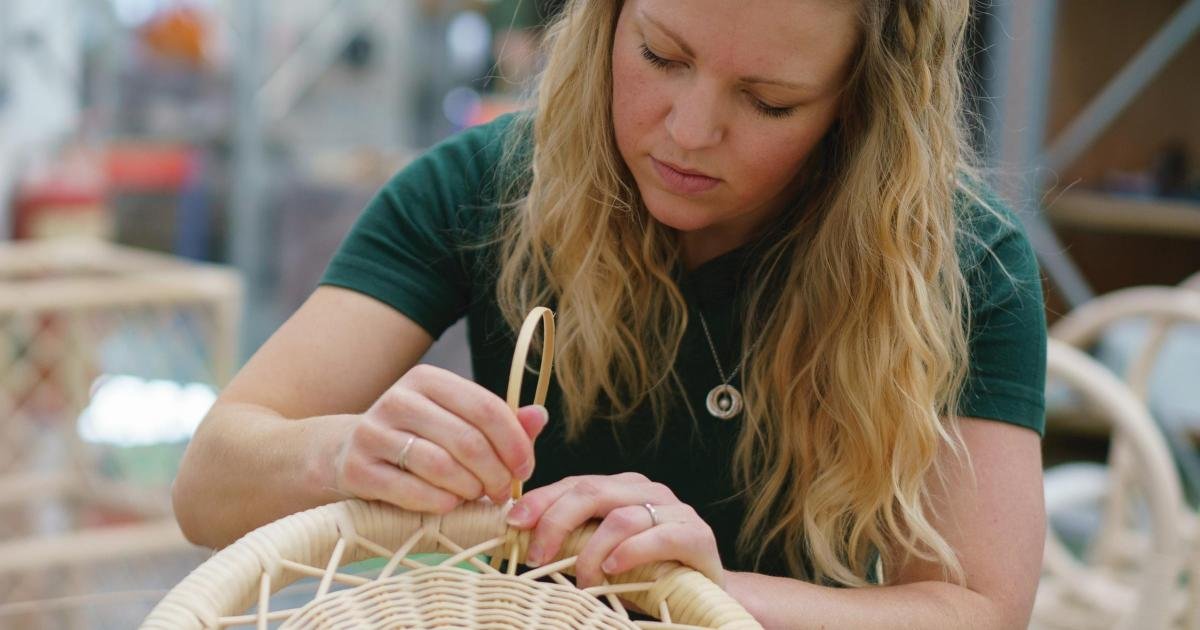
Other endangered crafts include Welsh Vernacular Thatching, now classified as critically endangered, bobbin lace makers – the number of skilled practitioners is declining, with few opportunities to learn the craft, and accredited routes such as City & Guilds no longer available – and rattan making. Currently there is only one rattan company working in the UK, meaning that all the skills and knowledge are held in one place.
Says Mary Lewis, Head of Craft Sustainability at Heritage Crafts, ‘Craft is not just a creative endeavour, but is a living, evolving part of our shared cultural landscape. Sadly, the future of many skilled trades is hanging in the balance. Rising operational costs, a lack of structured training and mounting market pressures are placing unsustainable strain on crafts that depend on expert hand skills.
‘Trades such as cut crystal glassmaking, pewter working, organ building, industrial ceramics and the allied trades that support silversmithing are examples of those that are becoming vulnerable.
“However, at the same time, heritage craft is emerging as a powerful force in sustainability and cultural resilience, and craft is increasingly recognised as a vital expression of cultural identity.
‘Heritage crafts offer communities accessible and meaningful ways to engage with their histories, skills and traditions. Behind every entry for our Red List of endangered crafts are stories of extraordinary people. It is their passion, resilience and quiet determination that give this work its meaning.
‘I’m struck not only by the challenges we face, but by the astonishing diversity and breadth of skill that exists across the UK. While some continue to thrive, many are under growing threat. We have highlighted the difficult and often heartbreaking choices that craftspeople are being forced to take. It is their voices, their hands and their stories that continue to inspire the work we do at Heritage Crafts.
‘We are delighted to be working in partnership with Essex Community Foundation to address the specific challenges to endangered skills and knowledge in Essex.’
Seeing Red
The Red List of Endangered Crafts was first published in 2017 was the first report of its kind to rank traditional crafts by the likelihood they would survive to the next generation.
The 2025 edition highlights:
• No new crafts have become extirpated (extinct in the UK) since 2023.
• 71 crafts are listed as critically endangered, up from 62 featured in 2023.
• 93 crafts are listed as endangered, up from 84 featured in 2023.
115 crafts are deemed currently viable, up from 112 in 2023. Despite being classified as viable, these crafts are not risk-free or without issues, and continue to be monitored.

Salter McKinlay Charitable Fund
Essex Community Foundation has provided grants to the Heritage Crafts Association through the Salter McKinlay Charitable Fund, one of the many funds it manages on behalf of individuals, families, companies and public agencies.
Ron Salter met Iris McKinlay during WWII when he was in the Royal Navy and she was a WREN. He was from London, she came from Liverpool, and they married in Devon. After the War, Ron and Iris moved to North London and Ron began a career in the Civil Service, working for the Department of the Environment.
During his distinguished career, Ron held a variety of senior posts and spent time in Malaysia and Singapore, where he was responsible for the decommissioning of military bases. He retired as Assistant Secretary in 1972 and was awarded a CBE in 1973.
Ron and Iris had two children. Their son, Michael, has lived in Essex since 1988 and set up the Salter McKinlay Charitable Fund with ECF in 2014 in memory of Ron and Iris, to give grants to help young people to learn new skills, build confidence or gain qualifications. Particular areas of interest for the fund are heritage crafts and STEM (Science, Technology, Engineering and Mathematics) subjects.
Are you an Essex craftsperson? Grants are available!
Applicants based in Essex can apply for a heritage grant of up to £2,000, which can cover or contribute towards:
● training to learn a new craft or technique
● training for an apprentice to pass on skills and knowledge
● investing in more efficient tools and machinery
● developing reduced-carbon routes to market
● exploring the use of alternative materials while maintaining the heritage character of your practice
● innovative approaches to supporting and promoting endangered crafts.
For more information and to apply for a grant visit heritagecrafts.org.uk/ecf , call ECF on 01245 355947, or see essexcommunityfoundation.org.uk