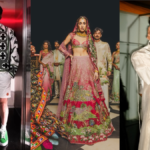

The front row of a contemporary Indian fashion week is no longer a parade of logos; it is an assembly of narratives. We are witnessing a quiet but seismic shift where the runway has moved beyond mere “apparel” to become a gallery for India’s most potent art form: its textiles. What was once confined to the “traditional” corner of the wardrobe — static, ceremonial, and perhaps a bit predictable — is now being reframed as a new, globally relevant visual language.
Handloom, intricate embroidery, and indigenous crafts are no longer positioned as heritage alone; they are being elevated as expressive, collectible masterpieces. This isn’t just about nostalgia; it’s about a reclamation of identity through the loom.
Craft’s Sensory Revival
This “craft-as-anecdote” feels especially urgent in the recent showcases, such as Saim’s debutat Lakmé Fashion Week. He arrived as a kind of restorative balm for the modern soul, proving that tradition doesn’t have to be rigid to be revered. Saim’s work doesn’t just use craft; it lives within it, drawing from a deeply embedded celebratory memory of an India that is both pluralistic and profoundly spiritual.
/filters:format(webp)/elle-india/media/media_files/2026/04/02/img-2026-04-02-11-33-33.jpg)
Inspired by the architectural sensuality of temple sculptures and the divine drapes of mythology, he used silk Chanderi bases and jersey drapes to exaggerate a feeling of mystery. It is in his surface language, however, that craft transcends into art — layered patchworks over sheer fabrics, he evolved the traditional clothing journey into something that feels both ancient and avant-garde.
The New Epoch: Where Streetwear Meets the Soil
If this craft revival has a headquarters, it’s in the studios of a few young, boundary-pushing labels that refuse to treat Indian textiles as “costume.” These brands are the bridge between the artisan’s village and the urban high-street.
-
Hindostan Archive: Founded by NIFT graduates, this label is a masterclass in the “cultural remix.” They’ve taken the Bandhani of Bhuj and the Ajrakh of Rajasthan and dropped them into silhouettes that feel like they belong in a Tokyo or New York subway—think double-kneed workwear trousers and sporty oversized sweatshirts that swap synthetic fleece for hand-blocked heritage.
/filters:format(webp)/elle-india/media/media_files/2026/04/02/img-2026-04-02-11-34-39.jpg)
-
Kartik Research: A favorite on the global circuit (and even seen on Lewis Hamilton), this label treats the “Made in India” tag as a luxury flex. They specialize in soft-tailored suiting and bomber jackets made from hand-quilted kantha or plant-dyed linens. It’s the ultimate “quiet luxury” for a generation that values the thumbprint of the maker over a loud logo.
/filters:format(webp)/elle-india/media/media_files/2026/04/02/img-2026-04-02-11-35-36.jpg)
-
Samaaj: Taking a “season-agnostic” approach, Samaaj treats fashion like a hype-beast drop. They repurpose old Phulkari dupattas into structured shirts and give Rabari saris a second life as camp-collared tops. Each piece is a one-of-a-kind archive, making the wearer feel less like a consumer and more like a curator.
/filters:format(webp)/elle-india/media/media_files/2026/04/02/img-2026-04-02-11-36-50.jpg)
The Global Vanguard: The Rahul Mishra Effect
Rahul Mishra remains the seasoned architect of the craft revival movement on the global stage. Mishra has effectively turned “Made in India” into the gold standard of Haute Couture. His shows are less about the garment and more about the ecosystem.
Each Mishra piece carries thousands of human hours and the weight of reverse migration — his signature philosophy of sending work back to the villages rather than bringing artisans to urban slums. His signature 3D embroideries and botanical landscapes are a love letter to the Indian hand, proving that Indian craft doesn’t need to be “westernised” to be relevant; it simply needs to be seen as the masterpiece it is.
/filters:format(webp)/elle-india/media/media_files/2026/04/02/img-2026-04-02-11-37-49.jpg)
The Verdict
As we move through 2026, the definition of “Indian Fashion” has finally outgrown its boundaries. What we are looking at is visual sovereignty. Whether it is the soulful, mythic drapes of Saim, the architectural haute couture of Rahul Mishra, or a Bandhani corset from a homegrown Gen Z label, the message is the same: Our textiles are not relics. They are a living, breathing language — one that is finally loud enough for the whole world to hear.