What is your connection to East Anglia and how has living here influenced your work?
I grew up here, in the same Clopton farmhouse where my studio sits today. My connection to East Anglia is as important to my work as the craft techniques I use, I could not have the one without the other.
Do you find inspiration in the region’s landscape, heritage or creative community?
The beauty of this region and my lifelong connection to the landscape and its heritage is essential to my ability to work creatively as a bookbinder. The strength of my connection to this area is something that I didn’t appreciate until I moved away. I left to attend university in London and began to pursue an academic career there. But over the years it became increasingly clear to me how unfulfilled I felt in the city. My decision to pursue what was once a hobby, bookbinding and move back to my roots in East Anglia was a conscious acknowledgment of my need to live somewhere I feel connected to the natural world and the history of the area. That feeling and connection is what motivates my work and inspires me in what I do every day.
What first drew you to the art of bookbinding? Was it love at first sight or a skill you discovered over time?
I have been in love with books my entire life, first as a passionate reader and, then, from my teenage years onwards, as a collector of books. I was always fascinated by books as artistic physical objects; an ambition I nurtured for as long as I can remember was to build a collection, my own library that included volumes that were important or interesting to me but were also beautiful to look at. The kind of books I love are those whose bindings are an artistic reflection of the text. This began with collecting second hand Folio Society editions in charity shops, but what I was most interested in were antique leatherbound books. I soon found out just how expensive they can be though, and I originally became interested in bookbinding as a means of making the kind of books I wanted to collect but couldn’t afford.
Tell us about how Aulwynd Bindery began. Where did the name come from, and what inspired you to turn your craft into a business?
Although I have been bookbinding as a hobbyist for around 10 years I only started trading as a professional binder a year and a half ago. Previously I was pursuing a career as an academic in London; I had just completed the first year of a PhD in neuroscience and philosophy when COVID-19 hit and derailed the entire project. I was due to image the brains of patients and analyse their memory centres, but COVID meant I could no longer bring in the participants and so the grant funding I had been allocated was lost. This meant that rather than working on the brains of actual patients I would have to spend the next three years coding artificial models of memory centres which did not appeal to me at all. So, with my academic career unexpectedly grinding to a halt I had to make a decision about what to do next, and decided to pursue my other passion in life – books. And in particular making, repairing and designing books. I have not looked back since founding Aulwynd Bindery – the name is an old English word meaning craft, and I chose it to signal the intersection of heritage, ancient skills and commitment to beauty that I put into all the books I make and the texts I work on.
Bookbinding is an ancient skill, how do you balance traditional methods with modern creativity?
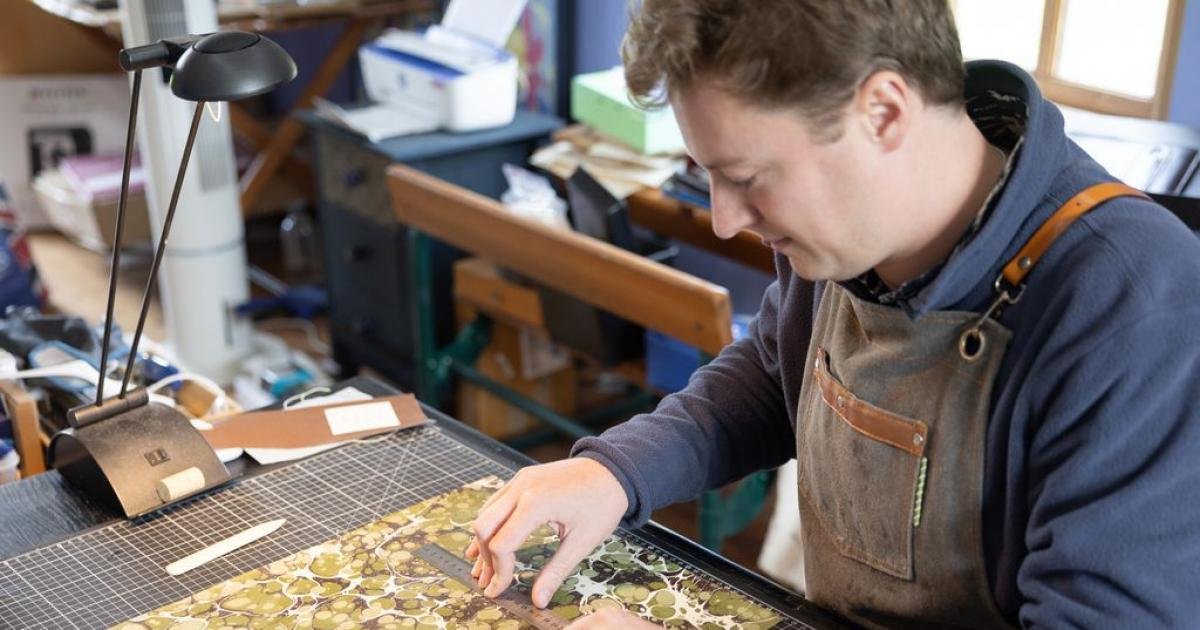
Modern is a bit of a dirty word in my book. Every aspect of my work makes use of the ancient, slow and skilful techniques that were used to make high quality, long-lasting and beautiful books for centuries and that, since the introduction of mechanical binding machines in the 20th century, have almost entirely been lost. These skills are the reason that our greatest libraries contain books that remain readable in their original bindings created back in the early Middle Ages. These bindings were also designed to be beautiful and, through their adornments, such as the emblems, borders and colours used on their covers, they convey aesthetic principles that accord with the written content they contain. They last because they are extremely well made using the finest materials – modern hardbacks produced in mechanical binding machines will not last beyond 50 years with regular use. The creativity for me also lies in the careful selection of materials, the design of the cover, the choice of sewing and binding styles, and the unique decorative elements which can be applied.
What do you love most about the process of making or restoring a book by hand?
I particularly love the process of thinking about what ideas or stories the author of a book has written about and devising a way to realise those principles through the aesthetics of the binding. I then enjoy the slow, precise process of using skills that have been passed down for centuries to bring that binding gradually to life. When it is finally complete and the book is there before me, the sense of gratification at having made something that is all the more beautiful due to the collaboration between the author and myself is extremely satisfying.
What’s the most unusual or memorable commission you’ve ever been asked to create?
The most memorable and in some ways unusual commission I have had was to create and bind the wedding stationery, guest book and vows folders for my brother’s wedding last summer. Obviously it meant a great deal to me to be entrusted with such an important role in realising the bride and groom’s wishes for their wedding day but it also involved a unique commission for binding special folders to contain their vows, and for the celebrant’s order of service. They wanted something beautiful and exclusive that could be held to read aloud from whilst speaking their vows during the ceremony, but which could also function as a long-term container for all their wedding paper materials and mementoes of the day down the years. I was able to create for them a cross between a display folder and an archival box bound using fine leather and handmade marbled paper.
You use fine, British-made materials, why is that so important to you?
Using the finest hand-made materials is really the only choice to make in order to produce beautiful bindings that are of sufficiently high quality for me to be satisfied with. And I want to support British craftspeople by working with materials produced as locally as possible by like-minded specialists keeping traditional crafts alive. The role of the traditional bookbinder is to make books that are of outstanding quality and longevity that far outstrips that of mechanically made books. This cannot be achieved without using the best materials and tools. Bookbinding is a heritage craft which is in danger of being lost altogether in the 21st century and the same can often be said for the work of many of the craftsmen and women who make the materials I choose to work with, so I choose to buy them from British makers to support heritage crafts that are also struggling to keep going.
What are the biggest challenges of keeping a traditional craft alive in today’s digital world?
As an independent bookbinder who has been trading for a comparatively short amount of time the greatest challenge is investing in the tools I use for my trade. Traditional bookbinding is a heritage craft and there are very few companies that still make essential equipment such as presses, gold tooling equipment, sets of letter stamps and specific knives and other hand tools. This means that such equipment is often extremely expensive and yet many techniques rely entirely on specific tools. So finding the money to invest in tools is difficult and yet without acquiring those tools the bindery is held back in the range of techniques I can offer clients.
How do you see people’s relationship with books and physical craftsmanship changing in recent years?
Well, a great deal of change has already happened – reading and the ownership and appreciation of books has to compete with movies, TV and, of course, the internet and all the opportunities it provides. There is also the fact that traditionally bound books represent an expensive and luxurious option for those that do still love to read and display books rather than choose to buy disposable paperbacks or use e-readers. Yet there will always be a market, small but persistent, of book collectors who love and invest in beautiful, traditionally bound books. I am one such collector myself and the desire to fix or rebind books in my own collection is the reason I began learning to bind books in the first place. I will always love making the dreams of such collectors come true by creating for them the perfect aesthetic binding to display their most loved books.
What’s your favourite East Anglian landmark?
There is an ancient oak tree that sits in the middle of the rolling fields near my home that has stayed resolute and undisturbed while all the forest around it has been cleared over centuries for farming. It is a haven for wildlife across all the seasons, and the diameter of the trunk means it must be at least 400 years old. It has always been my personal favourite feature of the East Anglian countryside.
What’s something that would surprise people about you?
When I was 23, I drove a small hatchback from London to Ulaanbaatar, the capital of Mongolia, travelling through Europe and Central Asia with my best friend. 10,000 miles and so many close shaves and adventures. One day I will have to write the book, and of course design the perfect binding for it.
What’s one of the most important lessons you’ve learned from the past?
The skills I have inherited from past centuries that I use every day to make my books; it really feels like having a direct line back in time.
What your specialist Mastermind subject?
The history and practise of Pagan beliefs in 20th Century Britain.
What is always in your fridge?
Some dry white wine, preferably Riesling.
What’s your simple philosophy of life?
Try not to overthink (something I often end up doing anyway)
Who is your favourite East Anglian person?
M. R. James
What’s your favourite film?
The Wicker Man
Where is your favourite holiday destination?
The Greek Islands, particularly Ithaka.
What do you love most about living and working in East Anglia?
I love being able to live in a place where I feel as connected to nature and heritage as it is possible to be in 21st Century Britain, that feeling of connection inspires all my work.
Do you collaborate with other local artisans or suppliers?
I work particularly closely with two local artisans whose work is of the highest quality. The first is Anna Brown, of Marbling Magpie, Essex, who supplies all the marbled paper I use, all of which she hand makes using heritage techniques. Her work can be viewed at marblingmagpie.etsy.com. The second is Henrietta Martindale, of The Styled Writing Company. She is an artisan calligrapher who creates entirely bespoke writing and stationery. We collaborate together on creating ready to buy journals and I offer hand bound books to complement her bespoke wedding stationery such as guestbooks, photo albums and archival boxes. Her work can be viewed at thestyledwriting.com.
What do you want to tell our readers about most?
I offer bespoke bookbinding and antiquarian repair work at my Suffolk studio and pride myself on helping clients with solutions that work with any budget. I have also recently begun offering entirely bespoke wedding stationery and associated bound books. Please get in touch via my website, aulwyndbindery.com, if you have a cherished book in need of repair or rebinding or wish to book an initial consultation for wedding services.
I also sell handmade journals and stationery of various kinds via my Etsy shop, aulwyndbindery.etsy.com.
Website
aulwyndbindery.com – bespoke, rebinding and repairs
aulwyndbindery.etsy.com – ready to buy journals and stationery
instagram.com/aulwyndbindery