Sentimental Value is one of those films you have to watch very closely. In the Norwegian director Joachim Trier’s latest work, which swept the board at the European film awards and is nominated for eight Baftas and nine Oscars, stories are hidden in closeups, half-tones and peripheral objects. Some of these stories are so well hidden, in fact, that they aren’t even apparent to the people who made the film.
In one scene, roughly an hour in, the camera glides down a corridor, and suddenly there she is: a woman’s portrait on the wall. Anyone who grew up in the Soviet Union and later Russia between the 1950s and 2000s, like me, would recognise her instantly. She has been endlessly reproduced: as prints, embroideries, portrait medallions, even on boxes of chocolates. In Britain, people may have encountered her on the covers of various editions of Anna Karenina.
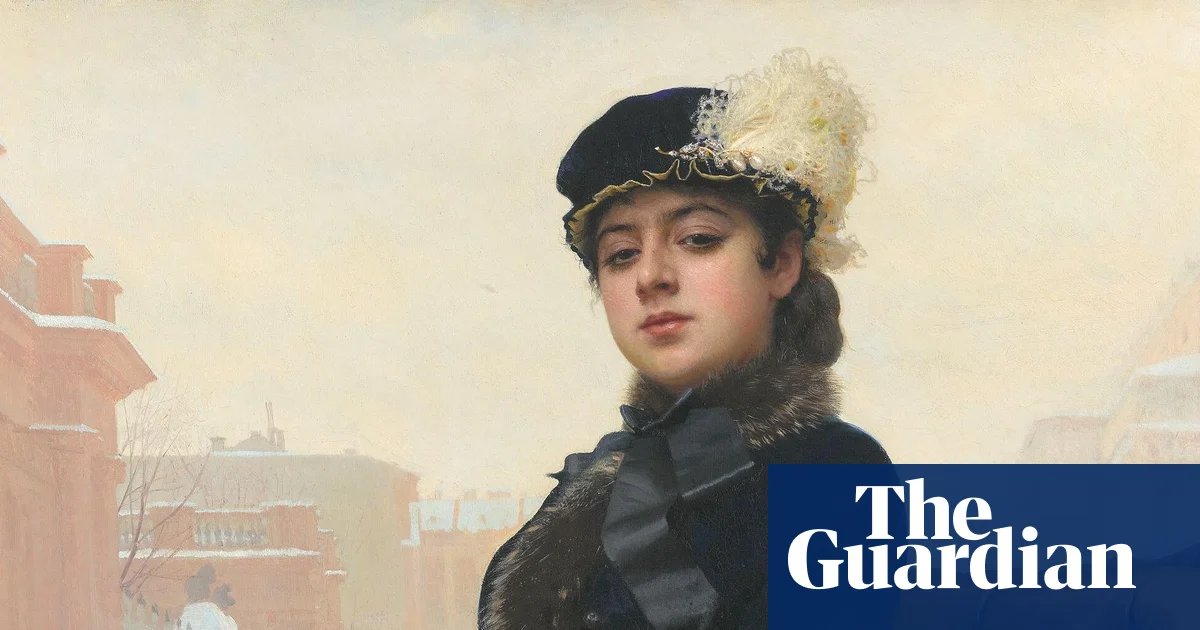
Portrait of an Unknown Woman is a painting by Ivan Kramskoy, a celebrated Russian portraitist. Kramskoy began his career as a provincial retoucher before being admitted to the Imperial Academy of Arts in St Petersburg. There, he went on to lead the Revolt of the Fourteen – a protest over the right to choose their subject for the Academy’s gold medal competition. The rebels later became known as the peredvizhniki, or the Wanderers, a group of artists who continued their protest by organising travelling exhibitions across the Russian empire.
In 1883, Kramskoy painted Neizvestnaya (the Romanised Russian for Portrait of an Unknown Woman), quietly hoping it would end up with Pavel Tretyakov, the founder of the Tretyakov Gallery – Russia’s leading museum of national art – and the guardian angel of the Wanderers. It didn’t.
To understand why, one has to look at the Unknown Woman through the eyes of her contemporaries. The woman is seated alone in an open carriage against the misty backdrop of St Petersburg – she is beautiful, but also carries an air of arrogance. For a woman, sitting alone was already a faux pas. The clothes made it worse: a fashionable velvet hat, a coat and muff trimmed with ribbons, gold bracelets. She had put on her Sunday best – something a society lady would never have done.
Reviewers called her “a cocotte in a carriage”, “a costly camellia”, and “one of the monstrous offspring of the great metropolis”. Tretyakov, who came from a conservative merchant background, was hardly eager to plant any monstrous camellias in his own house.
Portrait of an Unknown Woman was later acquired by a collector in Kyiv, and then by Pavel Kharitonenko, a Ukrainian sugar magnate. After the revolution, his property was taken over by the state. His Moscow house became the residence of the British ambassador – and the Unknown Woman eventually entered the Tretyakov Gallery, in violation not only of private property rights but also of Tretyakov’s own wishes.
After the second world war, the Soviet state sought to compensate the population for its immense suffering by granting a modest expansion of cultural life. With no real art market to speak of, private life became furnished with millions of cheap reproductions in gilt frames. The Unknown Woman was the runaway hit. She was mysterious amid the blunt visual language of Soviet symbols, bourgeois against the backdrop of grim everyday reality, and even a little sexy in a country whose official culture was resolutely prudish. She hung in almost every Soviet flat.
So when I spotted Kramskoy’s painting in Trier’s film, I was intrigued and wanted to find out more. What was the meaning of the Unknown Woman here? I decided to investigate, and sent a message to the film’s production designer, Jørgen Stangebye Larsen. His reply told the story of an unknown woman who became a known woman almost instantly.
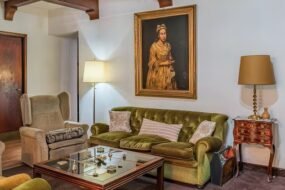
As it turns out, this was not the first time the portrait had appeared in Trier’s films. In Oslo, 31 August – Trier’s second film, from 2011 – the heroin addict Anders returns to his family home at the end of the last day of his life. The house is about to be sold. As the camera glides through the rooms, the portrait briefly floats past, still hinged to the wall.
Fifteen years later, the same wooden house in Oslo returns at the centre of Sentimental Value, housing the members of a troubled family from the early 1900s to the present day. The portrait appears again, this time in a flashback to the 1930s: a young woman comes of age, joins the resistance during the war, is arrested and tortured, and years later takes her own life in the same house.
The portrait in Trier’s film is not one of the countless cheap Soviet reproductions but a loose copy after Kramskoy, painted by a close friend of Larsen’s stepmother, long before he became one of Trier’s collaborators.
She was called Hedvig Broch, and this is the story he told me about her. Broch had wanted to become an artist since childhood, but her father insisted she find a “real” profession, so she enrolled at university instead of the academy. After majoring in sociology, she was admitted to the art academy in Copenhagen – but her husband forced her to choose between her studies and their marriage. She chose her husband.
Larsen told me she later became a very special presence in his life – a trusted adult figure – when he was a child. On Zoom, her daughter, Tiril Broch Aakre, recalls how Larsen used to perform magic tricks for her, while she, in turn, became a confidant of his teenage secrets. Broch and Larsen’s mother also had a ritual of their own: a Friday book club, just the two of them, sitting together and discussing whatever they were reading. Dostoevsky was among their favourites.
When she turned 50, Broch finally did what she had dreamed of for decades. She left her job and returned to painting in earnest. Russian artists such as Kramskoy had long been admired by Norwegian and Finnish painters, and one day Tiril came home to find a striking portrait of a young woman her mother had just completed. “It had, you know, a kind of soulfulness and vulnerability,” she tells me. “It just struck me.”
Hedvig’s Portrait of an Unknown Woman is very different from Kramskoy’s. The arrogant demi-mondaine turns into a figure that is still mysterious, but far more melancholy. The crew’s return to the wooden house in Oslo 15 years later was not the only reason Larsen chose to use the portrait again. Between the two films, Hedvig Broch – just like the protagonist of Oslo, 31 August and the mother figure in Sentimental Value – took her own life.
I called Trier and asked him whether this was life imitating art. He told me he had known nothing about the portrait’s history, and that its use in the film had not been intentional. Then he quoted a line from Goethe’s Faust to me: man merkt die Absicht und man ist verstimmt (“you work out what their intention is and it breaks the spell”).
Yet memory, unlike art, sometimes survives by intention alone.