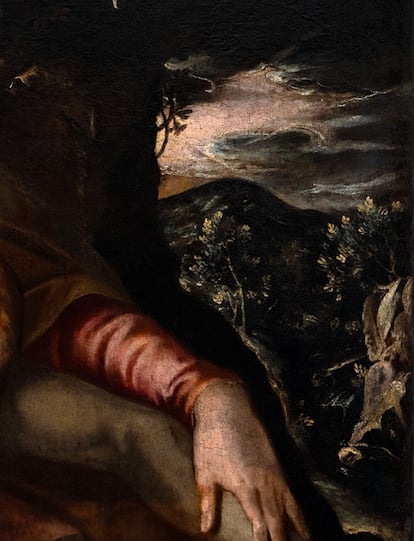
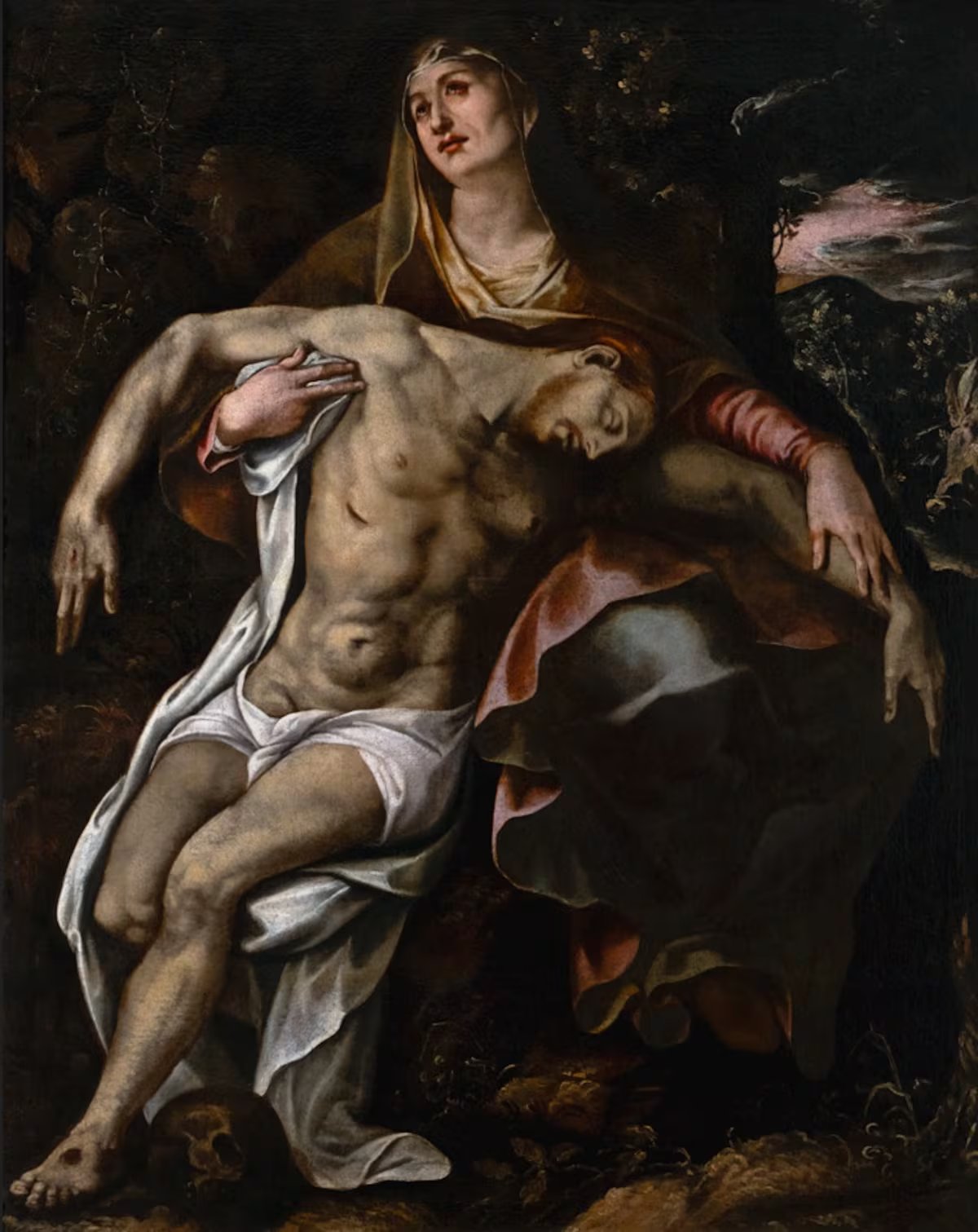
Has Belgium discovered an unpublished work by Michelangelo Buonarroti? The possibility of having recovered a hitherto unknown painting by the Renaissance genius — it would be the fifth attributed to the man responsible for the frescoes on the dome of the Sistine Chapel — is revolutionizing the national and international art world, despite the fact that there is still a certain degree of caution. After multiple tests and an in-depth analysis of the work and its context, the painting now attributed to Michelangelo by a Belgian expert is the Spirituali Pietà, an oil on linen canvas that represents Jesus Christ with his arms in the shape of a cross, supported by a Virgin Mary who weeps inconsolably.
Until its acquisition in 2024 by two Belgian collectors, it was identified simply as a work by “an anonymous artist of the sixteenth-seventeenth century.” It was put up for sale in 2020 by the Waennes auction house in Genoa. The catalogue noted that “the iconography of the painting expresses a heterogeneous figurative culture, dictated by Tuscan-Roman influences inspired by the models of Andrea del Sarto, Pontormo, Francesco Salviati and, of course, Michelangelo.” The starting price was low, with the value estimated at between €2,000 and €3,000 ($2,315-$3,470). Even so, no one bought it. Four years later, it ended up in the hands of the two Belgian collectors. A few days after receiving the painting, and upon closer inspection of the canvas, which had been cleaned and restored, they discovered two barely discernible monograms in the lower part of the painting.
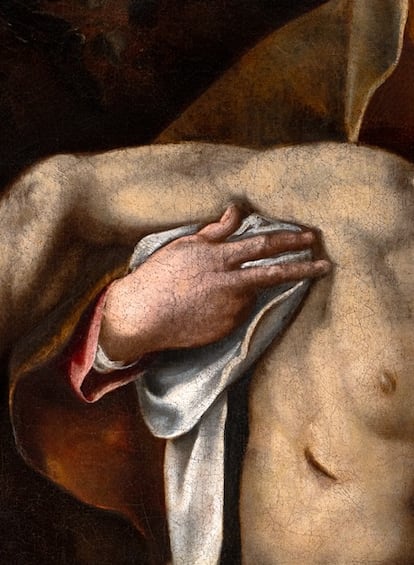
What happened next was thrilling. As Michel Draguet, professor of art history at the Free University of Belgium (ULB), an expert contacted by the collectors, explained to Le Soir newspaper: “One of the collectors told me: ‘The monograms prove it, the painting is signed, it’s a Michelangelo!’ I said, not so fast. Anyone could have placed a monogram on the canvas at any time. I told him that we would have to wait for the analysis of the KIK-IRPA [the Royal Institute for Cultural Heritage].”
But the collector insisted: “He asked me if I would be willing to carry out an in-depth study of the painting in the case that the analyses showed the canvas to be fine, the pigments good and the monograms from the same period. As I didn’t think it was the real deal, I thought there was no risk and accepted,” added Draguet, a member of the Arts Class of the Royal Academy of Sciences, Letters and Fine Arts of Belgium, as well as a high representative of the Belgian Federal Heritage and honorary director general of the Royal Museums of Fine Arts of Belgium.
Draguet’s surprise was immense: tests carried out by the KIK-IRPA — considered one of the five most prestigious institutes of heritage conservation and science in the world — did not find any modern pigments in the painting. On the contrary, the use of a color palette typical of the 16th century was confirmed. Carbon evidence also suggested, with a 95.4% probability, that the canvas was painted between 1520 and 1580, consistent with Michelangelo’s later period (1475-1564). And macro X-ray fluorescence confirmed that one of Michelangelo’s widely documented monograms was applied twice by the artist to the original surface of dried paint, before the natural formation of its network of cracks, ruling out the possibility that someone had falsified the artist’s hallmark signature.
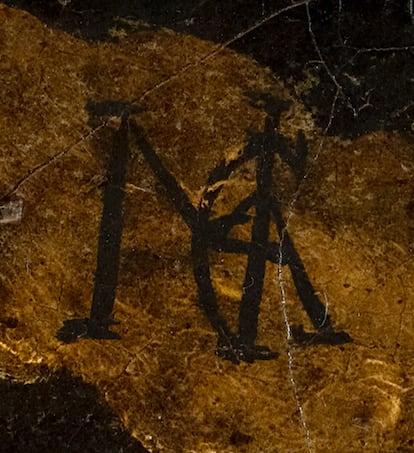
“The presence of two indexed monograms by the artist, integrated into the material of the work itself, allows us to consider this work to be autographed by Michelangelo,” said Draguet in his concluding statement. “If they were intact, it would be a sign that they were added later. Here, they are baked into the material,” he told Le Soir. With the scientific evidence in hand, Draguet, dubbed the “Sherlock Holmes of art,” launched a stylistic analysis of the work that, over 600 pages, considers Michelangelo’s authorship to be confirmed. Despite his extensive career, Draguet specializes in Belgian art of the 19th and 20th centuries. But he maintains that it was precisely because his gaze was fresh and unprejudiced that the collectors wanted him to lead the investigation.
According to Draguet’s conclusions, the identification of the Pietà Spirituali, a work closely linked to the Ecclesia Viterbiensis — a circle of reformers gathered around Cardinal Reginald Pole between 1541 and 1545 in the hope of restoring the unity of Christendom — “It challenges the established narrative by demonstrating that the master practiced easel painting to express his evangelical convictions within this group.”
If ratified by other experts specialized in Michelangelo, the Pietà Spirituali would contradict the claim of the Tuscan painter, writer and architect Giorgio Vasari (1511-74) in his Lives of the Most Excellent Painters, Sculptors, and Architects, that Michelangelo painted only four canvases during his career and abandoned easel painting after completing the Doni Tondo (c. 1503-1507) to devote himself to frescoes and sculpture.