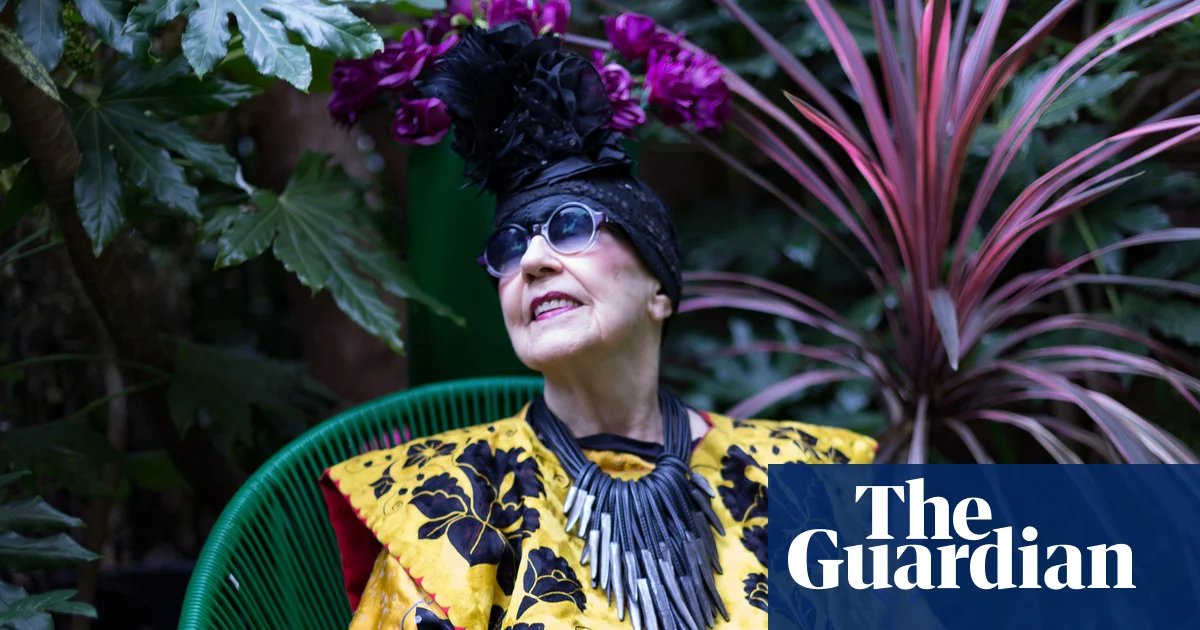
Though she accomplished much else, Molly Parkin has died, at the age of 93 after suffering from Alzheimer’s, as an acknowledged artist, which is what she had really wanted from life. She had passed through fashion, journalism, writing fiction and nonfiction, notoriety and foulmouthed fame, on television and off, plus more than 50 dwelling places, two husbands, and encounters with men beyond enumeration.
But art – paintings super-aware of emotion in a landscape – was her first and last love, and her serious talent. A male artist living so expansively could expect to be appreciated for surviving into old age, the loss of muse and money, the bottles and the cigarettes, the energy invested in the constant pursuit of sex and in telling the world about it. For a woman to have stayed that course is still novel – and quite something for a girl from the Welsh valleys.
The particular valley was the Garw in south Wales, where she was born in the mining village of Pontycymer, the younger daughter of Reuben Thomas, who had a hopeless fancy to be an artist. Her mother, Ronnie (Rhonwen, nee Noyle), played the organ in chapel. Molly loved the landscape; the darkness was at home, where, from infancy, her father sexually abused her. She had his attention, mostly for the wrong reasons; when the family moved to Dollis Hill in north London, he took her to hang about stage doors, thinking he could pimp her to actors; he also took her to the National Gallery to meet great paintings. The abuse, with beatings, and the attention ended with adolescence.
After she fell off a bicycle in her teens, she was absent from Willesden grammar school for months, up in her bedroom, painting, which set her on course, in 1949, for a scholarship to Goldsmiths College, London, then another to Brighton College of Art.
The stories she repeatedly told of what happened next, of seeking a sugar daddy, of Louis Armstrong swooping on her in a jazz club (she could not go off with him because she had to be at Silverthorne school, in Elephant and Castle, to teach the next morning), of the actor James Robertson Justice, 30 years her senior, moving on her knickers at the Ivy, sound different when you know about the abuse, but she did not reveal that secret, released by therapy, until her 2010 memoir, Welcome to Mollywood.
Through decades of raconteuring, she boasted that those encounters had been the start of a wild sex life. She was Robertson Justice’s unkept mistress until her father’s death in 1956, when she realised that he and the actor had been around the same age, and she dropped him.
Soon, in 1957, she met, at a party, the well-bred Michael Parkin, in advertising and TV production, who proposed within weeks. Her paintings, selling well in the West End, already collected by the Tate and Brighton Museum, paid for the house in Old Church Street, Chelsea, where they had two daughters, Sophie and Sarah, and lived until the day she found the hotel receipt that proved her husband’s latest infidelity, threw him out, and, paintbrush in hand, amended the street sign outside to read “No Parkin”.
Her gift with the brush went with him, for she lost all inspiration to paint just at the point when she had to fund the household singlehandedly. First she made hats for Barbara Hulanicki’s label, Biba, then made clothes for her own enterprise, The Shop, in nearby Radnor Walk. At a 1965 dinner party she sounded off to Clive Irving, editorial director of IPC magazines, about her art-trained view of colour in clothes. He invited her to be fashion editor of his new magazine, Nova, where Parkin arrived knowing less about mags than the many secretaries assigned to assist her.
For 18 months, Parkin and Nova’s art director Harry Peccinotti broke all the tenets of fashion journalism. Parkin had no interest in Paris collections, advocated for medium-price British labels, and photographed clothes abstracted into page decoration. When the advertisers’ expectation of an annual issue with editorial pictures of furs and jewellery was explained to her, she photographed the pelts and the rocks on the office roof. Readers liked her ideas about visual imperfection (her ideal of a model had been shaped by Rubens’ paintings), advertisers did not, and in 1967, she was out.
Parkin met with even less approval as, briefly, fashion editor of Harpers & Queen, but her ramshackle approach suited newspapers; she moved to the Sunday Times in 1969, and picked up a press award in 1971. Soon after, she lost patience with the frock business, and left to be a freelance, writing for both Men Only and Spare Rib, among a shelf of other magazines. She was already a rare raucous voice among the few female celebs on TV chatshows.
After years of serial, often trophy, men (many bored her – she spent tedious hours spanking John Mortimer), she had married the artist Patrick Hughes in 1969, and he and his three sons by a previous marriage joined her daughters in needing the financial support earned by her prolific pen. The couple moved in 1975 to Cornwall for its cheapness, eventually settling among artists in St Ives. Parkin was by then a novelist, and claimed the outline for her first book, Love All (1974), was only picked up because the publisher’s secretary liked her comic erotic style.
Hughes was invited to work in New York in 1979, and they moved in to the Chelsea hotel in Manhattan, also an artists’ colony. Parkin remembered it for a boozy sociability that developed into actual orgies, with herself and the rock hostess Anita Pallenberg as non-participants, poking at everyone with sticks to get on with it. The often combative marriage to Hughes ended in divorce in 1981.
Parkin went back to London, where, courtesy of Pallenberg, she moved into the Rolling Stones’ house in Chelsea for a couple of years, throwing weekend parties, and writing improperly where she could; eight larky bonkbusters in all, plus a fictional version of her marriage break-up, and a volume of poetry. And she turned to performance, as a comic with her own show at the Edinburgh festival, 1984-87; Dublin festival banned her act for obscenity.
Parkin returned to her familiar Chelsea Arts Club, Colony Club and Ronnie Scott’s as alcoholism submerged her. Nadir and redemption came after a several-day bender in 1987, when she ended in a gutter outside Smithfield meat market, where pubs opened through the night. As she told it, the voice of her Gawr grandmother came to her: “That’s it, cariad, you’ve had your last drink.” She joined Alcoholics Anonymous that week. Her return to painting took four months.
Constructing a sober life was tough. Parkin had mismanaged what money and property she had, and faced a bill for income tax. In 1998, she returned to Pontycymer and there declared bankruptcy, then rented a London houseboat, and moved for a while to a home in southern India, with 35 monkeys in its trees.
In 2002, she arrived, destitute, threatened by cancer (the tumour proved benign), at the housing desk in Kensington and Chelsea town hall, where she was offered a one-bedroom flat with mini-garden on the ground floor of the World’s End estate in Chelsea. Parkin grabbed it, planted trees, and made it her studio and home, obscuring the lewder paintings when officials visited.
In cheerful ruination, she became an institution, welcomed in 2011 to Desert Island Discs, amused that her old sexual energy had converted to active creativity. Her paintings sold again. In 2012 the queen awarded her a civil list pension for services to the arts. True to form, she derided its smallness. It was swiftly upped.
Sophie, Sarah and three grandchildren survive her.