
What does it mean to paint now, in an image-saturated world where every moment can be captured in high resolution and consumed within seconds? Recent contemporary painting trends suggest a widespread desire to slow down, distort, or even rupture the act of seeing. Across international exhibitions, artists are embracing blur, residue, surrealism, and dream logic. Their work suggests that painting remains a powerful site not only for image-making, but for reckoning with what lies just outside clarity—whether psychological, ecological, or metaphysical.

Léa Belooussovitch, Sequoia National Forest, Californie, États-Unis, 27 septembre 2021,
series Brasiers, (2023). Drawing with colored pencil on wool felt, 80 × 60 cm. Brussels, private collection. Léa Belooussovitch © ADAGP, Paris [2025]
Blurring the Lines: Why Soft Focus Is Dominating Contemporary Painting
Bypassing the endless figuration-versus-abstraction debate, a trend in blurred painting techniques has emerged. In these works, artists make borders hard to define and render figures as moving, fluid, and optically vertiginous.
Two exhibitions in France speak to this approach. One, at the Musée de l’Orangerie—”Out of Focus: Another Vision of Art, From 1945 to the Present Day” (on view through August 18, 2025)—presents work framed as expressing a “loss of distinctness,” often in response to political instability and trauma. In these paintings, the mind seems unable to clearly visualize a painful subject. Questions of how and what we remember are also poetically expressed throughout the show, with the observation that despite our best efforts, we are often left with a clouded sense of our lived experiences, which nevertheless hold deep meaning—even beauty.
Tied historically to artists like J. M. W. Turner and Claude Monet, the show features Gerhard Richter’s smeared figurative works and Miriam Cahn’s ghostly figures sinking into watery depths. Among these well-known artists is young French painter Clémence Mauger’s ultra-magnified, blurred forms that resemble molecular imagery.
Other works in the show respond to environmental issues. In Sequoia National Forest, California, United States, 27 September 2021 (2023), Léa Belooussovitch draws a glowing, burning mass of yellow and orange on wool felt.
This genre has the appeal of freeing itself from any supposed opposition between figuration and abstraction, while suggesting that an alternative mixture—or blurring—of the two is an apt portrayal of how ungraspable our memories and emotions can be. In this vein, forms emerge from the depths of memory, their outlines soft and blending into their surroundings, leaving a sense of unknown, rather than the appearance of clarity, not unlike our current period of uncertainty. This view also pushes back against today’s era of high-definition imagery, documented and shared to saturation.

Miriam Cahn, das schöne blau, (2008,2017) Oil on canvas 250.4 × 180.3 cm. London, Tate, T15643
Purchased with funds provided by The Joe and Marie Donnelly Acquisition Fund 2020
The Fondation Carmignac on Porquerolles Island offers a similar interest in blurred effects in its stimulating exhibition “Vertigo.” Here, artists take inspiration from nature as a catalyst for visual destabilization, at times not unlike the sensation of vertigo. Oliver Beer’s Resonance Painting (Lovesong) (2024) uses sound waves to produce a surface that ripples like water. Flora Moscovici’s Romancing the Light (2025), a chromatic tableau of layered, blended blues, greens, and violets, evokes the impression of being underwater and losing one’s bearings. The exhibition also includes Richter’s blurred works and emphasizes shared formal abstraction across many paintings, including historic pieces by Yves Klein, Frank Bowling, and Helen Frankenthaler, to name a few.
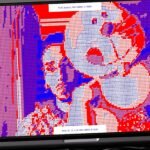
Anne Imhof recently explored similar visual strategies. In her Berlin show “Cold Hope” at Galerie Buchholz (through June 21, 2025), she exhibited paintings based on film stills she had photographed on a screen. These stills, drawn from coming-of-age films she watched while developing her performance Doom – House of Hope, appear blurred, pixelated, and moiré-like. According to the exhibition text, she deliberately created “blurs, veils, and wave-like pixel structures.”

Oliver Beer, Resonance Painting (Lovesong) (2024). On view at Villa Carmignac exhibition, Vertigo . Pigment on canvas, 200 x 150 cm Courtesy of the artist © Oliver Beer Photo : Thaddaeus Ropac gallery
Painting with Traces: Raw Canvases, Environmental Marks, and Studio Imprints
Many painters are embracing large, gestural works on unstretched canvases that retain direct traces of their environments—footprints, floor residue, and marks left by studio tools. They install these works in unconventional ways: draped, suspended, or arranged sculpturally within architectural space. The canvases often look worn, weather-beaten, or muddied.
At Kunsthalle Basel, Ser Serpas’s show “Of My Life” (through September 2025) exemplifies this approach. She is known to drape and suspend her canvases like drying laundry, integrating them with found-object sculptures and live performances. In the current show, where unstretched canvases are hung against the walls, Serpas displays figures derived from an A.I.-generated archive, which she paints onto one canvas and presses against another while the pigment is still wet, making a rough copy. Footprints and studio floor traces appear across the surfaces, while some floors and walls in the Kunsthalle also contain remnants of paint smears and studio activity.

Ser Serpas, Of my life, exhibition view, Kunsthalle Basel, 2025, photo: Philipp Hängr/ Kunsthalle Basel
At the Palais de Tokyo, Vivian Suter exhibits 493 paintings made over the past 20 years in her Panajachel, Guatemala garden. Her show “Disco” (through September 7, 2025) turns the gallery into a sun-drenched drying rack: the works hang from high walls, ceilings, and racks. She made the paintings outdoors, often depicting plants, animals, and landscapes, and then left them exposed to the elements to collect natural residue.
In capturing the leftover imprint of a physical thing or action, these artists also speak to the process of transformation over time. With each imprint, a double, fainter echo of the former version is created, highlighting the cycle of repetition, vanishing, and becoming something else. It is an ode to seizing a moment in all its imperfection, via direct contact, making it a counterproposal to our increasingly virtual, filtered, contactless, and distanced daily interactions. And yet, while this tendency may appear to be an attempt at preserving fleeting traces of life, it also asserts that nothing is ultimately motionless or frozen to the effects of time.
Georg Baselitz has recently begun incorporating the swirling traces of his wheelchair into paintings made on the floor. These works, now on view at Thaddaeus Ropac in Paris (through July 26, 2025), depict sinuous reflections of himself and his wife Elke. Baselitz uses his wheelchair wheels to trace looping lines around dripping, brush-painted, fragile bodies.

Exhibition view, Vivian Suter, Disco , Palais de Tokyo (Paris), 12.06-07.09.2025Copyright Vivian SuterCourtesyofKarma International, Zurich; Gladstone, New York / Brussels / Seoul; Gaga, Mexico DF; Proyectos Ultravioleta, Guatemala CityPhoto credit: Aurélien Mole
Surrealism Returns: How Contemporary Artists Are Reimagining the Uncanny
The 2022 Venice Biennale was part of a mass resurgence of interest in Surrealism. Many contemporary painters adapt Surrealist legacies in their own work, which can be seen in a number of recent exhibitions. In New York, Robilant+Voena’s exhibition “A Mysterious Vision: The Uncanny and Lingering Influences of Surrealism in Contemporary Art” (May 7–June 17, 2025; traveling to Milan this fall) tracks this. Curator Robert Zeller, expanding on his recent book, grouped 16 artists into four categories: The Psychic Landscape, The Psychic Interior, Non-Objective Fragments, and Uncanny Figuration. The show pairs contemporary painters, including Alicia Adamerovich, Jamie Adams, Ginney Casey, Vincent Desiderio, Lars Elling, and Lola Gil, with historical Surrealists.
Beyond a slew of recent institutional exhibitions and the 100th anniversary of Surrealism in 2024, it is not hard to understand the current fascination with the movement. Its interest in the strange, subconscious dream world is a fitting subject for the seemingly unreal contradictions to life as we know it today, where apocalyptic visions of the planet’s destruction, wars, and violence live alongside the goings-on of everyday life.

Exhibition view: Sun Yitian, “Romantic Room,” Esther Schipper, Berlin (2025) Courtesy the artist and Esther Schipper, Berlin/Paris/Seoul. Photo © Andrea Rossetti
Sun Yitian, in her Berlin exhibition “Romantic Room” at Esther Schipper (May 2–31, 2025), staged hyperreal paintings of mass-produced toys in dramatic, unlikely settings. Though the toys—like inflatable houses and dolls—exist in the real world and are produced in China, Yitian places them in dreamlike compositions that invoke art-historical scenes and expose deeper social realities.
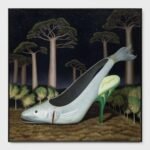
At Mendes Wood DM in Paris, Paula Siebra’s show “O Estranho Familiar (The Strangely Familiar)” (through June 25, 2025) depicts uncanny subjects in earthen tones that evoke ancient motifs. The gallery notes that Magritte’s influence looms large. In a previous show at the same gallery, Sanam Khatibi’s glossy still lifes and Renaissance-inspired landscapes combine sensuality and idyllic nature with violence, in a comparable vein to the style of Surrealist writer and artist Valentine Penrose, per one example given in the exhibition text. Khatibi is also featured in “Painting After Painting – Contemporary Survey From Belgium” at S.M.A.K. in Ghent, where her paintings place skeletons, creatures, and tangled limbs around crystal-clear bodies of water.

Sanam Khatibi This is America, (2025). oil on canvas 50 x 40 cm 19 3/4 x 15 3/4 in MW.SKH.082 Courtesy of the artist and Mendes Wood DM, São Paulo, Brussels, Paris, New York. Photo credit: Nicolas Brasseur
Painting the Sacred: Ritual, Myth, and Spiritual Revival in Contemporary Art
Also present at the Venice Biennale in 2022 was a fascination with mysticism, and many painters today are exploring spirituality, ritual, and myth. Danish artist Eva Helene Pade channels ideas of traditional pagan ritual in Forårsofret (The Rite of Spring), on view at ARKEN Museum of Contemporary Art in Denmark through August 31, 2025. These large-scale, figurative works are inspired by Stravinsky’s 1913 ballet and its mythic sacrifice narrative.
Judith Lowry, at the Nevada Museum of Art (through November 16, 2025), paints Indigenous stories passed down by her father, who was of Native Northern Californian and Scots-Irish descent. Her monumental paintings reflect the legends and complexities of her heritage.
This renewed interest in spiritualism can be viewed as a manifestation of curiosity for non-Western or pre-Christian cultures and their spiritual beliefs, while evoking a search for deeper meaning and connectedness to something larger—so often lacking in today’s post-capitalist moment.

Eva Helene Pade, The sacrificial Dance (R) (2024) Photo: Anders Sune Berg
In Monterrey, Mexico, Oscar Murillo’s exhibition “Spirits in the Swamp” at MARCO (through August 10, 2025) invites visitors to interact with a central work. Murillo treats the swamp—a biologically rich but often overlooked space—as a place where human and nonhuman spirits intertwine. According to the exhibition text, the piece emphasizes “transfers between human and nonhuman elements.”
Pol Taburet’s show “The Burden of Papa Tonnerre” at Schinkel Pavillon in Berlin (through July 13, 2025) mixes painting with bronze sculpture to tell the story of a man who gained speech and a cursed set of relics by making a deal with a witch. Taburet’s ominous paintings show figures engaged in ritual, casting spirituality as both burden and transformation.