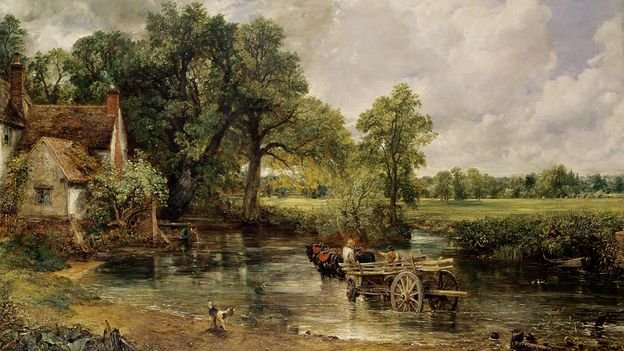
Yet, in other ways, The Hay Wain is a paragon of verisimilitude, painted by an artist who was true to his artistic vision despite the low position landscapes occupied in the European Academies’ hierarchy of artistic genres. “Constable is known for his attempts to be true to nature, and his commitment to painting a landscape that, for him, was very real,” Julia Carver, curator of the Truth to Nature exhibition, tells the BBC. “He was working at a time when that was not fully understood by a lot of people in the artworld, and he still held to it.”
Indeed, perhaps one of the reasons why The Hay Wain was not an immediate success when shown at the Royal Academy in 1821 is that it was too natural and too mundane for tastes at the time. But it was this same naturalism that saw it awarded a gold medal at the Paris Salon, where it was shown, along with View on the Stour near Dedham and Yarmouth Jetty, three years later. It was there that the writer Stendhal declared: “We have never seen anything like these pictures before. It is their truthfulness that is so striking.”

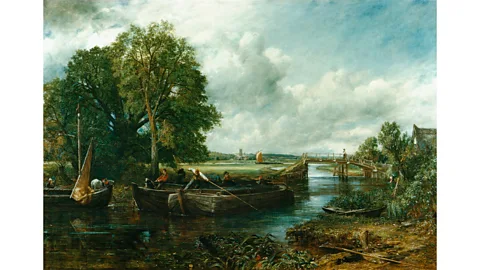 Getty Images
With the academic hierarchy in mind, “a lot of people who wanted to paint landscapes were starting to use history painting as a way to do it,” says Carver, referencing Constable’s predecessor Richard Wilson (1713-1782) and works by his contemporary, Turner, such as Dido building Carthage (1815). Constable, however, turns away from classicism and the temples, ruins and mythical beasts that populated the landscapes of many of his fellow painters, and he makes green, rather than the traditional brown, the dominant shade. Instead, he writes to childhood friend and fellow artist John Dunthorne about returning to Suffolk to make “laborious studies from nature” and create “a pure and unaffected” representation of the scenes.
More like this: