
In 1967, a critic in the Times wrote that “one of the unsolved problems of British art is the true status of William Nicholson”. The painter had then been dead for 18 years, too soon perhaps for a consensus to have fully formed around his reputation. However, some 60 years later, the problem remains unsolved. Nicholson (1872-1949) is simultaneously recognised as a painter of stature but rapidly passed over in surveys of the period – an artist who contributed but perhaps not quite distinctively enough.
While his son Ben is acknowledged as the pre-eminent British modernist, the father is too often seen as a quirky period piece – a dandy and a descendant of the Aubrey Beardsley Yellow Book artists, the portraitist of Edwardian Britain’s theatrical-literary crowd, illustrator of beloved children’s books such as The Velveteen Rabbit and a master of still lifes, a genre without great critical heft. Nicholson stood outside avant-garde developments and there is little or no hint in his work of, say, post-impressionism, cubism or vorticism. But then, as he wrote, this was intentional as well as instinctive: “The idea of a label of any sort scares away from me all desire to paint.” Rather, as his daughter-in-law, the painter Winifred, noted: “He was genuine to his own eyesight, faithful to his own pigment.”
Nicholson deserves greater renown, as revealed by the immaculate exhibition of his work at Pallant House Gallery in Chichester. It shows not just the breadth of his output but its quality; he was as accomplished in printmaking as in landscape painting, in portraiture as in stage design. What was constant across media was an unerring sense of style and an impeccable technique. The basis of that style was recognised early by James McNeill Whistler: “The art of leaving out is proof of the perfect acquaintance with the art of putting in.” Nicholson had an aversion to the extraneous.
It is this trait that undermines the claim that Nicholson was too traditional and too safe an artist. There was nothing purely conventional in his character: the artist liked to claim that he had been thrown out of art school for dressing up as a woman in black clothes and walking around with an open umbrella. Meanwhile his first professional forays came when he eloped with Mabel Pryde, a fellow student. The couple hid themselves in a former pub, the Eight Bells at Denham in Buckinghamshire, and when Mabel’s brother James came to visit he simply stayed on. In 1894, the two men formed a design partnership, J&W Beggarstaff, later simply the Beggarstaffs – the name coming from the trade name they found stencilled on a sack of fodder: “It is a good, hearty, old English name, and it appealed to us, so we adopted it immediately,” said Nicholson.
The pair designed posters for theatrical productions as well as household products, making designs for “Nobody’s washing blue” and “Nobody’s corn flour” in the hope that a willing manufacturer’s name could simply be inserted. Pryde believed that Beggarstaff posters should have an effect while glimpsed from a moving “horse-bus” and what unified their work was Whistler’s “leaving out”. They simplified forms to their basics, stripped of detail, three-dimensionality and decorative colour. Their pared-back images were heralds of one aspect of modernism and far more radical than anything produced by Henri de Toulouse-Lautrec or Alphonse Mucha on the continent.
Nicholson and Pryde were together for five years before parting company, having amassed more acclaim than money. Nicholson quickly found solo success with his prints. He produced numerous print series for the publisher William Heinemann, showing famous figures of the time, including, in 1899, an image of Queen Victoria as a conical megalith in black with a Skye Terrier, which proved enormously popular. Other publications, An Almanac of Twelve Sports and London Types for example, gave a Hogarthian and nostalgic overview of British pastimes and characters. “A was an Artist,” the celebrated opening image of his inventive An Alphabet, which tied each letter to a figure with a trade or trait, is a self-portrait in which Nicholson suggested the precariousness of his calling by portraying himself as a pavement artist.

Treat yourself or a friend this Christmas to a New Statesman subscription from £1 per month
Among the famous people he depicted in prints were the likes of Rudyard Kipling, Whistler, Cecil Rhodes and Sarah Bernhardt, and when he turned to painted portraits he added other well-known personalities such as Max Beerbohm, JM Barrie and Sidney and Beatrice Webb, the founders of the New Statesman, to his roster (although not, curiously, Winston Churchill, to whom he gave painting lessons). Although he needed the fees portraiture brought in, Nicholson was somewhat ambivalent about the trade: “Nothing frightens me more than a possible queue of sitters.” So he painted untitled people too – a red-faced and borderline villainous Morris dancer and a soldier stoic in the trenches in winter, a reference perhaps to his son Tony, who died just months before the Armistice – as well as family members. One of these, his second wife Edie Stuart-Wortley (she was the cause of a rift with Ben who had himself been sweet on her), is the subject of a stunning portrait, Lady in Grey (1918), in which Edie in a patterned dress stands half in, half out of a shaft of light. It demonstrates Nicholson’s extraordinary ability to marshal muted tones and light effects and make a moment of stillness both dramatic and enigmatic.
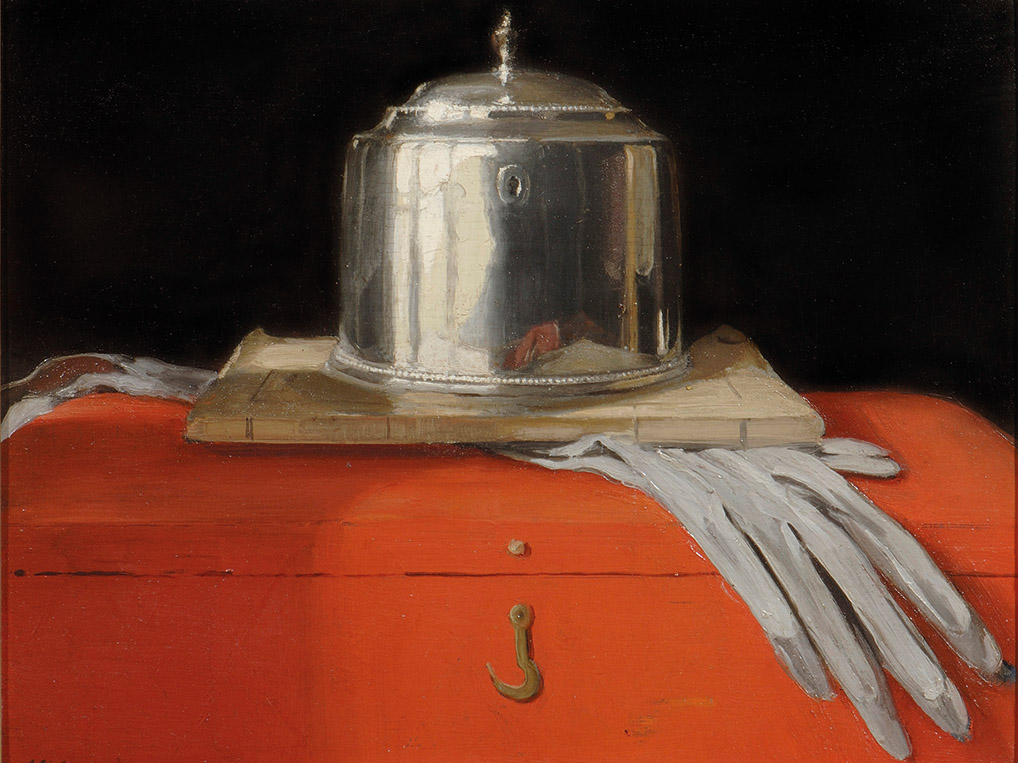
This facility is most frequently on show in his still lifes. Flowers, jugs (he was a magpie-like collector), bowls and silver and gilt ware gave him the opportunity to paint for himself. In The Lustre Bowl with Green Peas (1911) there are just four elements – a black background, a white tablecloth, a handful of pea pods and a silver bowl. These he turns into a perfectly harmonious composition, the eye alternating between the ensemble and each object as an abstract problem to be solved: silver as a combination of greys but different ones to the cast shadow, reflections as distortions not mirror images, each pea pod as a still life in itself, and the highlight, a smear of buttery white applied with the utmost confidence just overlapping the rim of the bowl so that the light appears effervescent and fizzing. However humble the subject, this is painting of the highest order.
Nicholson would apply the same techniques to his landscapes too. He lived at different stages by the South Downs and the Wiltshire Downs and would walk on the uplands with a small board that fitted into his paintbox. As with his spiritual descendant Eric Ravilious, he was enamoured with the curves of hills and the sweep of grassy slopes – still lifes of nature. In his wonderfully economical Snow in the Horseshoe (1927), he conveys the broad vistas of the Sussex Downs on a board just 40 centimetres wide, the snow in the hollows laid down in simple, long white strokes.
Here perhaps is the key to Nicholson. The aim of the realist artist, he said, “is to communicate what in the natural is irresistible to him” and, what’s more, “what in the act of communication in a particular medium is pleasurable”. His viewers can sense the pleasure Nicholson himself took in those languid, liquid strokes, the telling dabs that bring his pictures to life, and the just-so satisfaction of his compositions. The pleasure of his brush is transmittable.
William Nicholson
Pallant House Gallery, Chichester, Sussex. Until 10 May 2026
[Further reading: How to sell priceless stolen jewels]
Content from our partners