Ceramicists Teresa Munn and Moya Tosh have been talking to Open Studios colleagues specialising in printmaking
Centuries of technique and miles of ink have honed the processes of printmaking into the diverse art form it is today.

China was the cradle of printmaking with woodblock printing on textiles and paper invented in the 1st century. Early print methods spread to Europe by the 15th century, aided by the mechanical printing press and in the 19th century steam-powered presses facilitated the mass production of images and words.
Many 20th-century artists reacted against such industrial-scale printing, turning back to traditional, hand-skilled methods such as etching, linocut, wood engraving and lithography. The resurgence of hand-crafting methods re-established printmaking as an important art form.


Hilary Everest always loved drawing and painting and had a ‘lightbulb moment’ after stumbling across a book on printmaking owned by her uncle, an accomplished wildlife illustrator. It led her to complete a foundation course at Red Hot Press, Southampton, in 2019, which she describes as the beginning of her journey as a full-time printmaker following a career in graphic design and marketing.
“What drew me to printmaking was its inherent sense of jeopardy; there’s an unpredictability to the process that I find both exciting and rewarding. It’s a discipline rich with techniques … the learning curve is steep…” she says.
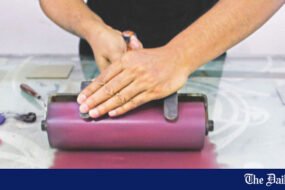
Every part of the process needs to align for a piece to succeed so elements such as having the right amount of ink on the roller, the depth of the carving, the type of paper and even how much pressure is applied during printing are crucial elements.
It’s these challenges that fascinate Hilary and, as her work has evolved from simple monochrome prints to more intricate pieces like multi-block prints and reduction linocuts, she has revelled in process: “I find the process of lino carving deeply therapeutic…”
Hilary’s subject matter is largely inspired by nature, its tempo, textures and tints, as well as coastal areas, wildlife encounters and travel destinations. She says these places “feed” into her work and she is still learning: “I’m constantly experimenting with new techniques and themes, exploring both detailed landscapes and more expressive, abstract interpretations. Lately, I’ve been learning to loosen my approach – focusing less on accuracy and more on evoking a feeling through pattern, shape and gestural line.”


Wendy Lloyd has a similarly interrogative approach to her print work: “I use lots of techniques in one picture to try to achieve an effect… I am constantly playing and experimenting… I do spend a lot of time ” proofing for colour. I will play and play until I get the colour I need.”
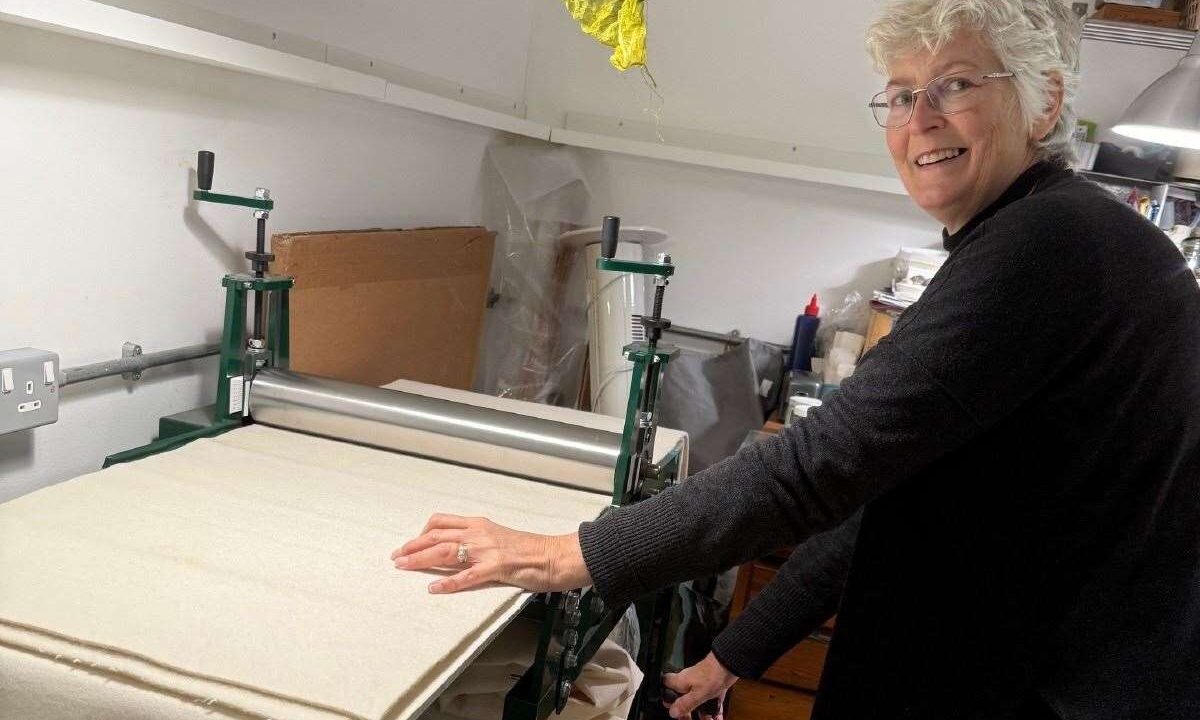
Based in Newbury, Wendy originally worked in textiles, making distressed screen prints and block printing. She sometimes combines both disciplines blending her expertise in collograph, etching and monotype with her skill in embroidery, dyeing and fabric ‘distressing’.
“… I enjoy stretching the boundaries of what print and textiles mean, combining techniques and trying to remain playful within the technical constraints that different processes impose,” she says.
She draws inspiration from everything around her and says she tries to do justice to reality without purely reproducing it.
She does a lot of coastal walking and has a deep affinity with landscape: “Skies are really getting me going at the moment,” she says.
Wendy teaches at City Arts and exhibits regularly with Open Studios, Newbury Printmakers, Newbury Art Collective and Textile Art07 and has also worked with Rabley Artist Printmakers.


Isabel Carmona’s early career was in architecture, specialising in sustainable design. She also drew, sketched and painted her travels in watercolour but fell in love with printmaking after a workshop colleague suggested she try collograph: “There is a sense of magic at the transformation – it is a physical process and what you draw is not what comes out of the press at the end,” she says.
She developed her multiplate collograph printing technique for a project exploring the Wash Common burial mounds, with mentoring support from the Arts Council (featured in Newburytoday, September 2022). These prints explore the relationship between the sky and the ground but Isabel is also know for her urban sketching and runs courses in the UK and abroad.
Her urban sketches are not meant to be a pure representation but rather a description of what’s happening in the scene and the feel of the place. She says: “For the sketch to leave the sketchbook, it needs some transformation, into either glicee print (printed reprographically), silkscreen print (printed by me manually), collected into books, printed as cards, or transformed into original artworks that do not reproduce the work tightly.” She has converted some of her paintings for silk screen printing, which allows the originality of the watercolours to shine.
Isabel is planning to experiment more with lithography and promises to show some of the results during Open Studios 2026, when she will return to the Newtown Road Cemetery Chapel with painter Kate Steele and ceramicist Helen Long. She will also continue her project working with the architecture of Donnington Castle using reduction linocut, drawing direct on to the lino and using a limited palette of colours.
Open Studios West Berks and North Hants 2026 runs from May 9 to 25. Accredited artists need to register by November 22 to be included.
Visit: www.open-studios.org.uk