Women artists were a highlight at the opening night of the International Fine Print Dealers Association (IFPDA) Print Fair, on view this weekend at New York’s Park Avenue Armory, from a coveted new release by Laura Owens at San Francisco’s Crown Point Press to the last available suite of Louise Bourgeois’s “Spirals” woodcut series, on offer from the artist’s estate with New York’s Carolina Nitsch Contemporary Art.
It’s a fair where Renaissance masterpieces hang alongside works fresh off the printing press, and age-old techniques meet methods that push the limits of what a print can be with dimensional and one-of-a-kind works. This variety helps appeal to a wide range of collectors—who are also understandably drawn to the relative affordability of prints, making prints and multiples a rapidly growing sector of the art market.
“Printmaking has always been this egalitarian form of art because it can come in multiples. It feels accessible to people,” Kathryn Fields, director of Childs Gallery in Boston, said. “It’s a way to dip your toe into the art world if you can’t spend the money on a one-off painting. You can buy a print, and that sort of starts you on your collecting journey.”

The 2026 IFPDA Print Fair at the Park Avenue Armory. Photo by BFA.
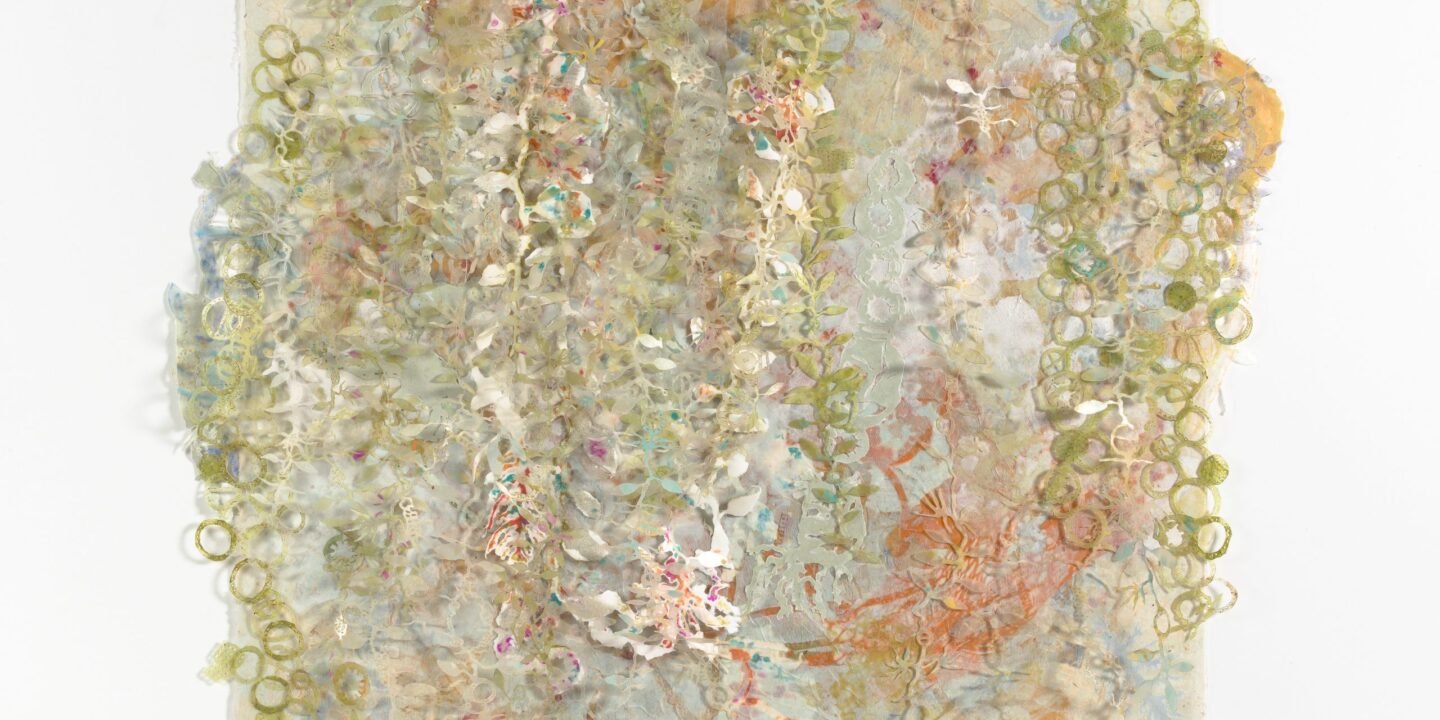
The gallery offers both art historical secondary market work, and new prints by contemporary artists it represents, such as Joan Hall. The artist specializes in making her own paper, incorporating printmaking techniques to create large-scale sculptural hanging works. Priced at $18,000 each, they are inspired by the invasive algae species and plastic pollution she encounters in her home near Rhode Island’s Narragansett Bay.
Hall is among the artists who make their own prints, start to finish. Cade Tompkins Projects of Providence, Rhode Island, is showing three large-scale, multi-panel works by Israeli artist Orit Hofshi. She hand-carves her woodcut blocks, which she reuses to create different compositions inspired by landscapes and nature. Each work is unique, embellished with charcoal rubbing and other drawings, with prices ranging from $55,000 to $75,000.

Orit Hofshi, Amphitheatre (2025). Courtesy of Cade Tompkins Projects, Providence, Rhode Island.
Another highlight was Santa Barraza, a Chicana artist whose work often draws inspiration from her mestiza ancestry. Her powerful retelling of a Mexican myth casts the woman as the warrior, carrying her dead love’s body across a volcanic landscape.
“This is from 1984, and you can see she was quite a feminist,” said Patti Ruiz-Healy, associate director of New York and San Antonio’s Ruiz-Healy Art. The unique work, a serigraph embellished with colored pencil, hand stitching, and gold leaf, is priced at $8,250.

Santa Barraza, Iztaccihuatl and Popocatépetl, Reversed (1984). Photo courtesy of Ruiz-Healy Art, San Antonio and New York.
Teamwork in the Arts
Printmaking is often an extremely collaborative process, with artists who don’t specialize in the medium working with a master printer to realize their visions.
“We’re known for experimentation in printmaking. We ask artists to dream big, and then we make it happen,” Sona Pastel-Daneshgar, curator at Tandem Press in Madison, Wisconsin, said.
New work by Marie Watt on offer at the fair is inspired by a recent series she did of neon sculptures. Her piece Shared Horizon (Facing East), printed in an edition of 24 priced at $12,000 each, seems to illuminate the page, the words seemingly glowing from within. It was the most expensive work at the Tandem booth, which was presenting a strong slate of women artists, including Dyani White Hawk, Alison Saar, and Michelle Grabner, among other artists.

Marie Watt, Shared Horizon (Facing East), 2025. Photo courtesy of Tandem Press, Madison, Wisconsin.
Gemini G.E.L. had an all-women presentation, titled “A Woman’s Place is in the Workshop.” Founded in 1966 by Sidney Felsen and Stanley Grinstein, the Los Angeles artist workshop and publisher was slow to begin working with women artists, until Vija Celmins began producing etchings there in the 1980s.
Her delicate drypoint of a vast sea of waves at the fair is $40,000. More affordable is Tacita Dean’s “Eclipse Drawings” screenprints, velvety images based on long exposure photographs of a solar eclipse that start at just $1,500.

Tacita Dean, Eclipse Drawings #10 (2025). Photo courtesy of Gemini G.E.L., Los Angeles.
Today, Gemini is run by Felsen’s wife, Joni Weyl, and daughter, Suzanne Felsen, and Grinstein’s daughters Ellen Grinstein and Ayn Grinstein.
Crown Point Press has also passed the torch to the next generation of women, with Valerie Wade taking the reins following the death of founder Kathan Brown a year ago this month.
The new Owens series, of five colorful images in an edition of 12, was already selling nicely, with six moving at $8,500 each on opening night.
“We just finished them up in the studio,” gallery sales associate Gabi Sarussi said, pointing to the unique combination of intaglio, screen-printing, and lithography elements that allowed the artist to achieve distinct layers of opacity in the images.
Bringing in a New Audience
“The past two or three years, we’ve met a lot of really great younger collectors in late 20s through early 40s who are really drawn to buying prints, because it allows them to acquire work from bigger artists whose paintings or sculptures might be at price points that are inaccessible,” Alexandra Slattery, sales director at New York printmaker studio and gallery Two Palms.
Among the booth highlights was a monoprint by Cecily Brown, created alongside works currently on view in her new solo show “Picture Making” at London’s Serpentine Galleries. The artist drew in crayon on a wood plate, then used an industrial hydraulic press applying 600 pounds of pressure to transfer the image to paper, leaving behind impressions of the wood grain. Two of the four available had already sold for $62,000 on opening day, along with 24 of 28 prints in a new Brown edition at $7,500 each.

Cecily Brown, Untitled (2024). Photo courtesy Two Palms, New York.
And those buyers are educating themselves about the many different techniques that printmaking can entail, from traditional methods of etching or drypoint to working with sculpted topographical paper to achieve three-dimensional results.
“People are becoming more aware that a print is not just a reproduction of a painting or drawing,” Conner Williams, the head of prints and multiples for Artnet Auctions, said.
He’s also found that there has been a shift in what prints are resonating with buyers. Andy Warhol’s “Endangered Species” series of animals, for instance, is now outselling the more dated pop culture references of the once-coveted Marilyn Monroe silkscreens.
“With the tastes changing so much in the market, you have to assume that some of them are just a different generation,” Williams added.
This year’s edition is also the first time that the fair has allowed dealers to bring works on paper more broadly, with drawings in addition to prints and multiples.
“Adding drawings to our mandate was something we’d been thinking about for a long time. Artists don’t really separate prints and drawings in their practice, and museums don’t either—they’ve almost always combined those disciplines within their departments—so this felt like a natural evolution for us,” fair director Jenny Gibbs said. “It also reflects how collectors are thinking now, moving more fluidly across works on paper, whether that’s a unique drawing, an editioned print, or a monotype.”
Different Models for Success
All of the work at the fair still has to be a print or work on paper. The exhibitors, however, don’t fit into neat boxes. There are print shops, working directly with artists—sometimes only by invitation—to design, print, and sell new work. There are galleries that sell work exclusively from the secondary market, offering prints by blue-chip art historical artists at a fraction of the price of their paintings or sculptures. There are galleries that do both, offering historic secondary market work and representing contemporary artists making new prints.
The fair includes longtime leaders of the field, such as Tamarind Institute, the lithography workshop in Albuquerque. But the mega dealers David Zwirner, Hauser and Wirth, and Pace are also here, and have become increasingly involved in the print world.

Ruth Asawa, Henry and Adam (TAM.1568), 1965. Photo courtesy of David Zwirner.
Pace has its separately owned publishing arm Pace Prints, founded in 1968, with its own printmaking workshops and paper workshop. In 2023, Hauser and Wirth Editions opened a dedicated New York gallery space on 18th Street. Zwirner, meanwhile, launched Utopia Editions, its publisher of original prints by the gallery’s artists, in 2021. It’s a smart business model, helping artists make more work to meet collector demand, and expanding the gallery’s client base in one fell swoop.
In addition to new prints from Elizabeth Peyton—both larger and cheaper than her paintings—and Mamma Andersson ($10,000), Zwirner’s booth included tender Ruth Asawa drawings of her young children from her time at Tamarind in the mid-1960s ($7,500 and $9,500), and vibrant Joan Mitchell works boldly translating her expressive brushstrokes into print form ($50,000).
Also sourced directly from the artist’s estate was the Bourgeois series, priced at just under $600,000 and featuring a recurring motif in her work.

Louise Bourgeois, “Spirals” (2005). Photo courtesy of Carolina Nitsch Contemporary Art, New York.
“I work directly with the studio, and I’ve been begging them to have the set,” Carolina Nitsch said, noting that the rest of the edition of 15 are all in museum collections, including the Museum of Modern Art in New York. “They are made using the Ukiyo-e technique. The first block creates the wood grain, with this sort of iridescent ink. It’s almost pearlescent. And then the second block is the actual wood block design. It’s signed only on one sheet, so it has to stay together as a set.”
By the end of the fair’s preview, it was on hold with an institution—proving that even at the print fair, there are some areas where new collectors will have trouble competing!
The International Fine Print Dealers Association (IFPDA) Print Fair is on view at the Park Avenue Armory, 643 Park Ave, New York, New York, April 9–12, 2026.