
 The music industry addressed its discovery challenges two decades ago. Streaming sites have changed how we find films, podcasts, and even potential partners. However, the contemporary art world continues to operate as if the internet had no impact.
Online art sales reached $10.5 billion in 2024, accounting for 18% of the global market. The digital art sector is expected to grow from $5.3 billion to over $40 billion by 2033. Despite this digital expansion, the main discovery challenge remains. A collector in London might have trouble finding an emerging artist in Mexico City.
A New York interior designer could spend weeks sourcing the perfect piece from a Berlin studio. Traditionally, success relied on knowing the right contacts, attending major fairs, and building relationships over many years.
That is the issue that NALA is solving.
The Gallery Model’s Structural Limits
The gallery model was effective when physical proximity was necessary for discovery. But the economic landscape has shifted. Traditional galleries earn commissions of 50 to 60 per cent on sales, yet 30 per cent operate at a loss, and another 30 per cent only break even.
This is not a critique of galleries, as they provide vital services: curation, exhibition space, and collector relationships built over decades. However, their model was designed around scarcity rather than scalability. Less than 2% of artists work with galleries – and yet the largest online art platforms work almost exclusively with those galleries. This means 98% of the global talent pool are left out of the marketplace entirely.
Buyers are, at best, seeing a tiny sliver of the art they might genuinely love.
An artist in São Paulo shouldn’t have to seek representation in Chelsea to connect with collectors who appreciate their work. A designer in Dubai shouldn’t need to attend Art Basel to find pieces that could significantly enhance a client’s space.
The core issue is infrastructure. The art world lacks the connectivity that other creative industries take for granted.
The Interior Designer Challenge
The discovery problem affects more than collectors; interior designers face it daily. Art is one of the most time-consuming decor elements of any design project. Scouring galleries, searching online listings, and attending art fairs takes considerable time and cost, and is particularly difficult when clients have specific requirements around scale, palette, and style. However, these are often discovery problems masquerading as matters of taste, and can lead to huge delays in fulfilling the brief.
NALA addresses this by providing tools tailored to design workflows, including image matching that finds relevant works based on visual similarity and search filters for size, colour, and medium. The main advantage remains the same as for collectors: access to a worldwide network of artists without gatekeeping.
What Technology Can Actually Do
This shift does not seek to replace human assessment. Instead, it applies the technological sophistication found in streaming services to cultural discovery.
At NALA’s core is a proprietary recommender engine developed using MIT data science methodology, drawing on some of the world’s largest art databases. Rather than relying on keywords or popularity signals, it optimises for taste alignment. It operates through visual and conceptual affinity and analyses user activity alongside global market patterns.
Early iterations revealed a crucial insight: people do not respond uniformly to an artist’s entire output. They connect with specific pieces for specific reasons. Shifting from artist-level to artwork-level matching moved the platform’s like-to-dislike ratio to roughly three-to-one. A meaningful signal that the system is genuinely predicting connection rather than proximity.
USA Today highlighted NALA for this approach. It acknowledged its potential to influence collectors’ habits and create a system in which an artist in Lagos can be as visible as one with a gallery representation in Chelsea.
Economics Built Around Creators
NALA operates without taking a commission, enabling artists to keep 100% of their sales. This is not driven by idealism but by a considered view on what sustainable creative ecosystems actually require. The goal is a fair, more efficient art ecosystem where artists can build sustainable visibility and buyers can reliably discover work they genuinely love.
Some concerns around the role of technology in art tend to conflate different functions: generating content versus routing attention. NALA does the latter. The art remains entirely human. The technology makes the connection faster, more global, and less dependent on who you happen to know.
Building trust with both artists and collectors while developing a two-sided marketplace has required product, marketing, and operational execution in parallel. Encouraging artists to engage, while ensuring collectors feel confident discovering and purchasing on a new platform, has presented a continuous set of challenges. However, the conviction that expanding access for artists while improving discovery for collectors is worth building has remained steadfast.
Mexico City and the Living System
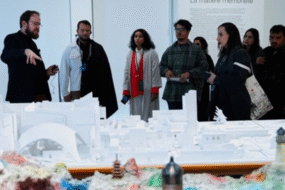
Earlier this year, NALA launched CASA NALA in Mexico City during Art Week. The exhibition, pánta rheî koiná: Everything Flows in Common, brought together 24 Mexican and international artists. It was curated to highlight both the differences and the merging storylines of artists from many backgrounds and career stages, reflecting what the platform enables online.
The residency became an energetic space for dialogue and community across generations during Mexico City Art Week. It created both exposure and direct sales opportunities for the artists involved.
The curatorial framework reflected the wider philosophy: art as a living system rather than a static marketplace. Works connected through visual language and shared visibility, not through gallery affiliation or price bracket. The response from both collectors and designers confirmed what the data already suggested. There is an appetite for discovery models that overlook traditional gatekeeping without abandoning curatorial intelligence.
The Spotify Parallel
NALA is often likened to Spotify for the art world, and this comparison is quite fitting. Although art isn’t infinitely reproducible like music and each painting is unique, the core challenge of discovery remains analogous.
Spotify overcame the challenge of helping listeners find music they love from millions of tracks through intelligent matching, behavioural data, and algorithms that enhance human taste. This approach also applies to art: how do you help someone discover something they’ll love when they don’t know it exists? How do you showcase quality without relying solely on prestige networks?
NALA uses this method in visual art. Its image recognition algorithms examine aesthetic signatures from a database of more than 18,000 artists, uncovering affinities that human curators might miss. This helps artists connect with collectors who truly value their work, instead of relying on random gallery encounters.
What Comes Next
The broader art and creativity technology market is projected to grow substantially over the next decade. This growth will not be evenly distributed; some investment will support tools that assist artists in creation, while other resources will fund platforms that facilitate audience discovery.
The opportunity is something more meaningful:
- Artists finding collectors who genuinely value their work,
- Designers sourcing pieces that transform spaces,
- Collectors building relationships with creative practices rather than simply accumulating assets.
NALA sits at this intersection, not as a replacement for galleries, advisors, or fairs, but as infrastructure that enables discovery at scale. The art world has resisted its technology inflexion point longer than most industries. That resistance is ending, opening new pathways for artists and audiences to find one another beyond traditional networks.
As digital discovery becomes a core part of how art is experienced and discovered, the platforms that succeed will be those that strengthen the connection between creators and their audiences.
NALA was built with that goal in mind: to expand access, deepen connection, and make the discovery of art more globally accessible.
 NALA is a next-generation art discovery platform that rethinks how people find and connect with contemporary art. Rather than relying on names, trends, or price signals, NALA operates through visual and conceptual affinity, matching viewers to artworks based on what they respond to intuitively.
Blending image-recognition technology with curatorial insight, NALA creates a fluid ecosystem where emerging and established artists are discovered on equal footing. The platform serves collectors, interior designers, and institutions seeking meaningful, resonant works – positioning art not as a transaction, but as an evolving relationship between image, space, and perception.