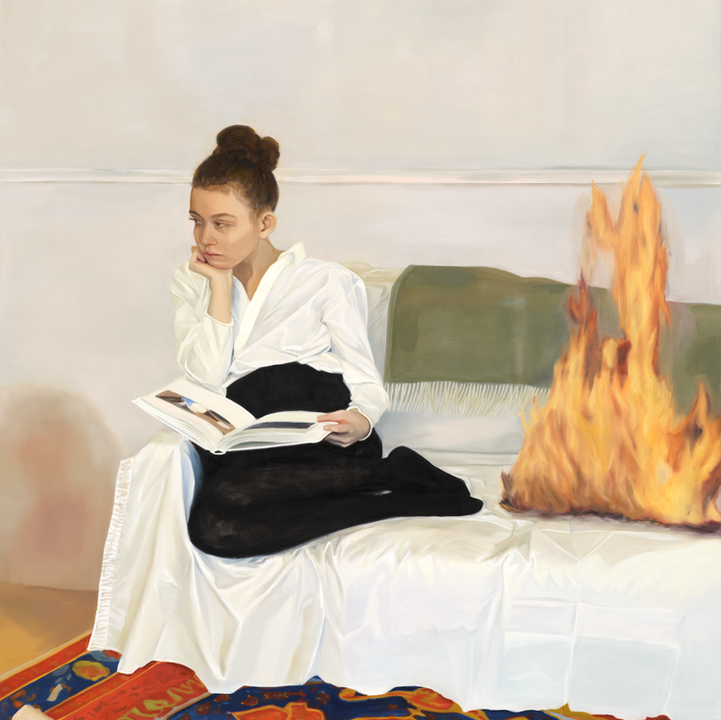
Shannon Cartier Lucy, ‘Brooklyn’s l’ennui,’ 2023. Oil on canvas; 70 x 52 in. Collection of Sandra Ballentine, courtesy of Night Gallery, Los Angeles. © 2025 Shannon Cartier Lucy.
Nik Massey
The Frist Art Museum in Nashville celebrates 25 years in 2026. Nashville’s Country Music Hall of Fame and Museum also opened a new building in 2001 less than a half mile away. Half a mile in the other direction, also in 2001, the city opened a new Main Library.
These openings coincided with the inaugural seasons of the National Hockey League’s Nashville Predators (1998) and the National Football League’s Tennessee Titans (1999). The Predators’ arena is located between the Frist and the Hall of Fame; the Titans play just on the other side of the Cumberland River.
A new symphony center followed in 2006.
Nashville has been on a rocket ride of population and economic growth for the past 30 years.
“It was in the mid-90s when civic leaders came together, and Nashville was just starting to grow, and these folks really were strategic about what does Nashville need to be a vibrant big city,” Frist Art Museum Senior Curator Katie Delmez told me in a phone interview. “Thank goodness they had the foresight, the insight, the wisdom to know that in addition to a professional football team and a professional hockey team, they were also thinking about the cultural institutions. The philanthropic families each kind of picked their pet project, and happily, Dr. Tommy Frist acknowledged that (Nashville) did not have a centrally located, physically large, visual arts institution that would be interested in showing the art of the world.”
Enter the Frist Art Museum.
Delmez moved to Nashville for good in 1998 after undergraduate study at the city’s Vanderbilt University. She’s been with the Frist since opening and has seen the area’s dramatic growth firsthand.
In 1990, Nashville’s Davidson County had a population of 512,000. By 2024, it had reached 729,000. That’s 40% growth. The surrounding metropolitan area has similarly bulged. More than 2,000,000 people now call the region home. That milestone was crossed during the pandemic when the area saw an influx of new residents. Greater Nashville added nearly 150,000 new residents between 2020 and 2024 alone.
Due to its favorable climate, Tennessee’s lack of a state income tax, colleges (Vandy, Tennessee State, Belmont, Fisk, etc,), and ever-growing entertainment and cultural options, Music City U.S.A. has been one of the country’s “it” places to live, work, and play since Garth Brooks was dominating radio. The city has unquestionably benefitted from some magic. Brooks spearheaded an explosion in the national popularity of country music–Nashville’s No. 1 claim to fame–that also took place in the mid-90s; the Tennessee Titans went to the Super Bowl in their first season in Nashville.
Under the radar, absent the attention received by singers, Nashville’s visual artists and their advocates have been working, building community, rising. These are the figures–nearly all women–the Frist spotlights during its silver anniversary exhibition “In Her Place: Nashville Artists in the Twenty-First Century.”
Nashville’s Women Artists
Karen Seapker, ‘You are Spring,’ 2023. Oil on canvas; 72 x 48 in. Collection of Sasha and Charlie Sealy. © 2025 Karen Seapker.
Sam Ange
“In Her Place,” on view from February 1 through April 26, 2026, spotlights the central role women have played—and continue playing—in shaping Nashville’s visual arts community.
“I never looked at our arts community through the lens of gender before two of the artists that are now in the show casually said, ‘You know, all the major figures in (Nashville’s) art world are women,’” Delmez recalled. “It was a light bulb moment, ‘Oh, you’re right.’ As I started to think, the artists themselves, but also the gallery owners, many of the professors at the time, the directors of the museums, were all women.”
Women have long been at the center of Nashville’s vibrant visual arts community. Their presence has become especially pronounced during the city’s recent period of remarkable growth. An outsized number of local women artists are showing their work across the country and globe and receiving prestigious grants, residencies, and critical acclaim.
“The core group of artists and the ones that this idea began with are mid-career artists who are exporting Nashville as a visual arts brands beyond our city,” Delmez said. “They are the ones having their work shown in galleries and museums in New York and London, Miami Art Week. They’re getting the prestigious residencies and grants and having their work written about by important art historians and critics.”
Artists like Nashville’s María Magdalena Campos-Pons, a 2023 MacArthur “Genius” Grant winner whose work has been exhibited in prestigious museums and biennials around the world. Compos-Pons additionally teaches in Vanderbilt’s fine arts department, mirroring how many of the city’s female artists have historically made ends meet and extended their influence.
Born in Cuba, she also embodies another, more surprising through-line among Nashville’s women artists: international roots.
Tehran-born ceramicist Raheleh Filsoofi. Persian American artist Kimia Ferdowsi Kline. Puerto Rican painter Yanira Vissepó. Laos-born multimedia artist Sisavanh Phouthavong Houghton, who also teaches at Middle Tennessee State University.
All are featured in “In Her Place.”
“This has become a global arts community,” Demez said. “Nashville as a city has become more global. As such, the artists coming here have as well. That is a more recent phenomenon of certainly the last 20 years, if not even more recent.”
Nashville’s latest growth spurt has been driven by immigrants. A full 15% of Davidson County’s residents are foreign born. Almost 40,000 people have moved to Nashville from other countries since 2020 according to census data.
Nashville is home to the largest Kurdish population in America. They are represented in the Frist exhibition by Beizar Aradini who was born in Kurdistan and immigrated with her family to Nashville as an infant in 1992.
“Nashville is welcoming. I’ve always believed. It’s open to new ideas, and it is progressive, not in a political way, but it’s always looking forward, moving forward, and excited about growth in an array of disciplines,” Delmez explained. “We all have grown together, and whether it’s artists moving here, or our capacity to be bringing first rate art to Middle Tennessee that hopefully then inspires the artists around us, the whole community has been lifted up by all the good things that have been happening in Nashville in the last couple of decades.”
“In Her Place” displays nearly 100 paintings, sculptures, textiles, and installation works made in the 21st century by an intergenerational group of 28 celebrated Nashville-based women artists. The Frist felt compelled to spotlight one more Nashville women artist as part of its 25th anniversary celebration.
Barbara Bullock: “Sistah Griot”
Barbara Bullock, ‘Gathering,’ 1993. Oil on canvas; 70 x 40 in. Collection of Alan and Andrée LeQuire, Nashville.
John Schweikert
Barbara Bullock (1949-1996) moved to Nashville in 1969 from Washington, D.C. after having grown up in Buffalo, NY. Her mother lived in Nashville and Bullock came to be closer by and study art at George Peabody College for Teachers, now a part of Vanderbilt University, like countless other female artists before and since who went to Nashville for schooling.
A debilitating stroke at the age of 35 dramatically changed her life and art. Her style shifted from precisely rendered graphite illustrations to boldly colored paintings defying realistic spatial construction. Her new direction was influenced by the double vision her stoke caused and the work of M. C. Escher.
“She was more introspective,” Carlton Wilkinson told me in a phone interview about how Bullock’s work changed after her stroke. Wilkinson has guest curated an exhibition of Bullock’s paintings and drawings to run concurrently with “In Her Place.” “She had to wear a patch over one eye because her vision became skewed and she had to train her eye back to normal.”
Bullock used artmaking to do so. Artmaking as physical therapy to heal her double vision and restore fine motor skills. A rare surgery undertaken to return proper blood flow to her eye allowed her to eventually stop wearing the patch.
“That was a lot of her subject matter, healing herself and her personal life, the isolation that she experienced,” Wilkinson explained.
While Bullock engaged with Nashville’s artistic and academic communities, she wasn’t a “life of the party type.”
“She was a loner. She was an introvert,” Wilkinson said. “She had some emotional issues growing up.”
A childhood with a degree of privilege uncommon for African Americans in mid-century. Prim and proper. Hierarchical.
“She was really raised to serve men,” Wilkinson said. “Her grandmother was very much a traditionalist. The women were like debutantes; they were there for the men. This is coming from a Northeast sensibility. She was raised by her aunt and uncle. He was a dentist. She was a doctor’s wife, a socialite.”
When Bullock married briefly in Nashville, it was also to a gentleman of means. The couple lived in a well-to-do neighborhood. The artist would reject that life.
“She took this kind of vow of poverty when she left her husband because she lived very well up until that point,” Wilkinson said.
In Bullock’s life and art, he sees parallels to writers.
“Flannery O’Connor or Emily Dickenson, they lived sort of isolated lives, but had this intuition about humanity that was just incredible. I see her in that kind of world; one of isolation, but yet still connected, very much observing,” Wilkinson said.
The Frist’s Bullock exhibition is not the artist’s first. She had a one person show at Vandy. One for the Tennessee Crafts Association. Another in Atlanta which was reviewed by “Art in America.” Her career was moving. Then came the stroke. Then the cancer which took her life. Now, Bullock is mostly unknown outside of Nashville.
“I see her work as some of the most significant, prolific paintings of the latter 20th century. The summation of her work, collectively, such a profundity,” Wilkinson said. “What she was addressing back then, and this is the 30th anniversary of her death, is so relevant right now; it’s incredible what we’re witnessing in her work. One piece has a white male standing in front of these dolls, all female dolls… it is so reminiscent of Epstein.”
Bullock’s painting after her stoke may have been performed with healing in mind, but her ultimate goal in art was helping to heal the world of social inequalities.
“Sistah Griot: The Iconoclastic Art of Barbara Bullock” features approximately 40 works. Griot is a West African term for an oral historian and storyteller, a role many saw Bullock fulfilling. The pieces on view come from private collectors around the country. Black and white. Laborers and professionals. Wilkinson was amazed by the diversity of Bullock’s collectors when putting the show together.
“You don’t decorate with Barbara’s art, you commit to it,” he said. “That’s been the motivation of all her collectors, that’s the common thread.”