[ad_1]
James Joyce referred to them as “the weird sisters” in Ulysses. William Butler Yeats, meanwhile, called them “the angel and the demon” for their markedly contrasting personalities. Yeats might have known it firsthand—he was their brother.
The Yeats sisters, Susan Mary (1866–1949) and Elizabeth Corbet Yeats (1868–1940)—better known as Lily and Lolly—have long lived in the shadows of both of their brothers, the poet and diarist William Butler Yeats and painter Jack B. Yeats.
In fact, Lily and Lolly Yeats were revolutionary forces all their own. The sisters played a pivotal role in developing the visual and written language of Irish national identity at the turn of the 20th century, one that enraptured the world and still continues to shape the popular imagination.

Dun Emer Press workshop (c. 1903)
Over their lives, the sisters collaborated with countless women artists, including May Morris, daughter of William Morris, and Pamela Colman Smith, who illustrated the iconic Rider-Waite-Smith tarot deck, in bringing this vision to life.
Now a new exhibition, “Collaborating in Conflict: The Yeats Family and the Public Arts,” curated by Marjorie Howes, Christian Dupont, and Diana Larsen at the McMullen Museum of Art, centers the sisters’ contributions to 20th-century art and literature in a wide-ranging multimedia exhibition.
Irish Subjects, Irish Materials
Among the highlights of “Collaborating in Conflict” are rarely exhibited embroidered banners of Irish saints—including Saint Patrick, Saint Brigid, Saint Ita, and Saint Kevin—that the Yeats sisters had made for St. Brendan’s Cathedral, Loughrea, in County Galway, Ireland, as part of their enterprise Dun Emer Industries.

Lily and Elizabeth Yeats in 1900. Photograph: The Board of Trinity College Dublin
The sisters founded Dun Emer—which included Dun Emer Press and Dun Emer Guild—along with textile designer Evelyn Gleeson in 1902 as an Irish Arts and Crafts cooperative. Dun Emer would play an influential role in the broader turn-of-the-century Irish Revival, which fused Irish nationalist politics with a renewed interest in medieval Irish design, craft traditions, and Gaelic literature.
Like many other Art and Crafts collectives of the era, Dun Emer paired art with social justice. It was founded with the mission of providing training and employment for Irish women and, according to its prospectus, to “find work for Irish hands in the making of beautiful things.” The cooperative was named after Emer of Irish myth, the wife of the hero Cú Chulainn, who, in one story, teaches girls to embroider.
Dun Emer Press, led by Lolly Yeats, was devoted to the publication of Irish authors, including books by W.B. Yeats, Lady Gregory, Douglas Hyde, and Katharine Tynan. Dun Emer Guild, led by Lily Yeats and Evelyn Gleeson, focused on the production of textiles, including rugs, embroidery, and tapestries, using Irish materials, including linen and silk.
How Ireland’s Saints Became National Icons
In 1902, the cathedral St Brendan, Loughrea, was built by prominent architect William A. Scott, marking a major moment in the rise of Irish cultural identity. Scott, along with the church’s major benefactor, Edward Martyn, an ardent Irish nationalist, wished to see the church decorated in an Irish Revivalist style that spoke to the spirit of the times and the desire, by Irish Catholics, to see their own culture reflected in the church.

Æ (George Russell, 1867–1935), designer; Dun Emer Guild, embroiderer
Saint Patrick sodality banner (1902–04) Silk and linen on wool. St. Brendan’s Cathedral, Clonfert Diocesan Museum.
“By the early 20th century… Irish Catholics leveraged their increasing social and political strength to assert independence, supporting Irish industry and crafts. Rising nationalism and a renewed admiration for handmade objects created fertile ground for the Arts and Crafts Movement,” wrote art historian Lyndsey McDougall of this shift in “Narratives of agency and the material cultural of Masonic and religious embroidery made in Ireland.”
In 1903, Dun Emer Guild won a major commission to create 29 banners for the new cathedral. These banners were to adorn the pews, and a handful were used in processions to denote different sodalities, or groups of lay people, devoted to a particular saint. Lily Yeats, who oversaw hand embroidery for Dun Emer Guild, guided the project, bringing in prominent Irish artists and intellectuals to make designs that were in turn embroidered by the women of the Dun Emer Guild.
Irish writer and editor George William Russell, known by the pseudonym Æ, created the design for the banner for Saint Patrick, Ireland’s most famous saint, now on view at the McMullen Museum of Art. Here, the saint appears with his crozier, driving snakes into the water, as in the famous legend of St. Patrick symbolically driving paganism from the island nation. The banner’s border is also decorated with shamrocks, the botanical symbol used by Saint Patrick to explain the idea of the trinity, three aspects of God—Father, Son, and Holy Spirit, in one being.
Æ was an Irish nationalist, but also a mystic and devotee of theosophy, and his father was an employee of a prominent linen draper. Russell also studied drapery. In these banners, richly varied aspects came together to celebrate handicraft, Irish materials, and a visual language that celebrated Ireland’s mythic past.
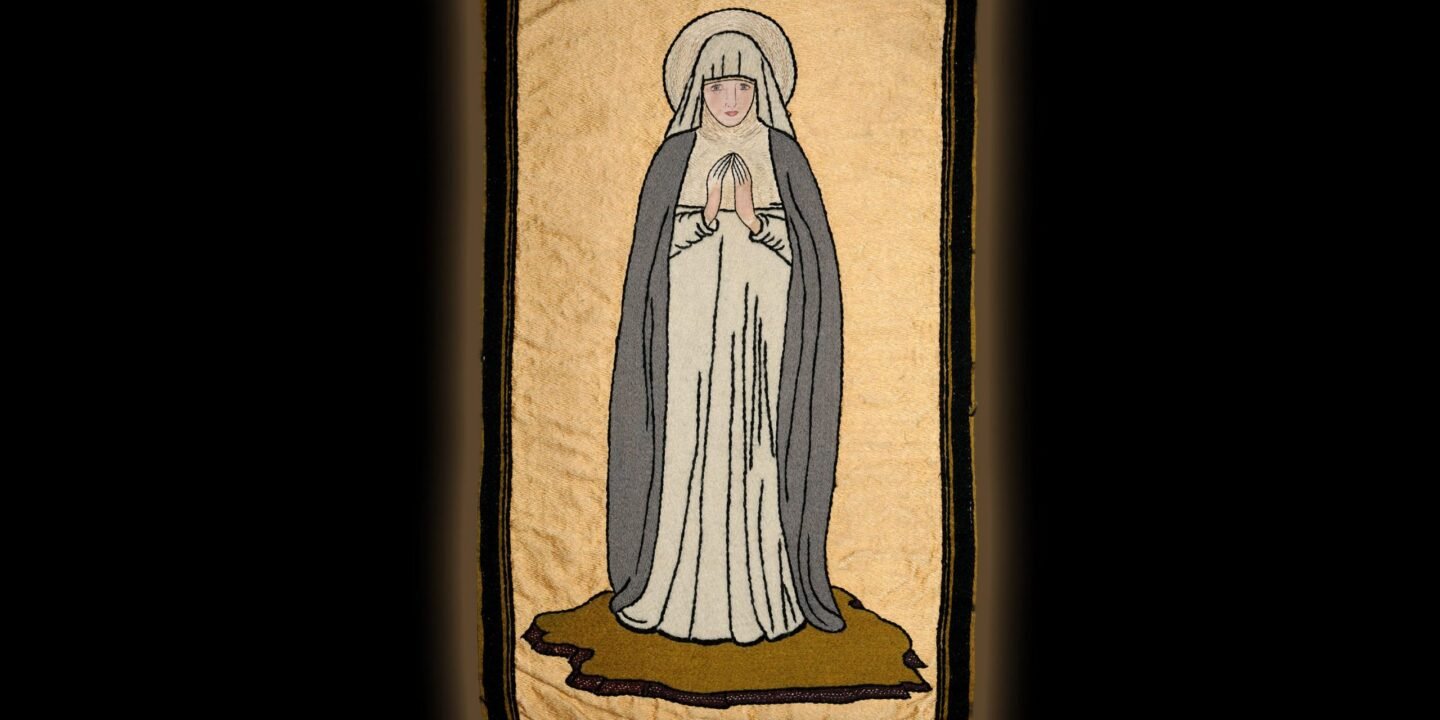
The jewel of the exhibition is artist and occultist Pamela Colman Smith’s luminous vision of Saint Brigid, Ireland’s mother saint. Smith, who had exhibited at Alfred Stieglitz’s 291 Gallery, found a nuanced subject in Saint Brigid, whom she depicts with a serene elegance.

Jack B. Yeats (1871-1957), designer; Dun Emer Guild, embroiderer, Naom Caoimgín (Saint Kevin) sodality banner (1902–04). Silk and linen on wool, St. Brendan’s Cathedral, Clonfert Diocesan Museum. © Estate of Jack B. Yeats. All rights reserved, DACS/ARS 2026.
Saint Brigid is said to have been born to an enslaved Christian woman and fostered in the home of a druid before eventually becoming an abbess who founded the convent in Kildare. She came to embody both Christian and pagan histories, as Brigid was also a Celtic goddess associated with fire, poetry, and spring. The Catholic saint’s feast day of February 1 coincides with the ancient pagan festival of spring, Imbolc. Unique among the banners, Brigid’s halo incorporates silver threads, rather than standard thread, and the face and the hands of the saint are painted directly onto the silk ground.
Other saints included in the exhibition are Saint Kevin, designed by the sister’s brother Jack B. Yeats, and Saint Ita, designed by his wife Mary “Cottie” Cottenham Yeats (née White). Cottie depicts Saint Ita as a young medieval queen with plaited hair and holding a young blond boy. Saint Ita founded a monastery at Killeedy, Limerick, where she cared for the poor and sick, and mentored young boys. Among these was Brendan, Loughrea Cathedral’s patron saint.
Among the banners commissioned, eight feature women saints, and another four depict the Virgin Mary (another delightful banner, though not included in the exhibition, features St. Gobnait, patron saint of bees and beekeepers). Dun Emer, in this way, emphasized the centrality of women to Irish culture, not only as religious figures, but through the elevation of woman-made embroidery led by a women-run cooperative.
In its time, the banners were highly regarded and received acclaim for celebrating Irish craft, supporting social justice, and defining an Irish aesthetic that merged medieval and ancient traditions with the language of modern Celtic revival.

Mary Cottenham Yeats (1867–1947), designer; Dun Emer Guild, embroiderer, Naom Íte (Saint Ita) sodality banner (1902–04). Silk and linen on wool. St. Brendan’s Cathedral, Clonfert Diocesan Museum.
“The banners, designed and made by Irish hands, epitomized the fusion of cultural heritage and religious art, a rarity in a church environment often dominated by imported goods,” wrote McDougall.
The banners also centered embroidery at the heart of the Irish Revival and with it, women’s craft. Embroidery was a way that Irish women throughout history, including those of Dun Emer, navigated strict social conventions to attain independence and influence. In this case, the embroidery provided a fair livelihood for the Dun Emer workers and prized their craft over commodification.

Evie Hone, Saint Brigid. St. Brendan’s Loughrea Cathedral, Galway, Ireland.
“The Guild’s founders believed in the intrinsic value of craftsmanship and the importance of providing fair wages and healthy working conditions for their craftswomen,” said McDougall. “While the products of the Guild were sold, the process was designed to reject mass production and preserve the unique artistic quality of each piece.”
In 1908, Dun Emer would ultimately fracture. Gleeson continued to run Dun Emer Guild on her own until 1964. Lily and Lolly Yeats, meanwhile, left to establish Cuala Press, which would continue to bring visions of Irish Revivalist culture around the world, including many more visions of Ireland’s women saints.
The influence of the Loughrea banners would be long-lasting, as St. Brendan’s became a vessel for Irish Arts and Crafts art, featuring stained glass by the collective An Túr Gloine, including a window by the artist Evie Hone; Celtic-inspired carvings by Michael Shortall; and sculptures by John Hughes—making the cathedral one of the most expansive troves of Irish Arts and Crafts in the the world.
“Collaborating in Conflict: The Yeats Family and the Public Arts” is on view at the McMullen Museum of Art at Boston College, 2101 Commonwealth Ave, Boston, Massachusetts, through May 31, 2026.
[ad_2]
Source link