
[ad_1]
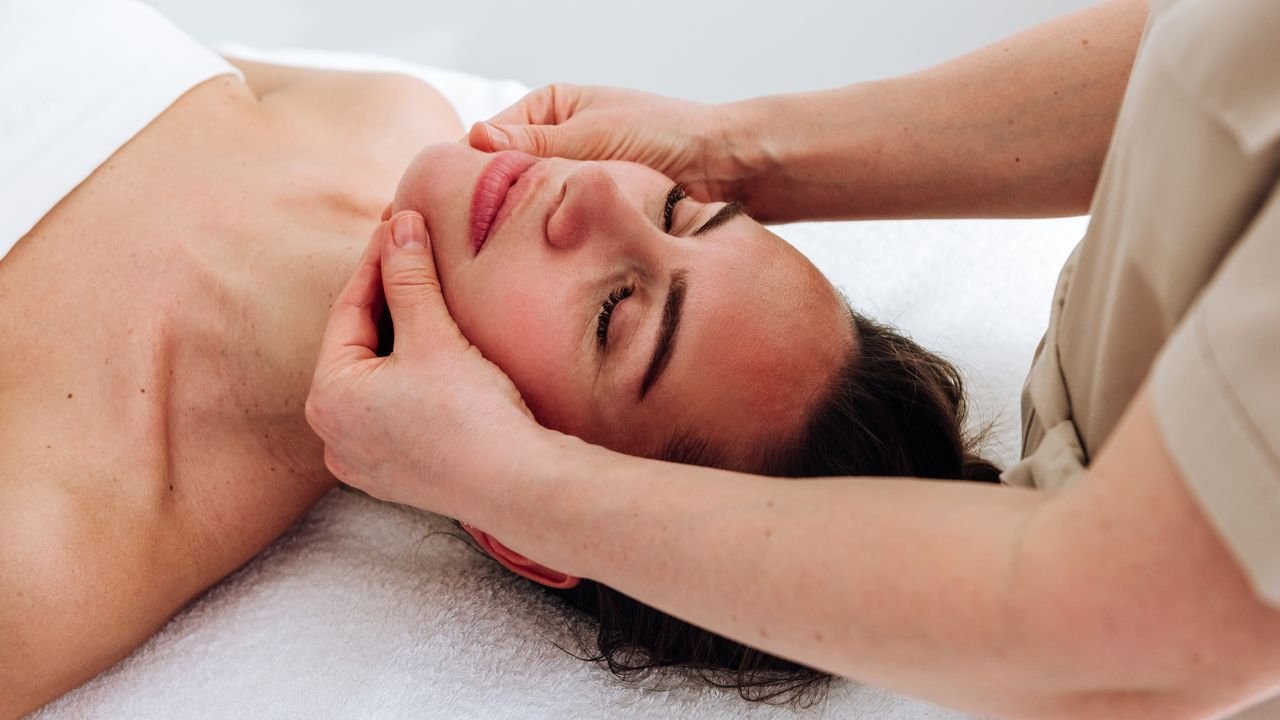
A session usually lasts around 40 to 50 minutes. Your therapist warms up the muscles, works externally, then moves inside the mouth to deal with deeper strain. It feels unusual for about a minute, then it just feels logical: firm, targeted work, more sports massage than spa ritual.
Evgeniiya Sorokina, co-founder of FaceRoom, explains: “Before working intra-orally, we warm up the tissues, stimulate circulation, relax the neck and shoulders, and prepare the platysma, a key muscle influencing the lower face, jawline, and neck. Buccal techniques should never be done in isolation; they’re part of a comprehensive lifting massage because facial muscles, like body muscles, need preparation.”
Because facial muscles attach to bone on one side and blend into surrounding muscle and skin on the other, deep tension in areas like the masseter or buccinator can subtly pull the face downward over time. Buccal work releases that from within, helping restore a lighter, more defined contour.
Is it just face yoga or lymphatic drainage rebranded?
Not quite. Face yoga strengthens muscles. Lymphatic drainage tackles puffiness and fluid retention. This massage goes deeper still, working inside the muscle to release what’s been holding the face tight.
“I often compare this work to stretching the body. You would never stretch cold muscles. You warm up first,” says Sorokina. “Buccal techniques are powerful, but they must be part of a holistic, well-structured approach, not a standalone trend. Facial massage can sit alongside injectables, biorevitalisation, devices, and other skin-quality treatments. As with the body, we don’t rely on one method alone. We combine strength, flexibility, and recovery.”
What you walk out with
You walk out looking more defined, a little lifted, and noticeably less puffy. Not frozen. Not overdone. Just fresher, lighter, as though someone turned the stress dial down. It isn’t permanent, and it isn’t meant to be. A course delivers better results than a one-off, the same way consistency beats a single workout.
It’s also not for everyone: if you’ve recently had fillers, dental surgery, active infections, severe TMJ treatment, or a very lean facial structure, speak to a professional first.
Face yoga to complement the facial
[ad_2]
Source link