[ad_1]
This year marks the 70th anniversary of the Ljubljana Biennale of Graphic Arts—a milestone marked by a dry but informative presentation at the National Museum of Contemporary History of Slovenia. Instead of looking entirely to the past, “The Oracle: On Fantasy and Freedom” imagines the possibilities that lie ahead of a precarious present. The relatively small scale of Slovenia’s capital works for this tight and focused biennial contained mostly within Tivoli Park, which explores, through fantasy and storytelling, the reaches of the imagination as a way toward freedom or back to democracy.
For curator Chus Martínez, the oracle represents a place where “all beings wonder about the course of life.” Art here is the oracle, the space within which this exploration can begin. Its aid is poetry, which in the words of Audre Lorde, “coins the language to express and charter this revolutionary demand, the implementation of that freedom.” Here, these ideas are made manifest in the work of Slovenian poet and writer Svetlana Makarovič, whose poems appear by the entrances to the biennial’s four main venues. The chosen works are taken from her collection Aloneness (2002), and were selected for their questioning of institutionalized faith and nationalism, as well as their resonance with the idea of art as a space for reflection and questioning. Also to this end, dialogue prompts—“Conversations with the Oracle,” conceived by writer and artist Ingo Niermann—are dotted about the exhibition, in an attempt (rather contrived) to encourage encounters with people and ideas both familiar and foreign. One asks us to imagine a society “that extends welfare rights to non-humans”; another to conceive of one in which “we always know what is true.” The works on show speak better to this objective.
Gabriel Abrantes’s four-channel video installation Bardo Loops (2024) occupies a handful of rooms in the MGLC Grad Tivoli. Going from room to room, I viewed the videos out of order, beginning with a clip where a ghost laments the ending of what I assume to be a romantic relationship over a somber tune on the piano. Formatted to the pithy vertical videos typical of the TikTok-era of social media, the other clips show more ghost-couples; one pair is breaking up, another argues about having a child after suffering losses, the last goes back and forth on the morality of genetic testing. Playing on a continuous loop, the stories are self-contained and make sense viewed on their own and also in succession. They emphasize that a breakdown in communication often lies at the root of the rifts between lovers and friends, while dialing up the refusal to listen and tendency to double down when confronted with opposing ideas that regularly occurs in discussions online.
Yarema Malashchuk and Roman Khimei’s starting point is technology also. Their documentary Open World (2025) shows a teenage boy returning from exile in Poland, through the avatar of a robotic dog (the kind being considered for military deployment), to Zaporizhzhia, where he lived before the Russian invasion. The boy appears on a smaller screen placed in front of a bigger screen that shows the streets and sights visited by the dog. He is seated in his bedroom, camera framed tightly around his face and shoulders as he speaks into a microphone to interact with people, at one point asking for help so that the dog can get up again after a fall. While referencing the destructive potentials of technology, the short film imagines also its reclamation as a uniting force.
The work gains an additional layer of meaning when viewed through another facet of the exhibition: the story of Žogica Marogica (Speckles the Ball), a puppet in a 1951 play written by Jan Malík, directed by Jože Pengov, and designed by Ajša Pengov. Ajša wanted puppets to be independent of the hands that animate them. Speaking at the opening, Martinez drew a clear line between puppets and technology, artificial intelligence in particular, as media that can act beyond the intentions of their creator. The question is whether either can be reined in, and used to resist oppressive and divisive mechanisms.
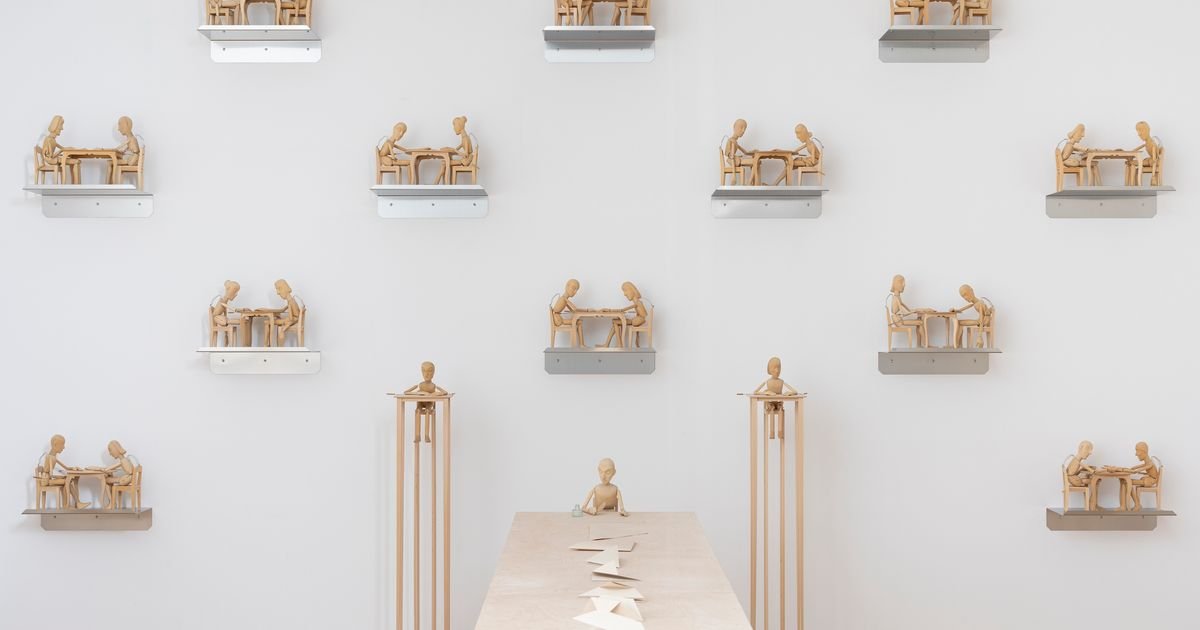
Nonhuman actors are accounted for across a range of works that touch on hybridity and interspecies collaboration. Silvan Omerzu’s animatronic puppets act out Slovenian legends or pretend to be poets, while in Joan Jonas’s video To Touch Sound (2024), created in collaboration with marine biologist David Gruber, we witness the birth of a sperm whale and learn about how the female pod members work together to support mother and calf. Elsewhere, Nohemí Pérez references her native Colombia on large-scale canvases depicting trees and animals, Eduardo Navarro dresses up as a seal taking care of their orphaned young, and Gabi Dao tells the story of otherworldly beings examining their connections to each other and the places they call home.
Collectively, these works serve to advance to the biennial’s central proposition of “the oracle” as a speculative space, imagining many paths forward and highlighting the small gestures—artistic, poetic—that might inspire meaningful action. As Makarovič writes: “Little songs I love to sing, / yet even more I love to swear.”
[ad_2]
Source link