
[ad_1]

NYC artist Jack Howard-Potter’s sculpture honoring the 1958 NFL Championship Game showcases his skills in bringing human body movement to life with steel. Images: Jack Howard-Potter
Professional football and the NFL go hand in hand with Canton, Ohio, the home of the Pro Football Hall of Fame. But the history of the sport isn’t confined to the museum.
In downtown Canton, visitors can view “The Eleven,” a series of walkable art pieces depicting 11 significant moments in pro football history. One of these pieces commemorates the 1958 NFL Championship Game, often called “the greatest game ever played.”
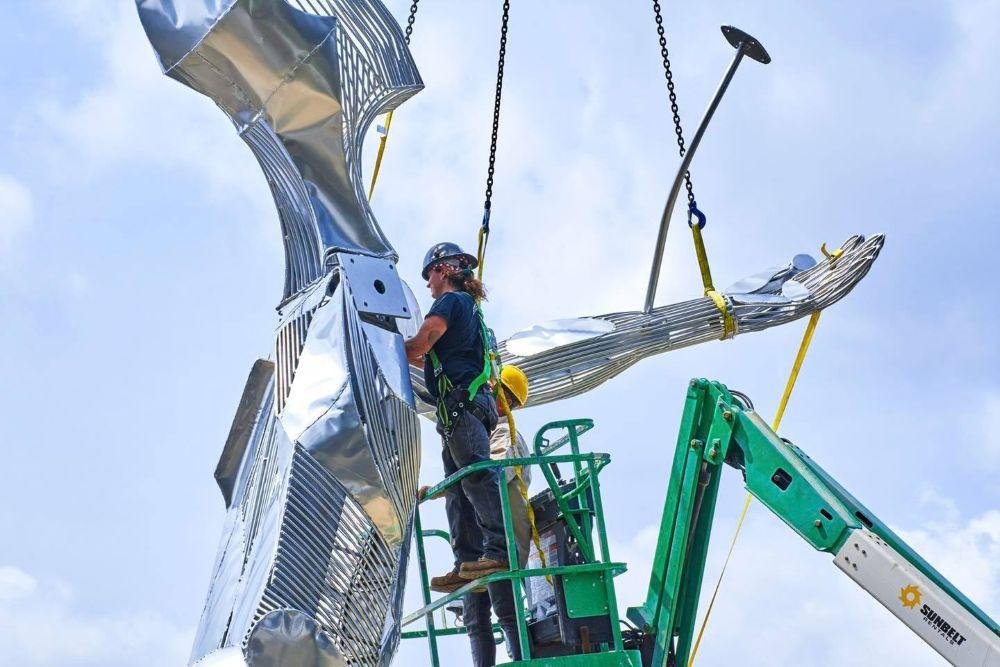
This 30-ft.-tall metal sculpture—which people can walk underneath—depicts Baltimore Colts wide receiver Raymond Berry diving for a ball in midair.
Jack Howard-Potter could have selected any number of moments or players from this game, but the sculptor chose Berry, who caught what was then a championship game record 12 passes and a touchdown for 178 yards, helping the Colts win the game over the New York Giants.
“The ball was welded kind of right in that spot where you’re not quite sure he’s going to catch it. It’s literally in midair,” Howard-Potter said of the sculpture. “I wanted to fill this [sculpture] with an air of uncertainty.”
One of Howard-Potter’s largest, most widely viewed sculptures, it is made from cold-rolled ½-in. steel rods and 20-ga. sheet metal plates and was hot-dip galvanized and powder coated.
The 6,000-lb. cantilevered sculpture—installed just ahead of the 2021 Hall of Fame induction festivities—not only depicts a key NFL moment, but it also demonstrates the New York City-based artist’s fabrication skills and his approach to using metal to depict human body movement.
A Clean Slate
The Berry sculpture comprises six large pieces supported by a large interior armature and stands on a concrete pedestal that is 10 ft. deep. This project required Howard-Potter to work closely with a structural engineer, spending three to four months to devise a structural steel system that could support such a large piece and two months to produce the armature.
“I knew there were engineers and concrete contractors that were going to be helpful in this, but I must say that work took a lot longer than I really thought it was going to,” he said.
Although the sculpture was complex, Howard-Potter said it took just nine months from the contract signing to installation in Canton. For instance, he originally estimated fabrication to take about four months, but it was finished in about half that time.

Jack Howard-Potter’s 30-ft.-tall sculpture honoring wide receiver Raymond Berry is part of “The Eleven” series of walkable art installations in Canton, Ohio.
Howard-Potter has become a fan of using cold-rolled steel rods instead of scrap metal in his artwork, explaining that he likes the idea of his metal having a clean slate—a story that’s yet to be written. The rods also provide him with the bending characteristics he needs to mimic body movement in his work.
“In the cold-rolled steel … you can bend it, and it’ll have this elastic effect where you can bend over a really long area and achieve these long, swooping bends,” he explained. “I do it cold because I can keep them kind of consistent and long and elongated and flowing, and I can mimic the muscular fibers of the muscle.”
When it comes to his fabrication process, Howard-Potter said, “I bend all the forms one at a time, I match them up to where they have to go, I cut them, I weld them. And then this is basically the process over and over and over again over the course of weeks and months to make these huge sculptures. And this is exactly the process I used on the [football] sculpture.”
Capturing Movement
The 50-year-old knew he wanted to be an artist when he was in high school, but it took some time to figure out which medium he wanted to pursue. In college, he welded for the first time and said it “took my breath away.”
A week after his first welding experience, Howard-Potter bought a stick welding machine—and soon after, his first MIG welding machine. At one point, he left New York City to work with a blacksmith in Colorado and learn more about metalworking.
He has since spent his career combining his interests in metal and human anatomy to create small and large pieces depicting human body movement—all while using steel, which isn’t considered kinetic. His artist statement says it best: “I try to capture movement in a medium that does not move.”

One of Howard-Potter’s most recent pieces is “The Lift,” which was installed in Chicago.
[ad_2]
Source link