[ad_1]
Everything in artist Mark Cline’s orbit feels a little larger than life. Even his setbacks carry a certain Herculean weight. In the early days of his creative career, before he became known for sculpting the massive fiberglass figures that now define his work and an American landscape, when he was still trying to carve out a niche for himself, Cline was so broke that he sometimes slept on park benches. Years later, his studio burned to the ground—not once but twice—reducing decades of work to billowing piles of ash.
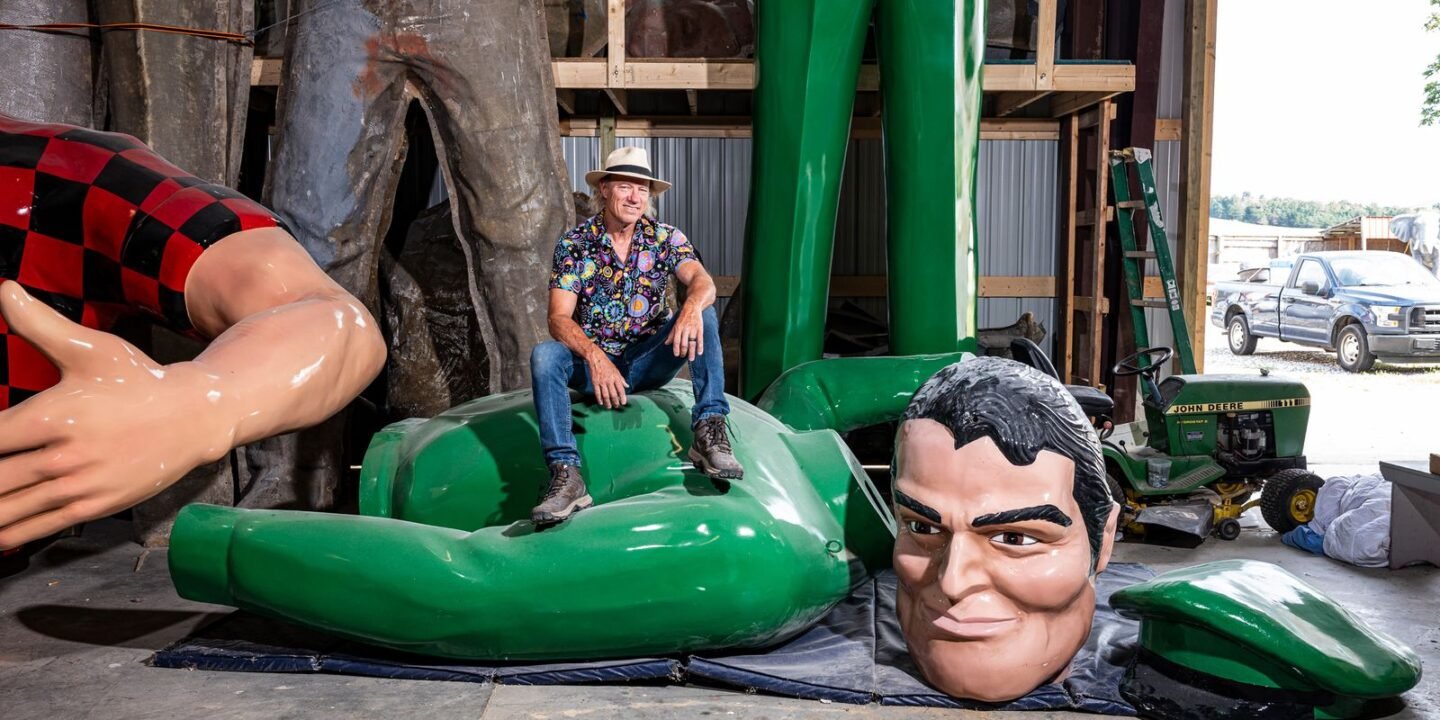
Self-taught artist Mark Cline (pictured in top image), whose background is in sculpture and resin work, started making fiberglass “giants” several decades back. Now his business, Enchanted Castle Studios, which he runs with his wife, Sherry, builds and refurbishes traditional advertising figures, huge dinosaurs, and more, such as Muffler Men (called such because they historically held car mufflers to advertise auto shops) owned by an Ohio collector.
And yet, eventually Cline found his way into a monumental niche: making the oversize fiberglass figures, the iconic “giants,” that dot Route 66. When I arrived at his Enchanted Castle Studios in the fall of last year, set amid rolling farmland 40 miles northeast of Roanoke, Virginia, business was booming and on a triumphant scale. Cline and his two-person team have enough giants looming on the docket to keep them hopping for a while. Both the self-taught sculptor and his towering creations appear to be in the midst of a glorious renaissance. That’s fueled in part by the 2026 centennial of Route 66, known as the Mother Road or the Main Street of America, famous for its role in funneling travelers of many generations cross-country.
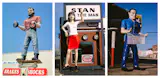
Route 66 celebrates its 100th anniversary this year, sparking a new wave of attention to its iconic kitsch and giant figures, most ranging from 14 to 23 feet tall. From left to right: Tire Man Big Brand tire statue in Van Nuys, California, 1991; Stan the Tire Man statue in Mount Vernon, Illinois, 1988; Tire Man statue in Birmingham, Alabama, 1980.
Highway guardians like this had their heyday in the 1960s, when cross-country road trips ruled and a chorus line of colossal statues sprang up along the nation’s roads, beckoning drivers to stop at local chains, franchises, and mom-and-pop businesses. Among the most popular archetypes of the era was the Muffler Man, with outstretched hands poised to grip an enormous car part; his female counterpart, the Uniroyal Gal, often clad in a bikini and said to have been modeled on First Lady Jackie Kennedy; and a popular variation called Paul Bunyan, a beefy lumberjack whose axe was sometimes swapped for a monstrously large hotdog.
“I’m working on giants seven days a week at the moment,” Cline tells me as we stroll through the property, his phone buzzing often with requests from small-business owners seeking massive pink doughnuts or chicken-drumstick-wielding cowboys.
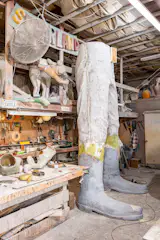
The interior of Enchanted Castle Studios is shared by a workshop and a warehouse, where completed projects like dinosaurs and miniature trains stand alongside molds for unique sculptures Cline has restored over the years.
Part Dr. Frankenstein’s lab, part backstage prop department, the studio is home to three steel hangars, where the magic happens. Inside, the air is heady with the pungent scent of resin, a nostril-stinging, eye-watering haze that clings to my clothes and hair for days afterward. Just beyond the workshop doors is a boneyard scattered with gothic skulls and life-size animals across the grass: elephants and camels lined up two by two as if ascending into some fiberglass ark.
By the mid-1970s, the folk-art craze had begun to fade in the rearview mirror. International Fiberglass, the original manufacturer of said giants, shuttered its operations, and the 1973 oil crisis made transporting these hulking figures prohibitively expensive, along with the price of resin, a petroleum product, rising. One by one, the titans were abandoned, left to deteriorate by the hard shoulder or hidden away in outbuildings across America.
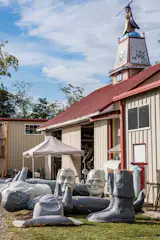
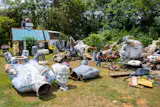
Sanded-down giants wait outside Cline’s studio for their turn to be refurbished.
Then, in the 1990s, Cline got his hands on a 14-foot Muffler Man, from which he created a soda jerk giant. Having started out mixing resin for small-scale figurines at a manufacturing plant straight out of high school, by this point he’d scaled up to crafting oversized curiosities for theme parks and roadside attractions, providing an intimate knowledge of fiberglass as a medium. “I made a mold of it to create more,” he says of his first Route 66 character, “but to be honest, I didn’t give it too much thought. This was before the Muffler Man revival had really taken off.”
The real turning point, Cline reflects, came as recently as 2018, when Mary Beth Babcock, owner of Buck Atom’s Cosmic Curios on Route 66 in Tulsa, Oklahoma, reached out with a very specific request: She wanted a Muffler Man mascot, high as a two-story house, but this time wearing a 10-gallon hat and clutching a shiny atomic age rocket.
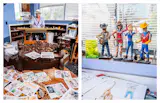
The figurines on his desk of Cowboy Bob, Stella Atom, Rosie the Riveter, and Buck Atom are miniatures of figures he made for Buck Atom’s Cosmic Curios on Route 66, a tourist attraction owned by Mary Beth Babcock that opened in 2018.
“Buck Atom helped spark the revival,” Cline says, the brim of a straw hat shading his eyes. “People were used to seeing a cowboy or an ice cream guy, but this one had been seriously tweaked; it took things to a new dimension and showed the possibilities.” He pauses, then adds, “Mary Beth had a big hand in designing it. I think these giants are really just extensions of the people who commission them.”
Today, Enchanted Castle Studios is much in demand, given that, as far as Cline knows, it is one of only two fiberglass studios in the country still crafting these mighty midcentury icons and the only one offering such a bespoke service. With revitalization grants flowing in for the Route 66 anniversary, Cline estimates that 20 of his creations now stand proudly along the Mother Road’s 2,448 miles, with more on the way.
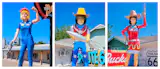
Left to right: “Rosie the Riveter,” “Buck Atoms,” and “Stella,” installed at Buck Atom’s Cosmic Curios on 66 in Tulsa, Oklahoma.
He speaks of them with an affection more commonly reserved for eccentric relatives. “Big Ron in Springfield, Illinois, is the tallest I’ve made. He’s almost thirty feet, with his arms stretched up in the air,” he marvels fondly. “I also did an Uncle Sam character in Uranus, Missouri, who lost his head when a tornado smacked right into him on April Fool’s Day. You couldn’t write it!”
Cline has had a side hustle as a Mick Jagger impersonator since the 1980s, “back when we both looked good in spandex,” he quips. Ever the showman, he makes frequent outfit changes during my visit and reappears in a paint-streaked T-shirt and star-spangled bandana for this afternoon’s task: assembling the dismembered body parts of a cowboy lurking in the shadows of his workshop. As a tub of resin heats nearby, he notes that very little has changed in the construction of the giants since their golden age. “We now add metal frames to the feet and legs to help them withstand extreme weather, especially out in the Tornado Corridor. And the fiberglass is stronger now. But essentially, it’s the same process.” Unlike the neon signs from this time period, which have now mostly been replaced with LED replicas, these giants are perhaps some of the last true relics of the old Route 66.
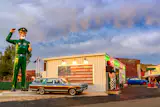
This sculpture of Big A, a Texaco Big Friend Muffler Man, is located at Gearhead Curios, a restored gas station that’s now a tourist attraction in Galena, Kansas. It’s named and modeled after owner Aaron Perry and was completed in 2024.
Cline climbs through the neck of his cowboy figure, disappearing into its hollow belly like Jonah being gulped down whole by the whale. Inside the cavernous shell, Cline curls up, almost fetal, as he smears dripping, warm filler to bond the statue’s torso and legs together. It’s dirty work, Cline is quick to acknowledge, once he’s reemerged from the cowboy’s throat. This is perhaps why he’s struggled to find a protégé to hand the reins over to once the 65-year-old eventually retires.
“I’m like Willy Wonka looking for my Charlie,” Cline muses, shaking off the splatters and standing before a cast of his creations, including a life-size statue of Elvis Presley, curling lip and all. “Dust gets everywhere and is hard to scrub off the skin. It’s a lot of physical work.”
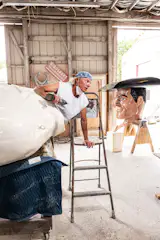
“Zack, the Phillips 66 Cowboy,” of Giants Garage in Hot Springs, Arkansas, being refurbished in Mark Cline’s studio in Natural Bridge, Virginia.
While Enchanted Castle Studios is usually closed to the public, Cline does open up this wonderland for weekend-long sculpture-making workshops. It’s here that he hopes to find the next generation of apprentices to keep this endangered art form alive. “It would be nice to find someone who can take over the business within my class. In a way, I’m searching for that special someone, and the students are also searching for something by attending. There’s a hope that we’ll find each other.”
“I can’t teach someone to be an artist. I can just teach the techniques and they have to do the rest of it.”
—Mark Cline
With Route 66’s birthday putting the spotlight back on its curbside quirk, Cline reflects on why these cartoonish juggernauts still roam the collective imagination. “They’re performing the same function as in the midcentury. Their primary job is to get people to turn their steering wheel and pull into your parking lot.” And for him, the allure of these molded warriors remains the same as when he gazed up at these big models as a small child. “My work is all about the healing power of joy. Because I’ve now got hundreds of pieces dotted around the world; right now as we speak, there’s someone looking at one of my giants, laughing with their family, and enjoying themselves.”
Cline, seen here refurbishing Zack, a Phillips 66 Cowboy, which is usually at Giants Garage in Hot Springs, Arkansas, says there are differences between the historic giants, which were typically advertisements for large companies, and the new ones. While all are made from molds (which Cline has had to remake himself by copying the existing figures), “the ones that they built years ago are not as thick as the ones I build. They mass-produced them. Some of them held up really well. Others did not.”
Cut to a few days later, and I’m doing exactly that: standing on 11th Street, a stretch of Route 66 in Tulsa, craning my neck backward to admire Cline’s 21-foot masterpiece Cowboy Bob. He’s the latest commission for Babcock, who owns a handful of hip businesses in the Meadow Gold District. While other entrepreneurs might invest in blue-chip art, Babcock’s high dollar habit, it seems, is collecting Route 66 giants, as made clear by the gaggle of five statues surrounding us.
They’re part of a broader urban revival in Meadow Gold, a neighborhood that—like much of Route 66 itself—fell into decline after the highway was decommissioned in the 1980s. In recent years, however, this once-forgotten stretch has seen its derelict warehouses and auto shops reimagined as vintage Western boutiques, maker markets, and art galleries. Thanks to Cline’s highway heroes, the area has earned a new nickname: the Land of the Giants.
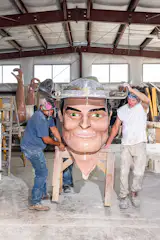
“Now almost everybody wants them tweaked,” he explains of the new sculptures he’s working on, which are physically demanding to produce. “They want their own individual figure, of course. And they want a big hand in helping to design it. So it’s an extension of themselves.”
As we linger in the shadow of Cowboy Bob—who weighs roughly the same as a sumo wrestler—Babcock reflects on the emotional reach of these statues, which she sees as more than just economic catalysts. “There’s something deeper going on here,” she says, nodding. “I remember visiting my grandmother in Oklahoma’s Panhandle as a kid, a beautiful place with horned toads and tumbleweeds rolling by. There was a water station shaped like a giant pink elephant, and it left such a strong impression on me.”
She hopes today’s children will experience that same spark of wonder when they look up at her statues—particularly her Rosie the Riveter, a figure she hopes will inspire girls to see themselves as strong, capable, and worthy of towering tributes. But more broadly, her aim is a simple one. “With all the heavy things going on in the world,” she says, “I hope people can pause, even for a minute, and just smile.”
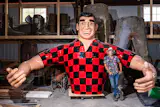
Cline credits his friend Joel Baker, a Muffler Men documentarian, for bringing attention back to the art form, as well as social media. “There are people that travel hundreds of miles just to be photographed with these giants,” he says. “I don’t know of any other way that would have spread so rapidly.”
[ad_2]
Source link