[ad_1]
The Brooklyn Museum has just opened Iris van Herpen: Sculpting the Senses — and it does something fashion rarely achieves: it stops you cold. Not because of trend or spectacle, but because of genuine wonder.
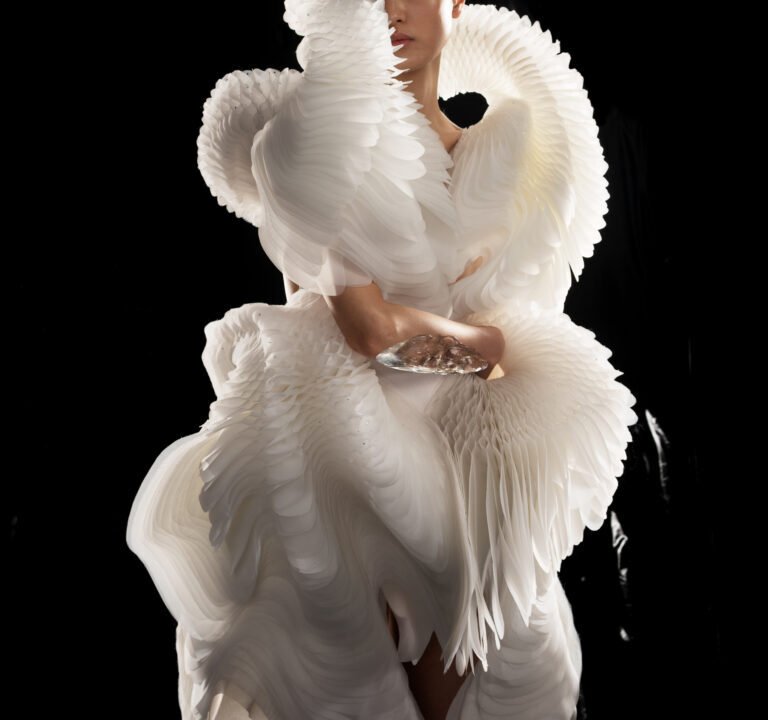
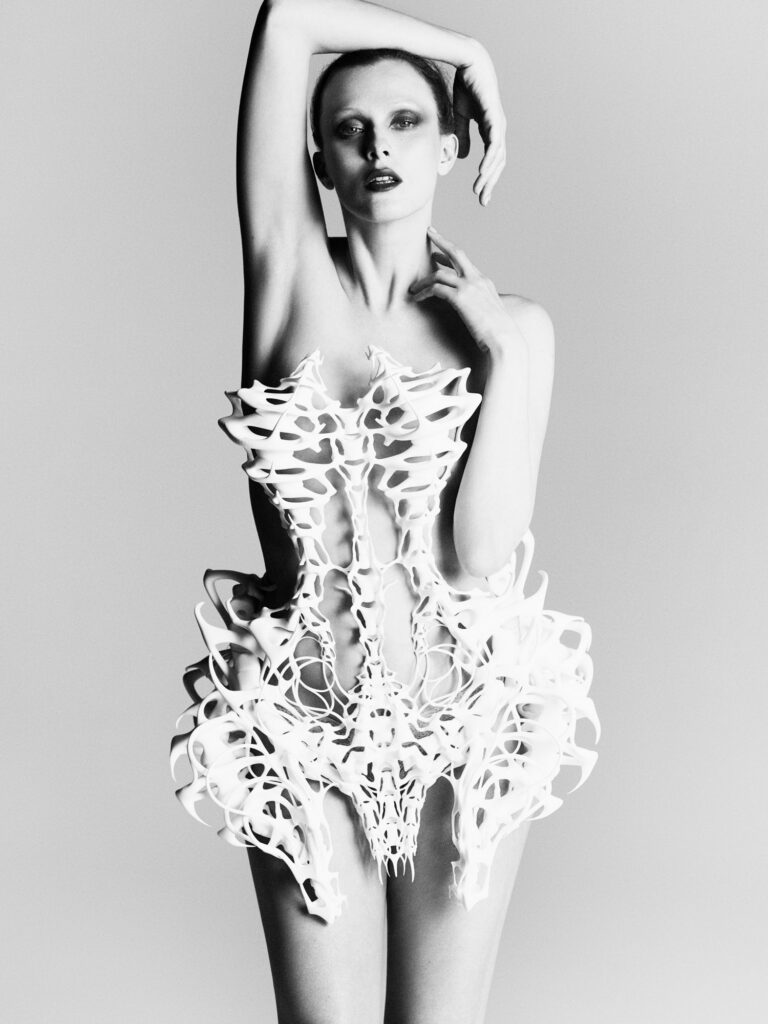
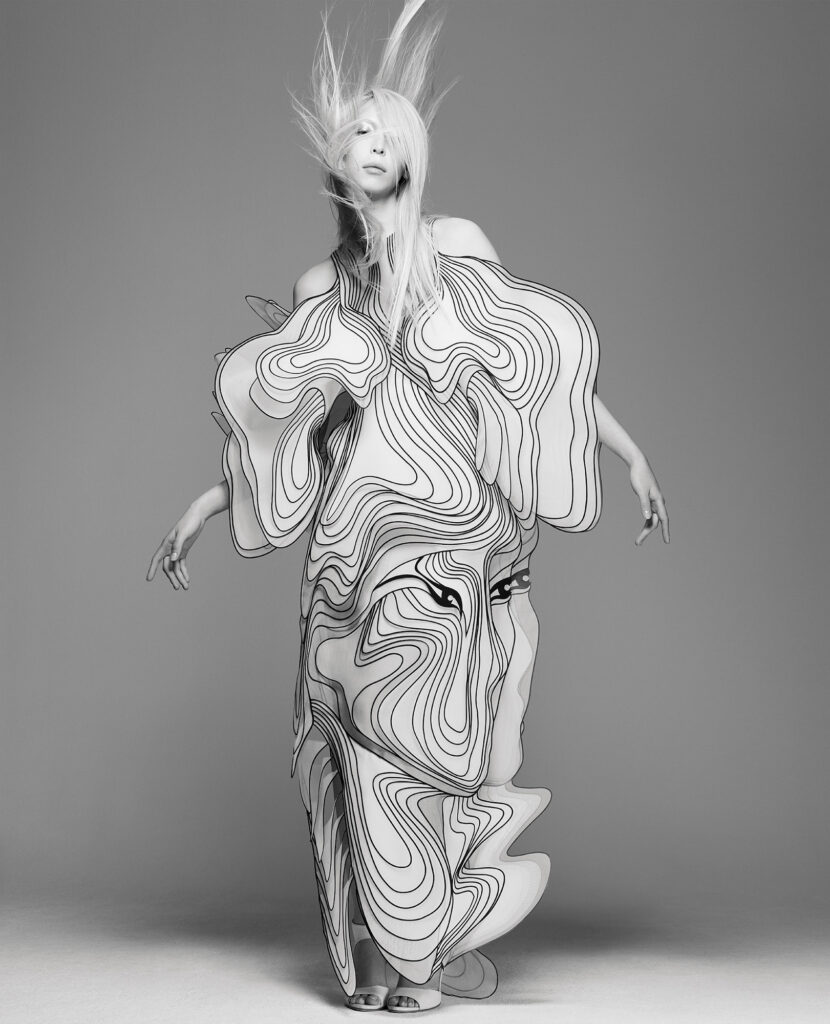
Van Herpen’s haute couture doesn’t dress the body — it transforms it. Gowns grown from fractal geometry, biomimicry, and neuroscience feel less like clothing and more like something discovered, not designed. To stand in front of one of her pieces is to feel the categories dissolve. Is this fashion? Sculpture? Biology made wearable? The answer, characteristically, is all of the above and none of them exactly.
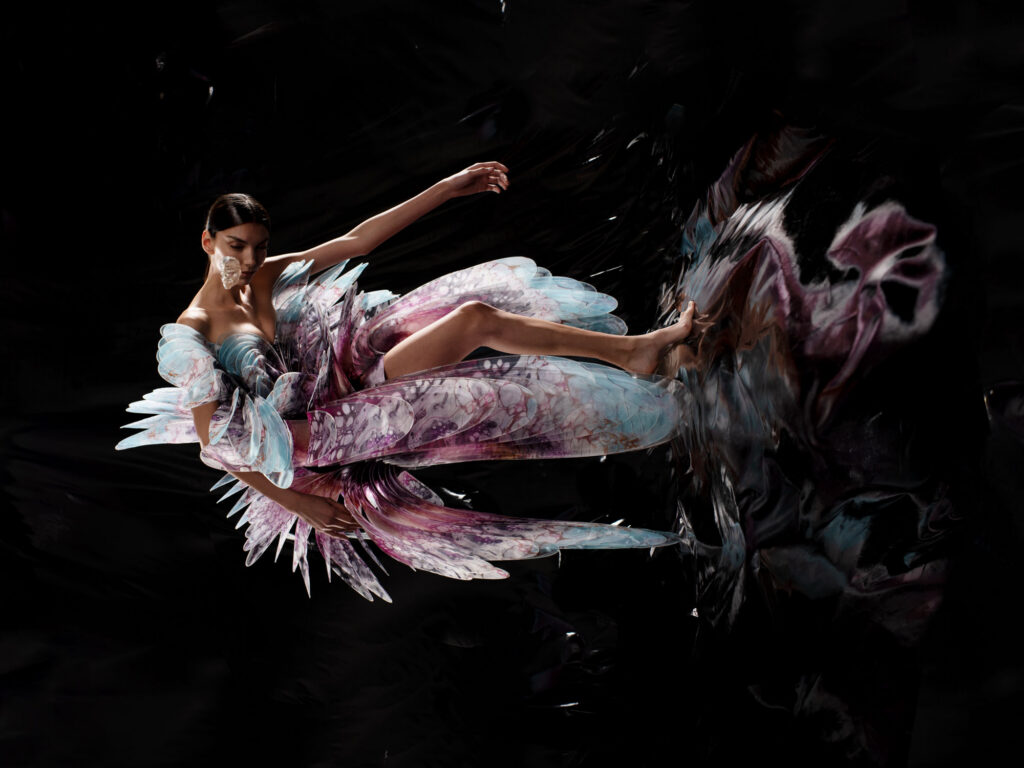
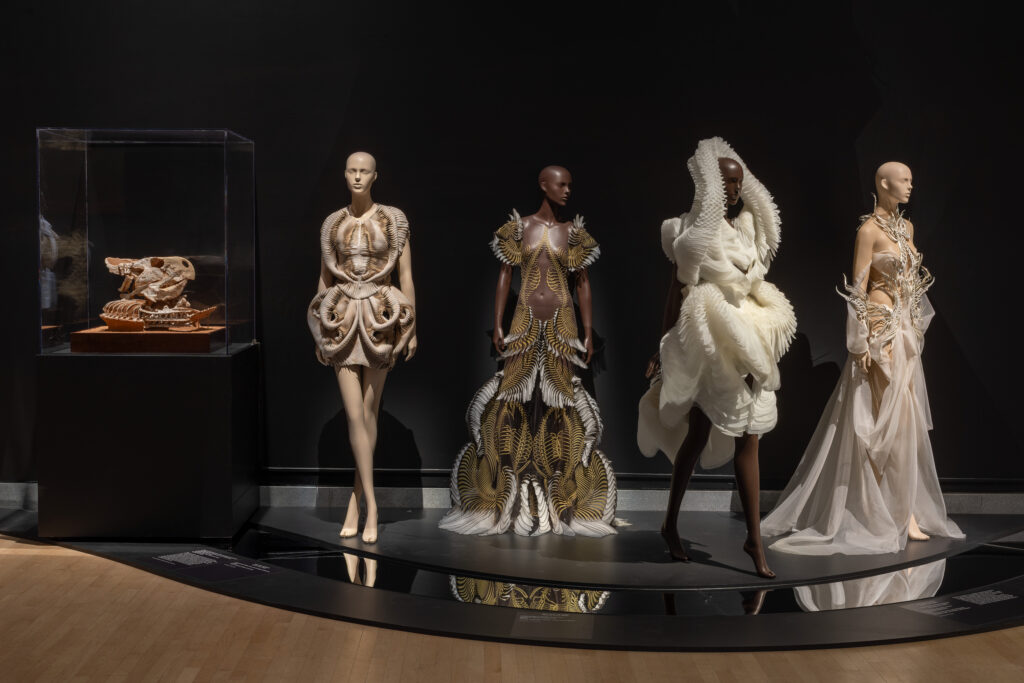
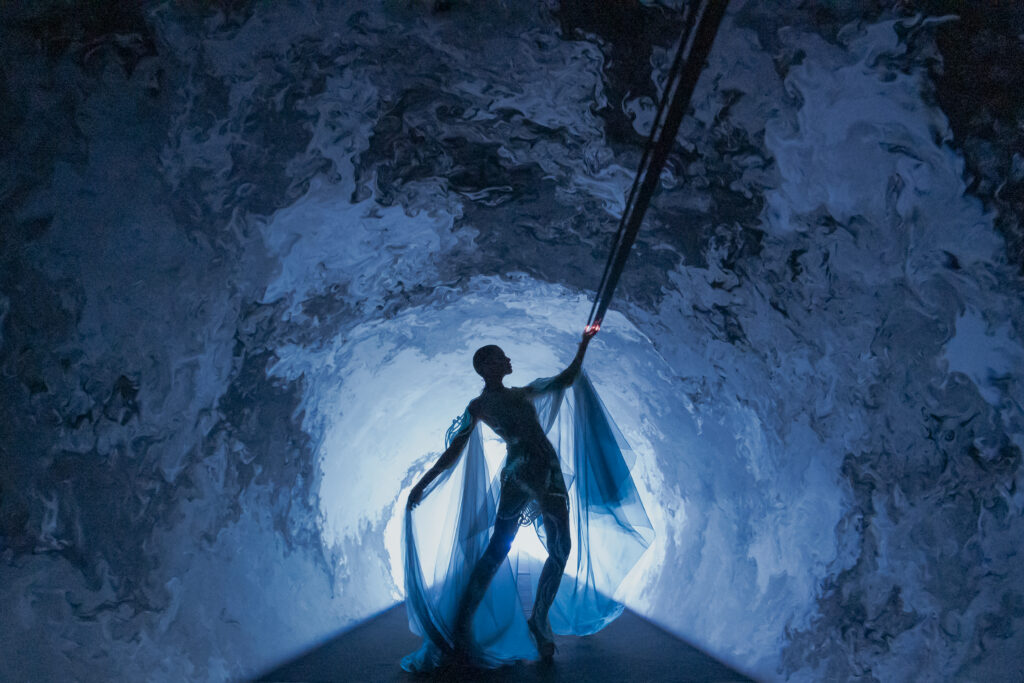
Sculpting the Senses arrives at the Brooklyn Museum as its North American debut — a global sensation that has already moved through Paris’s Musée des Arts Décoratifs, Brisbane, Singapore, and Rotterdam, gathering momentum at each stop and arriving here at what feels like precisely the right cultural moment. More than 140 extraordinary couture pieces appear alongside coral specimens, fossils, and living sculptures — the natural world not as backdrop, but as co-author. Immersive works by Philip Beesley, Tara Donovan, and Wim Delvoye surround them. A soundscape by Salvador Breed turns the gallery into something you don’t just see; you feel it — in the chest, in the peripheral vision, in whatever part of the body responds to beauty before the brain has a chance to name it.
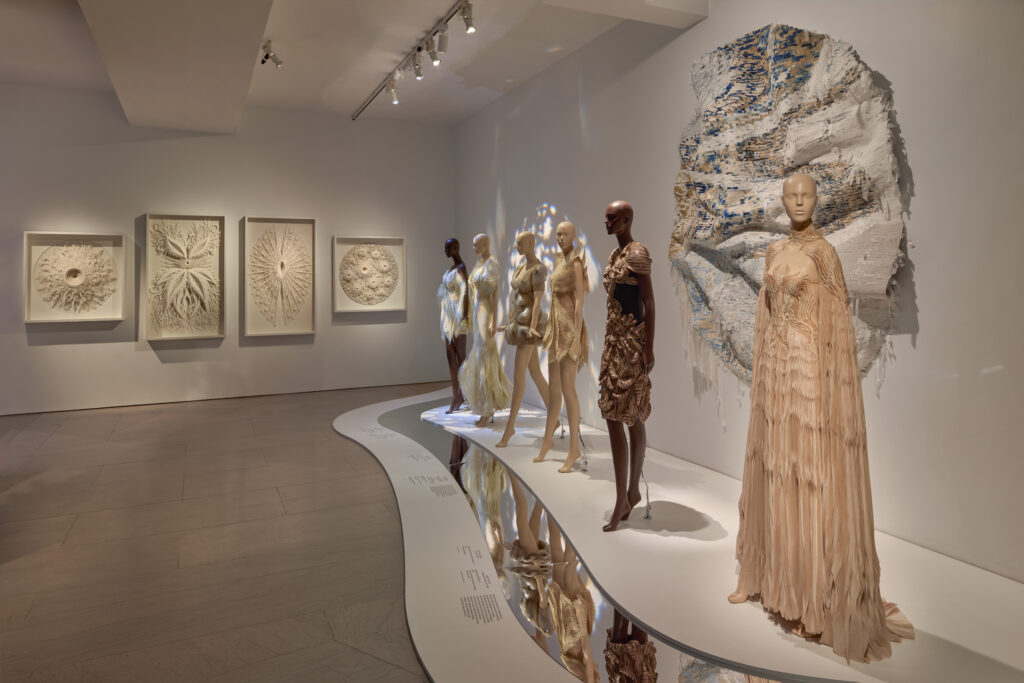
The show is a convergence of fashion, science, and the living world that feels less like an exhibition than a living organism — couture breathing in dialogue with science, sound, and the natural world. Van Herpen continues to experiment with sculptural draping and hand-manipulated textile techniques that allow fabrics to form organically, often resulting in textures that resemble fossils, marine life, or living matter rather than conventional couture construction. That sense of evolution extends even to Van Herpen’s relationship with color. “The first 10 years of my work, I hardly used color,” she says. “Then slowly, I started working with it — and it became this beautiful explosion, this dancing relationship with color.”
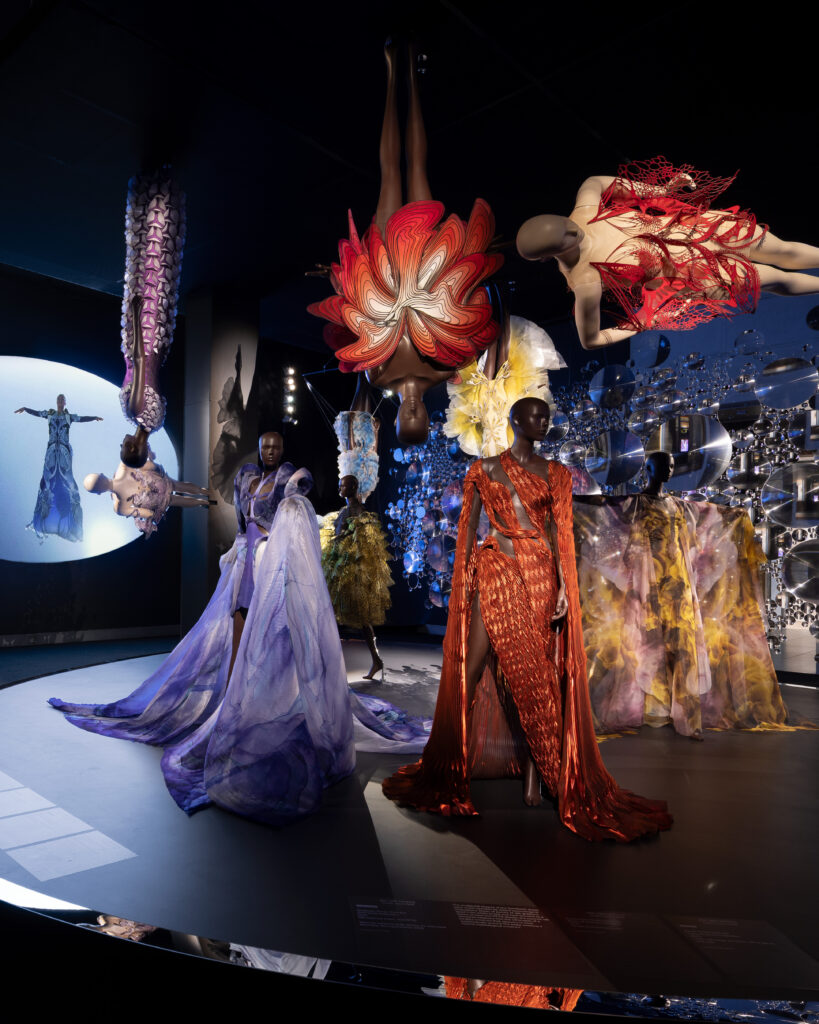
The names who wear her work tell their own story: Beyoncé. Björk. Cate Blanchett. Miley Cyrus. Lady Gaga. Ariana Grande. What connects them is not taste alone, but authorship. These are women who reach for Van Herpen not for decoration, but transformation. When the moment demands something beyond fashion — something closer to performance, sculpture, or myth. These are not outfits in the conventional sense; they’re declarations, chosen when the moment is cultural rather than merely ceremonial.
The exhibition itself will continue evolving throughout its New York run. Van Herpen plans to create a new look live during the exhibition, periodically returning to work from within the museum itself — transforming the atelier into part of the performance. “I want people to intuitively join me,” she says. “Not through announcement, but through discovery.”
Ahead of the exhibition’s New York debut, we spoke with Van Herpen about intuition, biomimicry, and what it means to create clothing that thinks.
by Gio Staiano
Scott Drevnig: Your work draws so deeply from the natural world — coral, mycelium, fluid dynamics. Do you think of yourself as a fashion designer, or something else entirely? Has that label ever felt limiting?
Iris van Herpen: That question really touches the core of how I think. I’m not thinking in terms of disciplines. I think fashion relates to art, to architecture, to science, to philosophy, to nature, of course. And I don’t think in boxes. I think of fashion being fluid and I can be in between all of these disciplines at the same time.
SD: The women who wear your pieces — Lady Gaga, Beyoncé, Cate Blanchett — seem to choose them for cultural and artistic moments as much as aesthetic ones. What do you think they’re communicating when they put on one of your gowns? And does that weight of meaning affect how you design?
IvH: It’s different when it’s women that I work for directly. I always work for the special moments that are very public, but there are also women that acquire a work for more private experiences — and even for a combination of embodying the work and exhibiting it in their homes. The work lives in between the world of art and fashion, and it can be experienced in different ways. The women on the red carpets are expressing themselves at very special moments, and they always come to me with a story — about what is in their minds. I love expressing a story that someone wants to embody in my work, because I see each piece as a portrait. When someone comes to me with their inspirations and their story, I translate that into materiality. That is really the point where I fall in love with that person at that moment.
SD: Neuroscience, biomimicry, fractal geometry — your process reads like a research lab as much as an atelier. Where does the science end and the intuition begin? Is there even a boundary?
IvH: In my work, intuition and science are constantly dancing together. I move fluidly in between them. I do my research — I go to scientists to collaborate with — and as part of that whole process, intuition is always present. Even the decisions about who I work with, and the way I translate that into materials, are all based on intuition. Intuition is a very elementary part of my process that I always protect, from the beginning until the end
Iris van Herpen: Sculpting the Senses Brooklyn Museum · Now through December 6, 2026 Featuring 140+ couture pieces alongside works by Philip Beesley, Tara Donovan, Rob Wynne, Kim Keever and Wim Delvoye, with a soundscape by Salvador Breed.
[ad_2]
Source link