[ad_1]

Discover Uzbekistan’s rich art and culture with our guide to the country’s most inspiring artistic spots.
Uzbekistan is celebrated for its turquoise domes, labyrinthine medinas, and legendary hospitality. This jewel of Central Asia boasts a history stretching back to Alexander the Great and the Timurid Empire. For me, the trip was fuelled by a fascination with its artistic legacy. Beyond monuments and madrassas, I hoped to uncover a treasure of handicrafts shaped by history, identity, and tradition. I imagined Silk Road caravans carrying silk, spices, and metals through Samarkand, Bukhara, Khiva, and Kokand, bringing ideas, styles, and techniques from Persia, India, China, and beyond.
Above all, I was curious to trace Uzbekistan’s echoes in India — the miniature paintings of Mughal courts, the textiles and embroideries that connected two lands across centuries. Walking through bazaars and ateliers, I discovered more than I had imagined: live demonstrations, home-museums that took me behind the scenes, and hands-on experiences that offered a taste of the real deal. What thrilled me even more was seeing how museums, craft schools, and local artisans continue to nurture these traditions for new generations. Here are my recommendations for the top three experiences to dive into Uzbekistan’s art & craft.
Uzbekistan’s art & crafts: Suzani
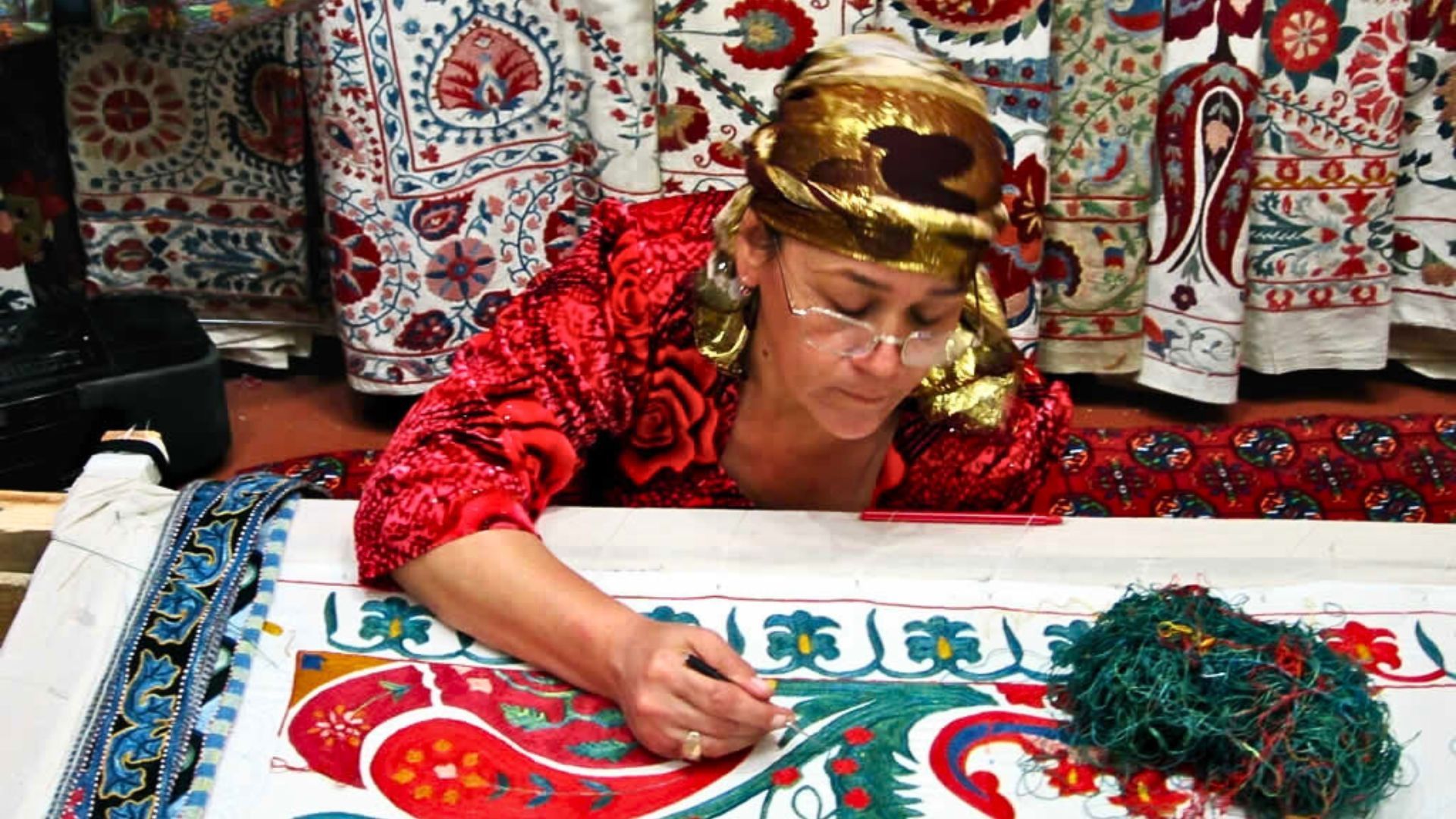
I was keen to learn about Suzani embroidery (from the Persian suzan, meaning needle), one of Uzbekistan’s most intricate traditional arts. Historically, these textiles wrapped belongings in nomadic yurts, served as bedding or prayer mats, and were regarded as treasured dowry pieces. It was intriguing to learn that, even today, learning embroidery from mothers and grandmothers is a cherished cultural ritual for girls in the country. So how could I pass up the chance to visit master embroiderer Madina Kasimbayeva’s workshop in Suzukota Craftsmen Town in Tashkent?
For over two decades, the UNESCO Award-winning artist been reviving and reinventing the Tashkent school of Suzani. Her atelier employs over 100 women and has trained nearly 1,000 apprentices, many of whom now run their own workshops across Uzbekistan. The tour was an eye-opener in more ways than one.
The large decorative textiles are made from cotton or silk and are hand-embroidered with silk threads. Motifs dripped symbolism: pomegranates for fertility, sun and moon disks for life-giving energy, pepperpods to protect against the evil eye, and the Tree of Life linking heaven and earth. Artisan women worked side by side on taut fabrics stretched across low wooden frames, filling sunbursts, tracing curling vines, and shaping rosettes. From chapans and wall tapestries to cushions and even embroidered furniture, the displays made me realise how Suzani has evolved from a heritage craft into a vibrant element of contemporary design.
Uzbekistan’s art & crafts: Miniature painting
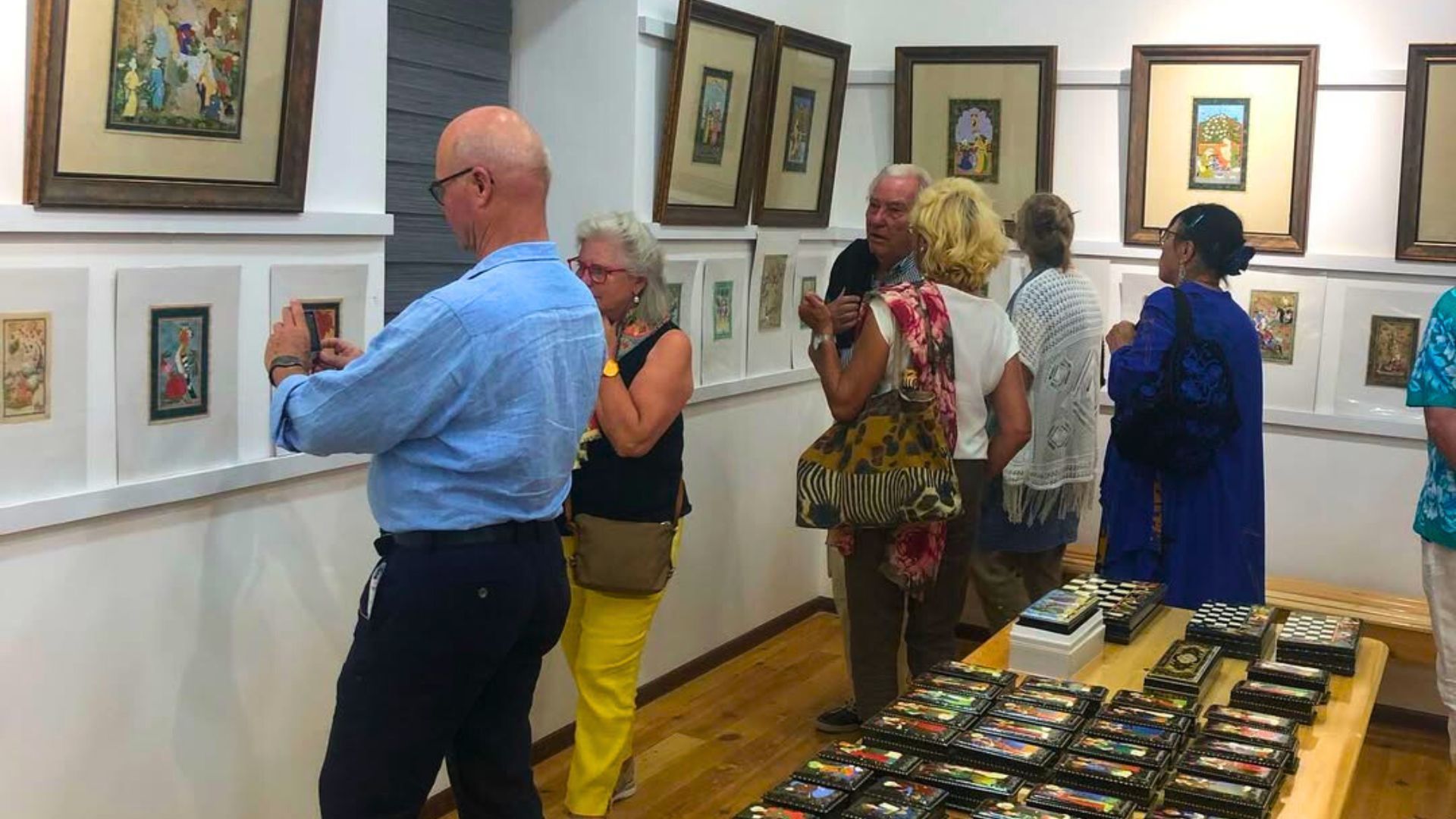
On our first evening in Bukhara, we had the privilege of meeting Davlat Toshev, a seventh-generation master miniaturist from a family long associated with Bukhara’s Eastern school of painting. His atelier, Ustoz-Shogird, which serves as a gallery, studio, and classroom, is open to both students and visitors. Inside, walls are lined with his manuscripts, framed miniatures, and awards — including recognition from international exhibitions such as the Louvre in 2023. Toshev is widely respected for restoring ancient manuscripts and creating new miniature paintings, sometimes working on centuries-old sheets of silk paper. He also trains young artists and even children with special needs, ensuring the continuity of a rare, ancient Uzbek craft. Wandering through the workshop’s rooms, I learn that every element of miniature painting is handcrafted. Pigments are ground from natural materials — lapis lazuli for blue, malachite for green, vermilion for red, saffron for gold.
Did you know?
The city of Bukhara is a historic centre for zardozi, a luxurious, intricate style of gold-thread embroidery historically reserved for royalty.
Brushes are so fine that they are made from single hairs. The compositions feel lyrical, almost meditative: courtly gatherings of poets and sages, pomegranate gardens, birds carrying messages across imagined landscapes. Entire cosmologies unfold within frames no larger than a postcard. Toshev explained that miniature painting originated from royal manuscripts and was elevated to a fine art in Bukhara’s historic kitabkhanas by painters, calligraphers, gilders, and poets. A collaborative art of intellect and imagination. But the most unexpected revelation came in our conversation, when he mentioned that his ancestors had their roots in Agra, where they had worked for the Mughal courts.
Enjoy a modern-day journey through the Silk Road with our guide to Kyrgyzstan and Uzbekistan.
Uzbekistan’s art & crafts: Ceramics
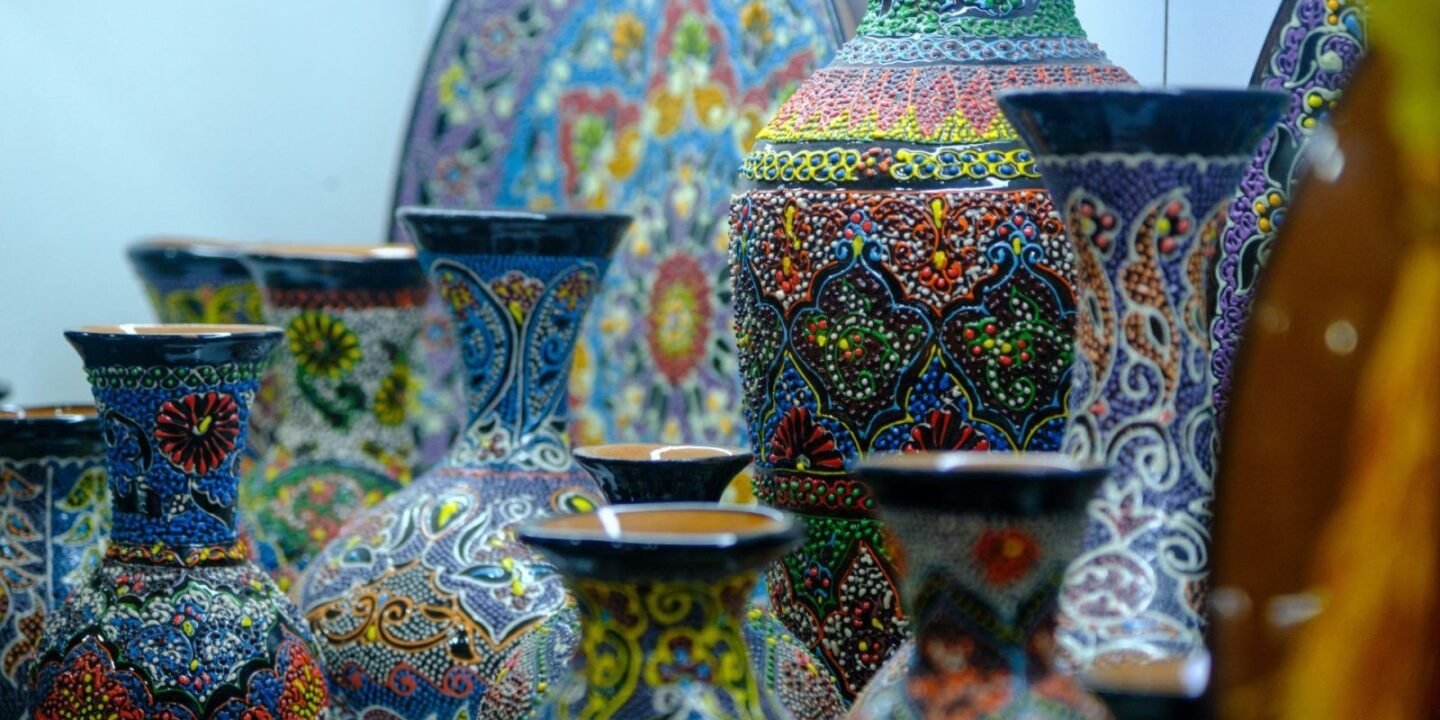
A 46-kilometre drive from Bukhara brought us to Gijduvan, the centre of Uzbekistan’s ceramic heritage. Our destination was the house-workshop of the Narzullaev family of ceramists, heirs to a craft that once adorned caravanserais, madrasas, and palace walls along the Silk Road. Their workshop continues a lineage of hand-thrown pottery and hand-painted glazing using techniques passed down through generations. Behind a modest doorway, a courtyard led us into a working home. All around, there were shelves stacked with bowls and plates in vivid blues and greens. An earthy scent of wet clay hung in the air. In a far corner, they showed me a clay kiln, where painted vessels are stacked, sealed, and fired for hours to fix the mineral colours forever.
Inside one room, potters worked at wheels, shaping vessels with practised hands. They invited me to try. I sat at the wheel, holding the mound of spinning clay with tentative hands. The form wobbled and caved in. We laughed together at the clumsy attempt. Gijduvan ceramics, I learned, are distinct from those of Rishtan or Khorezm — thick-walled yet surprisingly light, painted in shades of brown and yellow with blurred geometric patterns in dark green and blue. Sunbursts, almond leaves, stylised flowers, and protective eyes repeat across the surfaces. Then came a final tip: look for the frozen glaze drops on the rims, formed during firing. By the time I left, I knew I could recognise Gijduvan ceramics anywhere.
Shop the best travel experiences here
Preservation efforts
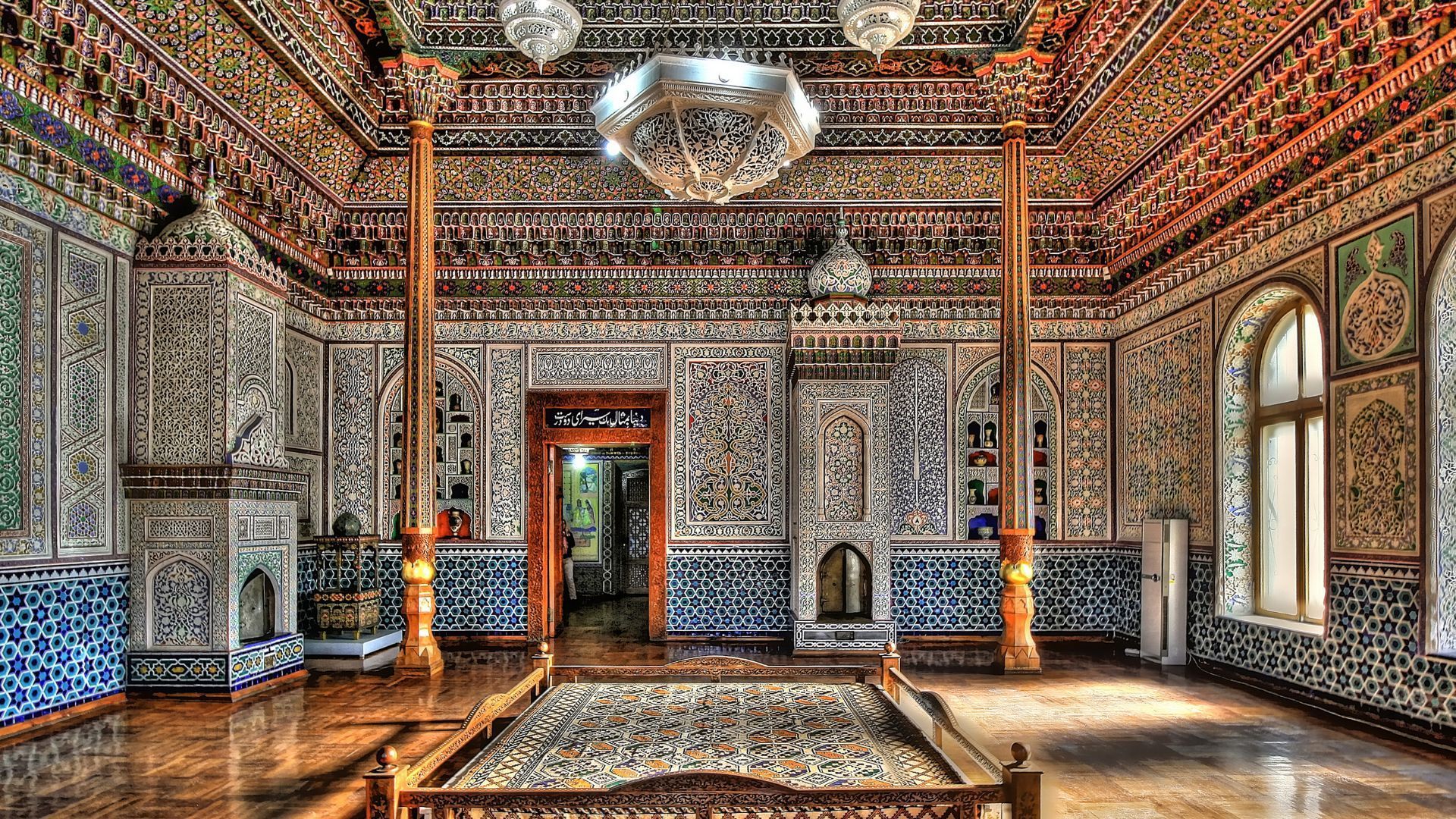
In countries like Uzbekistan, traditional crafts are rooted in inheritance. Skills are passed down from one generation to the next to keep centuries-old knowledge alive in daily life. In recent years, this continuity has gained new visibility through initiatives by museums, such as the State Museum of Applied Art and Handicrafts, craft schools, and independent ateliers.
Did you know?
The city of Rishtan in Uzbekistan is famous for its distinct, bright blue-green glazed pottery.
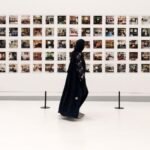
In 2025, the first edition of the Bukhara Biennale brought local craft traditions into dialogue with contemporary art from around the world, placing Uzbekistan’s living heritage on an international cultural stage. As visitors, we can help these arts thrive by attending workshops, shopping at local markets, participating in craft experiences, and supporting artisans.
Also read | What Drives Young Travellers Today? Our Editors Trace The Trends
Insider tips
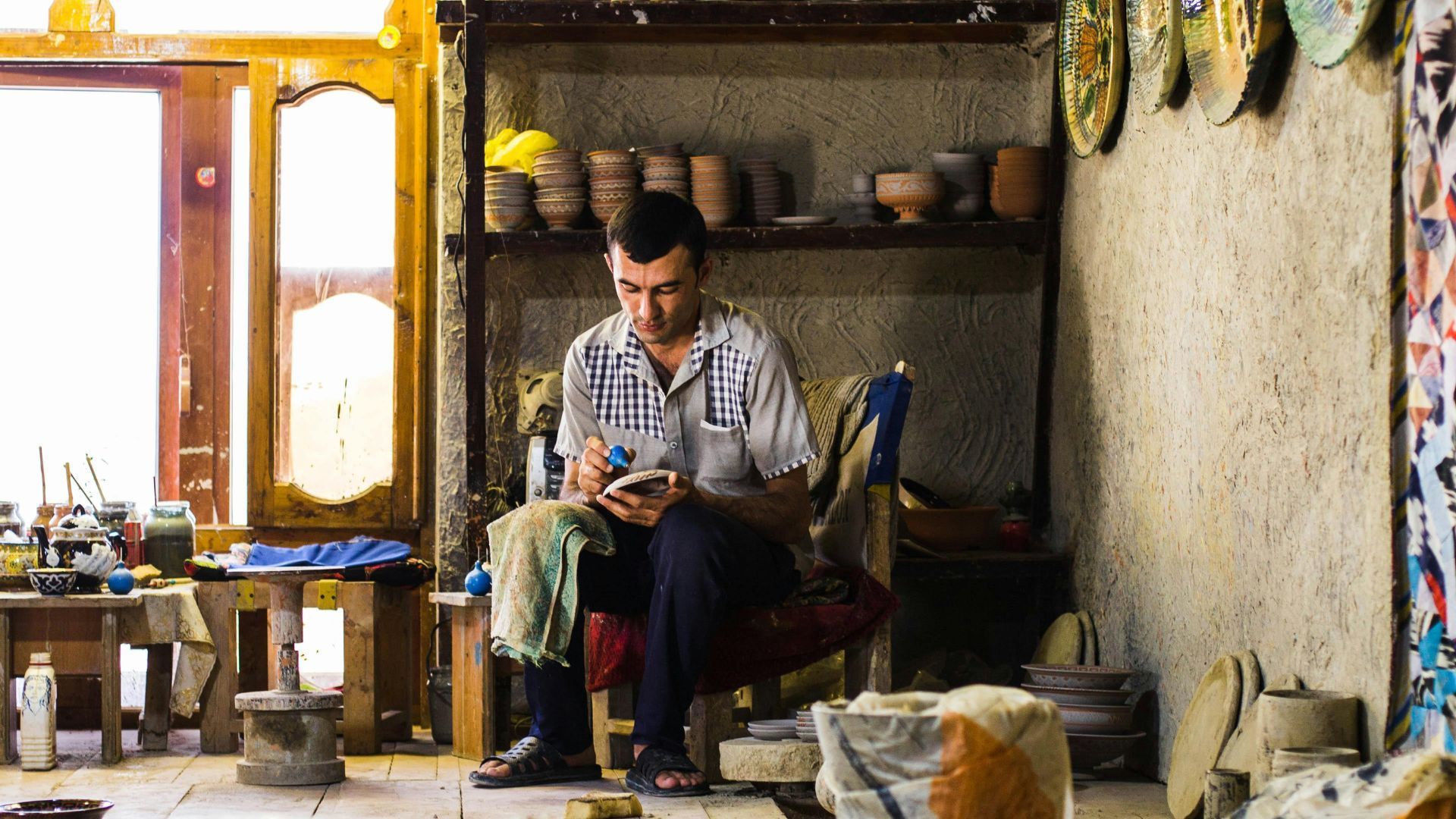
- In bazaars such as Chorsu in Tashkent, Siyob in Samarkand, or Toki Zargaron in Bukhara, you can see crafts on display and speak directly with makers.
- If you want to experience Uzbekistan’s art and crafts, consider booking a workshop in a local artisan’s home, whether it is Suzani embroidery, miniature painting, or hand-thrown ceramics.
- Hands-on experiences like these allow you to take home not just a souvenir, but a deeper connection with the country’s artistic heritage.
(Feature Image credit: Far Chinberdiev/Unsplash)
Related | Uzbekistan Itinerary: Tracing The Silk Road From Tashkent To Khiva
Note:
The information in this article is accurate as of the date of publication.
We may earn an affiliate commission when you shop through links on our site.
FAQs (Frequently Asked Questions)
Which are the most famous of Uzbekistan’s art and craft
Ceramics, textiles, and miniature painting are the most famous traditional crafts of Uzbekistan.
Where can visitors buy authentic handmade souvenirs in Uzbekistan?
The best places to buy Uzbekistan’s art and craft are artisan workshops and historic bazaars in Samarkand, Bukhara, Khiva, and Tashkent.
Which cities are best known for local artisans and workshops?
Rishtan is famed for ceramics, Margilan for silk weaving, Bukhara for embroidery and miniature painting, and Khiva for wood and metal crafts.
What is Suzani embroidery, and where is it made?
Suzani is a hand-embroidered textile art featuring symbolic floral and sun motifs, traditionally produced in Bukhara, Samarkand, and Shakhrisabz.
How is Rishtan pottery different from other ceramics?
Rishtan pottery uses natural mineral glazes that create its signature turquoise and cobalt hues, all hand-thrown and painted in family workshops.
Can tourists take part in Uzbekistan’s art & craft workshops?
Many artisan studios in Samarkand, Bukhara, Margilan, and Rishtan offer short hands-on sessions for visitors.
What kind of silk products are produced in Margilan?
Margilan weavers produce handwoven ikat silks used for scarves, garments, cushion covers, and wall textiles.
How are traditional Uzbek carpets made?
Traditional Uzbek carpets are hand-knotted on vertical looms using naturally dyed wool, forming bold geometric and medallion patterns.
What materials and techniques define Uzbek metalwork and jewellery?
Uzbek craftsmen work in silver, copper, and brass, using engraving, repoussé, and stone inlay with turquoise or carnelian.
Are there any art festivals or craft fairs in Uzbekistan worth attending?
The Bukhara Biennale and regional craft fairs showcase master artisans, demonstrations, and exhibitions.

Written By
Punita Malhotra
Punita shifted gears from a career in entrepreneurship and publishing to live her dream of travel and ..Read More
[ad_2]
Source link