Marrakech – Director Lahsen El Bouhali has emphasized the driving philosophy at the heart of the Festival d’Art Digital (FAD) 2025, held in Khouribga. The purpose behind the gathering is to create a space where technology is a cultural engine and artistic medium that pushes Morocco’s creative industries toward new horizons.
In comments to Morocco World News (MWN), Lahsen El Bouhali, head of educational, artistic, and cultural affairs at the 1337 schools, explained that the Festival of Digital Art (FAD) is more than a showcase. For him, it’s a strategic national effort.
The initiative rests on two core pillars, he detailed. The first is economic: creative and cultural industries have become essential drivers of global economies.
The second is accessibility, El Bouhali told MWN, stressing: “Digital art is an emerging field, and therefore everyone is on equal footing in this sector, developed countries, developing countries, and less developed countries alike.”
In his view, the people behind the code are fundamental to this ecosystem. “As coders, as technology experts, they form a very important link in the value chain of this industry. That is why we created this festival,” he added.
Inside Heirloom’s Moroccan metaverse
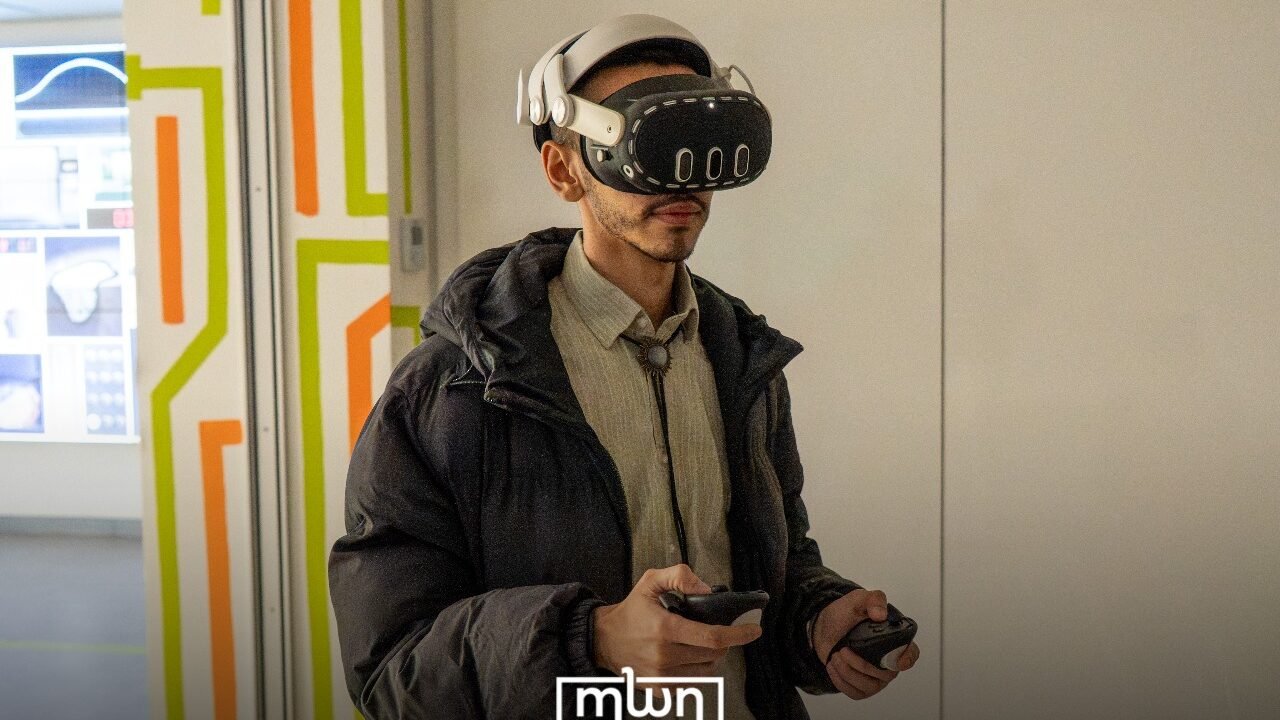
Within this vision, visual artist and VR developer Mohamed Adam Charai, known as Heirloom, builds worlds from memory. As he takes part in FAD 2025, he stands before a digital landscape shaped by objects that feel like home to every Moroccan.
“We all grew up in Moroccan homes… So I wanted to make something nostalgic that my generation can relate to, which is Tabsil Taws (Taws plate). We all had one in our homes.”
At 1337 Khouribga, Heirloom works with teams of 3D artists and developers pushing innovation into practical fields.
“We have a team of 3D artists and another team of developers who use game engines like Unity… Sometimes we build VR simulations that show workers risks inside factories,” he said.
These virtual environments help train workers more safely, reducing real-life hazards before they ever step onto the factory floor.
From Japan to Morocco
For digital artist Naoyuki Tanaka, robotics becomes a language of performance. His extended stay in Benguerir has opened space for experimentation and cross-cultural creation.
“At the moment, I’ve been in Benguerir from March to September. I’m in residence at UM6P from March to December, which is why I took part in this festival,” he told MWN.
His showcased project, RoboGames, explores communication between machines and the human interpretations layered onto them.
“‘RoboGames’ is a performance project I wanted to create with two robots that move and communicate with each other. But when you add a layer of human perspective, it turns into a battle,” he said, emphasizing that the work is about perception rather than conflict.
Dance? AR & VR got you covered too
Choreographer and contemporary dancer Ahlam El Morsli pushes movement into new dimensions, creating performances shaped by sensors, imagery, and augmented reality.
“We try to develop works that blend dance with digital and sound arts, using augmented reality and imagery synchronized with movement and sound,” she told MWN.
Her work often investigates boundaries, emotional, spatial, or imagined. “As I often say, these limits can be human, explored through dance, the body, and emotion, but also through material, geography, and psychological or imagined boundaries.”
The festival closed on a contemplative and immersive note with “Au bord du bord,” a collaborative sonic and digital piece by Wajdi Gagui, Ahlam El Morsli, and Jad Mouride.
The performance enveloped the audience in shifting layers of sound and visual expression, merging technology with emotion to conclude FAD 2025 on a resonant, atmospheric high.
Reinventing Moroccan familiarity through 3D
Within this creative ecosystem, visual artist and VR developer at 1337 Khouribga, Mohamed Adam Charai, known artistically as Heirloom, stands before a dreamlike digital universe crafted from memories of home.
His showcased work taps into shared Moroccan nostalgia. “We all grew up in Moroccan homes… So I wanted to make something nostalgic that my generation can relate to, which is Tabsil Taws (Taws plate). We all had one in our homes.”
Working at the intersection of artistry and immersive tech, Heirloom explains how the team at 1337 blends creativity with practical simulation: “We have a team of 3D artists and another team of developers who use game engines like Unity… Sometimes we build VR simulations that show workers’ risks inside factories,” he added.
These simulations create safer training environments, reducing the likelihood of workplace accidents by placing workers inside virtual scenarios before they ever step into the real world.
Ahlam El Morsli brings tech-driven choreography to the FAD stage
Blurring the boundaries between motion and machine, choreographer and contemporary dancer Ahlam El Morsli unveils a performance shaped by sensors, augmented imagery, and real-time digital manipulation.
She describes her artistic approach as a continuous dialogue between body and technology: “We try to develop works that blend dance with digital and sound arts, using augmented reality and imagery synchronized with movement and sound,” she told MWN.
Her work interrogates limits — physical, emotional, and imagined. “As I often say, these limits can be human, explored through dance, the body, and emotion, but also through material, geography, and psychological or imagined boundaries.”
The festival concluded with an atmospheric finale: “Au bord du bord,” a collaborative sonic and digital creation by Wajdi Gagui, Ahlam El Morsli, and Jad Mouride. The piece enveloped the audience in a sensory landscape where technology amplifies emotion, bringing FAD 2025 to a poetic and resonant close.