[ad_1]
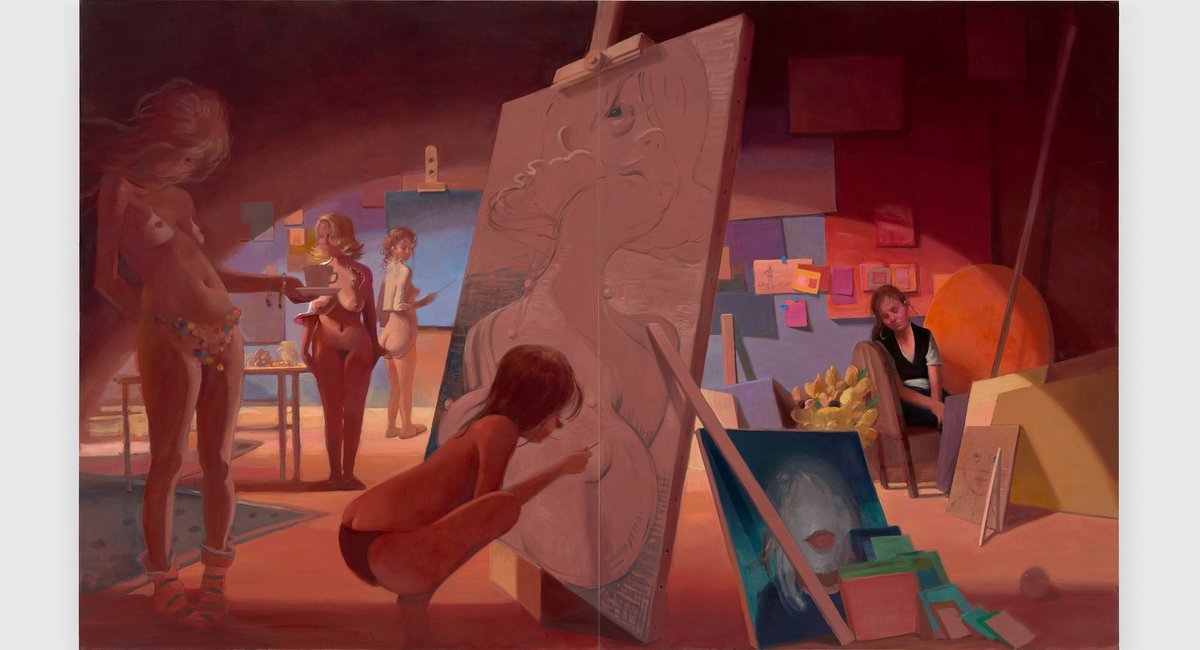
Across her career, Lisa Yuskavage has remained unapologetically focused on painting the female body. Her portraits of women and girls are bold and colorful and often sensual or sexual. In her new exhibit at the David Zwirner Gallery, her 10th with the gallery, many of those figures are painted as small portraits-in-progress on the artist’s easel. The works are, Yuskavage says, like taking a peek not just into the artist’s studio but the artist’s mind. In several, we see a canvas in the background, awash in a vibrant hue and waiting for the artist to apply the final brush strokes. Yuskavage’s subjects with their almost cartoonish breasts look directly at the observer, both the one in the painting and the one in the gallery, with inescapable intensity.
Her works, with their depictions of women, have at times generated as much criticism as critical acclaim. But Yuskavage remains one of the most celebrated painters in the United States with works in the collections of museums like the Met, MoMA and the Whitney. For decades, she’s been shown in exhibitions around the world, from Mexico City to Dublin to her hometown, Philadelphia.
Her current exhibit at the 19th Street Zwirner gallery, “Checklist,” is on view now through June 26. We spoke with Yuskavage ahead of the exhibit opening to get her reflections on art, process, and the legacy of her decades-long career.
You’ve been painting for decades. When you have an exhibit, do you find yourself getting reflective?
The upside of being this many decades into making art is that I have a lot to look back at. Because I’ve had so many exhibitions, I feel like it’s almost like stringing lots of pearls together. The body of work that is in this show is really so much about looking backwards and forwards in time. And so being reflective is really part of my head space right now, especially when I’m working in my studio.
Are you able to see changes in your art over time?
Well, what’s interesting is I couldn’t possibly have known when I was making paintings in the 1990s — a body of work which we loosely call “Bad Babies” — that many years later I would be using those images as characters again. Almost like actors. Back then, I didn’t understand that I was building a vocabulary that I would later be able to use to write larger sentences and thoughts and recollections. I never thought I was casting the roles that then would be my protagonists.
Do you look back on your young artist self kindly? Or are you hard on yourself?
I’m actually quite proud of myself for not listening to the slap-back I got. The thing is that socioeconomically, I was not advantaged. I came from a working-class background. I had several jobs in order to support myself, to pay for a studio. I had all kinds of jobs, bartending, running swimming pools, teaching swimming. And then later I was teaching watercolor classes which was a little closer to what I wanted to be doing, but I was certainly not getting paid to do my work. So because the time I got to do my work [was so precious], I wanted to trust my instincts.
What was it like when you started out?
When I was starting out, I was told by many people that painting was dead. Figurative painting was not a thing, especially the way I was doing it. [My work] was about light and space and you could feel this volume around the object. Then I was also told that women shouldn’t do those kinds of paintings, and I just said, “Well, that’s fine. I will be sitting on the sidelines, but this is what I want to do.” I wasn’t concerned with being in the center. I was concerned with making something that felt really powerful to me.
When I was a young artist, the art world was very small and there was no internet. [Some people] assumed I had some sort of treatise about feminism. They couldn’t possibly believe I was [thinking of] feminism as a human quality rather than trying to be didactic. I didn’t have a manual about what I was trying to get across. But it’s always been much more focused on color and light and trying to find a way to activate that in a very new way.
What message are you hoping we get from your striking use of color?
Love. Most of these things for me come out of the pleasure that comes from sinking into it. All of my color is about that. But even though I was painting figurative images, I was thinking a lot about color field painting. And what I really wanted was for the viewer to be overwhelmed by the saturation of a color, and have that color create a mood. And early on, a story started to emerge through color.
Every painting is started by putting down a field of color. The choice of that color is very intuitive. In some cases, it’s kind of a mustard yellow, and I build the painting above that. And often, there are many areas where that first layer is left untouched. The color becomes almost like one of the characters, whether it be male or female or inert, it is definitely a very strong element.
How would you describe the paintings in the exhibit?
I would say they are complex worlds within worlds and color plays a very strong role in how the mood is imparted. There are scenes of people painting, people modeling. There are scenes of people looking at each other. It’s a kind of a meditation on what it is to be a creative person. I like calling myself Lisa 6.0, operating system 6.0, because I’m in my 60s. You had asked earlier about how I look back on myself? I feel this love for my earlier works. These images, they’re my children.
[ad_2]
Source link