[ad_1]
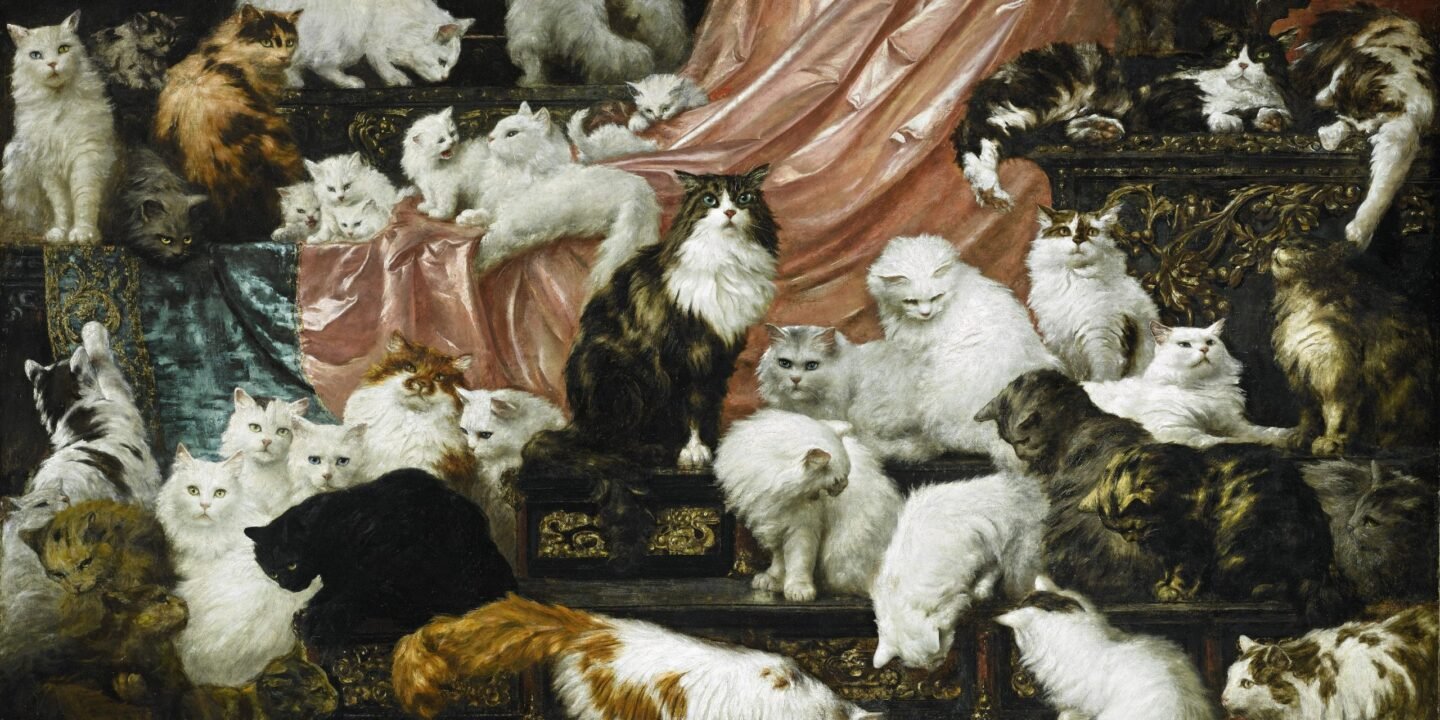
Carl Kahler’s 1891 painting My Wife’s Lovers just might be the most magnificent painting of cats in the history of art—and the story behind it is one incredible tail! The sumptuous portrait of 42 cats, mostly angoras, was commissioned by the ultimate cat lady, San Francisco millionaire Kate Birdsall Johnson, to enshrine some of her favorite feline friends in perpetuity. That’s right: there were others. Some claim she had nearly 300 cats. Others say her clowder maxed out at 50.
In recent years, the painting has enjoyed a new burst of popularity, driven by social media (with social media hashtags such as #meowsterpiece) and bolstered by a stunning 2016 sale at Sotheby’s where it earned a whopping $826,000, more than two times its presale high estimate of $300,000 (that comes out to $19,667 per cat).
The artist behind the work, Carl Kahler, is today known best for such resplendent paintings of cats. Another of his works, Three Black Cats, recently appeared at Sotheby’s this past February. But before taking on the commission for My Wife’s Lovers, the artist had actually never painted one.
Who Was Carl Kahler?
Born in Austria in 1856, Kahler established a career in Australia and New Zealand painting horse racing. The artist came to San Francisco en route to Yosemite, where he planned to paint nature scenes. Then fate intervened in the form of an invitation to the mansion of Kate Birdsall Johnson, a millionaire well-known for her art collecting and philanthropy, who offered him the career-altering commission. Other works in her collection included the ethereal 1874 painting Elaine by Toby Edward Rosenthal as well as Greco-Roman antiquities.
Johnson resided at a lavish summer property, known as Buena Vista Castle, which was famously the largest estate north of the Golden Gate. The sprawling grounds had formerly been the Haraszthy family vineyard (today, it is home to the Bartholomew Estate Vineyards). In the estate’s 40-room Victorian mansion, Johnson’s cats were said to occupy an entire floor and were attended to by their own servants. Along with felines, Johnson kept prize-winning dogs, horses, cattle, and a veritable aviary of cockatoos, parakeets, and canaries. Kahler would spend three years living at the castle, amid this menagerie, sketching the cats and familiarizing himself with their unique personalities.

Detail of My Wife’s Lovers by Carl Kahler.
In its final form, My Wife’s Lovers, completed in 1891, is six feet tall, eight-and-a-half feet wide, and weighs over 200 pounds. Johnson’s 42 felines appear tiered on steps draped with silk and, as with the great Renaissance tableaux, in various states of emotion. Some are resting, playing, and cuddling. A group on the lower left gathers around a moth. At the center of the portrait is Sultan, a handsome, large cat with green eyes and brown and yellow markings on his white fur. Johnson is said to have paid some $3,000 for Sultan on a trip to Paris. Next to Sultan is a white angora cat with blue eyes who is believed to be Johnson’s cat, His Highness (who appeared in another of Kahler’s paintings).
Kahler is said to have received $5,000 for this painting alone, approximately $170,000 in today’s value. The painting made a public debut at the 1893 Chicago World’s Fair, a loan from Johnson, where it caused a stir. As for the painting’s memorable title—My Wife’s Lovers—the appellation has often and understandably been misattributed to Johnson’s husband (who had already passed away two years prior). Instead, Kate Birdsall Johnson seems to have titled the painting after her late husband’s sobriquet for her furry friends.

Detail of My Wife’s Lovers by Carl Kahler, including Sultan and His Highness.
Johnson passed away in 1893. “During her lifetime, Mrs. Johnson, although very charitable, was inclined to be somewhat eccentric. One of her main fancies was the maintenance of a huge band of cats. She was particularly fond of paintings, and her collection is estimated at over $200,000,” read a newspaper obituary. It was rumored that Johnson left some $500,000 in her will for the cats’ care. In reality, Johnson, in her largesse, established a San Francisco hospital for poor women and children in her will and left a small maintenance sum for the cats.
What Keeps My Wife’s Lovers in the Spotlight?
My Wife’s Lovers, for its part, seems to have been blessed with nine lives. Following Johnson’s death in 1893, the painting was purchased by French-born collector Ernest Haquette for his lavish Palace of Art Salon. The 1906 San Francisco earthquake would destroy the Salon, ravaging 80 percent of the city. The quake would also tragically claim Kahler’s life at just 49 years old. But My Wife’s Lovers would survive the catastrophe, unscathed.

Carl Kahler, Three Black Cats (circa 1890s–1906).
In the 1940s, the painting enjoyed fame as a subsequent set of owners would take My Wife’s Lovers on a national tour and present the painting at Madison Square Garden in New York for a cat show. Some 9,000 prints of the painting were said to have been sold alongside the tour, and in 1949, Cat Magazine called My Wife’s Lovers “the world’s greatest painting of cats.”
Today, Kahler’s magnum opus is back in Northern California, purchased in the Sotheby’s bidding battle by John and Heather Mozart, fittingly eclectic collectors whose passions run from majolica and Portuguese colonial furniture to Elvis’s memorabilia. In 2016, the painting made its most recent public appearance at the Portland Museum of Art in Oregon. While cat and art lovers can only hope this meowvelous painting comes back on view soon, for now, the painting continues to delight on social media.
[ad_2]
Source link