
In the 4th century BC, Greece, where sculptors like Praxiteles carved marble into gods and philosophers debated the cosmos, the art of painting was often seen as a mere craft, until Pamphilus of Amphipolis came along. The man who would transform painting from a manual skill into a rigorous science and a cornerstone of education.
Pamphilus wasn’t just a painter; he was a visionary. A student of the esteemed Eupompus, he understood that true artistic mastery lay not just in mimicry, but in understanding the fundamental laws of nature. And so, in the thriving city of Sicyon, around 360 BC, he founded a school that would become the most prestigious—and expensive—art academy of the ancient world.
Aspiring artists, often from wealthy families, arrived at Sicyon, ready to commit ten years of their lives and a staggering sum of one talent (a fortune akin to building a small ship) to Pamphilus’s teachings.
Pamphilus’s paintings and philosophy were revolutionary
He famously declared that no one could be a truly great painter without a profound understanding of arithmetic and geometry. Pamphilus preached the pursuit of symmetric proportion and applied the mathematical canons of sculptors like Polykleitos to the two-dimensional canvas.
He taught his students the secrets of perspective and foreshortening, using geometric principles to create illusions of depth that astounded ancient audiences.
He was also a master of materials. Pamphilus championed the encaustic technique, a demanding method involving heated beeswax mixed with vibrant pigments. This technique, requiring incredible precision and speed before the wax hardened, produced paintings of unparalleled richness and durability, further cementing the Sicyonian school’s reputation for technical excellence.
But Pamphilus’s influence extended far beyond his studio. He understood the power of art to shape minds. Through his advocacy, he convinced the authorities to include “graphike” (drawing and painting) in the standard curriculum for all free-born Greek boys.
Suddenly, an art once deemed “banausic” (manual labor) stood alongside grammar and gymnastics, recognized as essential for cultivating a well-rounded citizen who could appreciate beauty, proportion, and intellectual discipline.
Though none of Pamphilus’s own works, like his vivid “Battle of Phlius” or the dramatic “Odysseus on his Raft,” survive today, his legacy endured through his students.
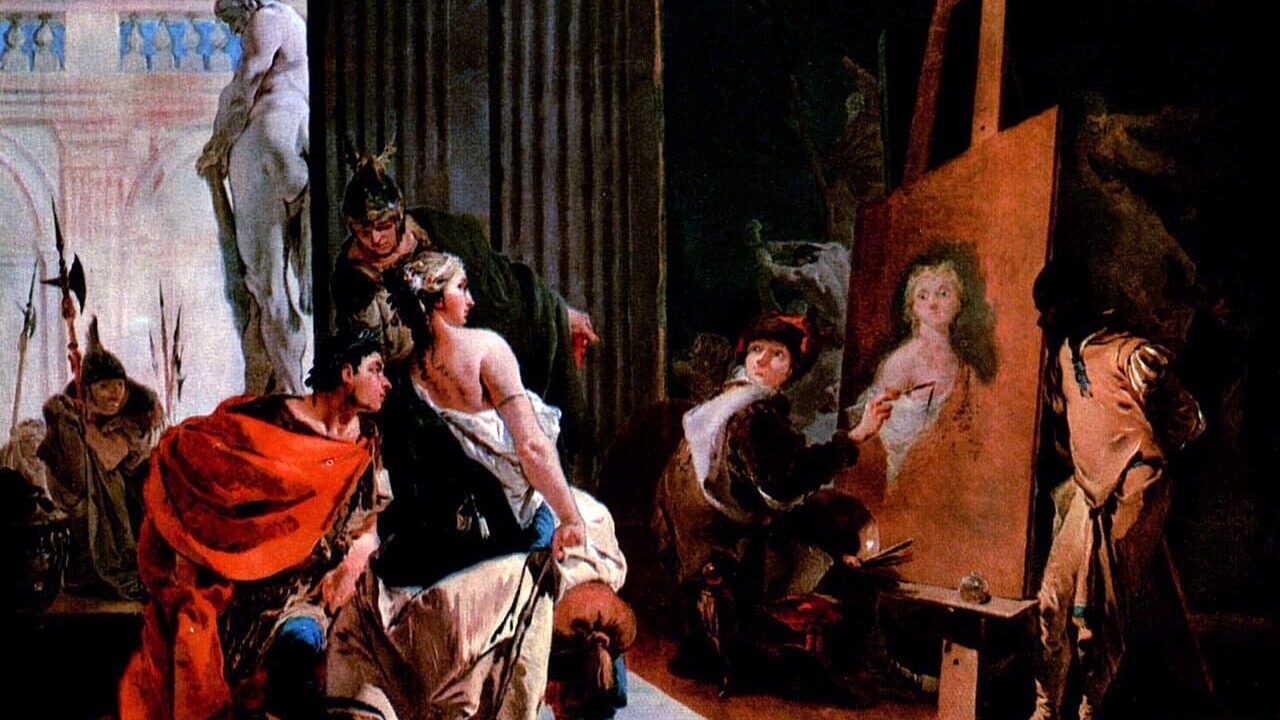
Apelles, the personal painter of Alexander, was his protégé
His most brilliant protégé was Apelles, who would go on to become the personal painter of Alexander the Great—the most celebrated artist of antiquity. Apelles’s legendary grace, precision, and ability to capture the soul of his subjects were directly attributable to the decade of rigorous training under Pamphilus.
Even at the height of his fame, Apelles continued to honor his old master, sending payments to Pamphilus’s heirs, a testament to the profound impact of his teacher.
Pamphilus of Amphipolis transformed painting from a craft into an academic discipline. By integrating geometry and mathematics into his curriculum, he established the theoretical foundations of Western art and ensured that drawing became a standard part of Greek education.