
Archives from the Museum of Modern Art (MoMA) in New York, recently made available to the public in digital format after remaining unpublished for decades, reveal new information about Francoist censorship and how the regime attempted to redefine abstract art to suit its own purposes. The American artist couple Helen Frankenthaler and Robert Motherwell, whose works are currently in dialogue with those of Joan Miró in the exhibition Miró and the United States at the Catalan artist’s foundation in Barcelona, experienced a legendary episode in Spain that has permeated the country’s post-war historiography without ever being fully clarified until now.
Motherwell and Frankenthaler traveled to Spain in 1958. They had left New York on June 13, two months after their wedding. Their honeymoon was still pending, and she wanted her husband to see Goya’s Black Paintings at the Prado Museum and the Altamira caves, taking advantage of the fact that the painter was participating with five works in The New American Painting, the MoMA traveling exhibition that presented American Abstract Expressionism for the first time in Madrid and influenced an entire generation of Spanish artists. But the local authorities demanded that Motherwell change the title of one of his works, Elegy to the Spanish Republic No. 35, leaving it as simply Elegy or Painting. The painter, furious, refused and even threatened to “cause a scene in Madrid.”
For decades, historians, clouded by Francoist propaganda, have disagreed about what happened. Some said the painting was censored, without specifying how. Others maintained it appeared in a Spanish newsreel before being removed, and still others swore that Franco, upon seeing it, exclaimed: “Well, I don’t see the elegy anywhere.” The catalogue for the Fundació Miró’s exhibition, Miró and the United States, perpetuates the doubt. Only Motherwell’s catalog raisonné offers a very partial and somewhat inaccurate commentary on the documentation from MoMA, where the painting is currently exhibited, along with others from the Elegy to the Spanish Republic series. What really happened?
For Motherwell, the series Elegy to the Spanish Republic recalled a just cause that was brutally crushed, so when the translator of the catalog into Spanish warned on June 9 that they would have problems exhibiting a painting that alluded to the Republic, René d’Harnoncourt, director of MoMA, advised the curator of the exhibition, Luis González Robles, on June 18: “In case you consider this title unacceptable, the painting would have to be removed from the exhibition and the catalogue, since we are not authorized to change titles of paintings without the consent of the author.”
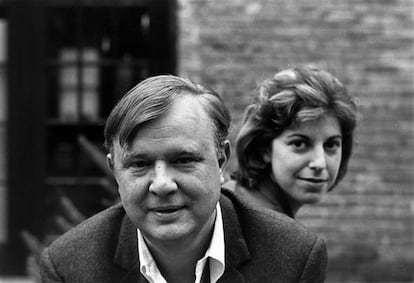
On June 19, the married painters, unaware of the ensuing chaos, informed the museum of their travel itinerary from Madrid: “We leave here on Sunday and still don’t know if we’ll go to (a) San Sebastián, (b) Barcelona and the Costa Brava, (c) the French Riviera, (d) St. Ives. It depends on car trouble and whether friends can find us a studio in any of those places. Anyway, considering the titles of Bob’s paintings, we might get lynched if we showed up at the opening here in Madrid! Or we’ll probably get kicked out of the Ritz for painting all night in the hotel rooms.”
The couple left Madrid on June 22 and settled in Saint-Jean-de-Luz, France. On July 9, a week before the exhibition was to open, Porter McCray, director of the international program, telegraphed Motherwell to inform him of the Spanish government’s request. The response was emphatic: “Better none of my paintings on display in Madrid,” and he sought the help of Alfred H. Barr, former director of MoMA: “I hope that in future exhibitions in other countries a footnote will be included in the catalogs indicating that I withdrew the paintings from Madrid due to the controversy surrounding the title. Personally, I don’t like controversies, but one thinks what one thinks, or one is nothing as a person, I believe. I regret any inconvenience this may cause your Museum staff. I will be the most affected, as I will not be able to return to Spain, which is only 11 kilometers away, and partly for that reason we settled here.”
Barr questioned whether Motherwell had reasonable grounds to believe he wouldn’t be allowed to go to Spain. “Why don’t you take a little trip to test the efficiency of Spanish intelligence? Certainly,” he ventured, “I wouldn’t assume you’d be expelled because of the Elegy incident.” The couple crossed the border to visit the Altamira caves at night, though they decided against going to Barcelona and visiting Marcel Duchamp and Salvador Dalí in Cadaqués.
McCray tried to calm Motherwell on July 29: “Didn’t you receive my letter from Madrid informing you that I assumed responsibility for removing only Elegy? Stop. The overall character of the exhibition, supported by young, liberal-minded Spanish painters, and the catalog that included your texts would have been compromised by the removal [of all the canvases].” And on August 2: “The choice was between the likely sensationalism that would have resulted from removing your work or all the works and the moral dilemma of putting at risk a group of people no less principled than ourselves, who by association would have been identified with our action.”
The double game
Porter McCray was playing a double game and on August 6 wrote to González Robles: “Dear Luis: I have had a very unpleasant experience with Motherwell regarding his Elegy, the title of which, as you know, we tried to change for the Madrid exhibition. Since he is a very impetuous person, I am sending you my most recent exchange of letters with him so that you may be forewarned in case he writes or appears in Madrid.”
Motherwell gave in. In the middle of his honeymoon, he didn’t want any more complications. Frankenthaler painted two canvases titled Madrid, one with cheerful colors and the other gloomy with X’s, which can evoke erasure, censorship, a common mark in the Nazi era for “degenerate art”.
The MoMA archives also shed light on how Madrid tried to conceal Tàpies and Saura’s belated refusal to continue participating in exhibitions organized by the Franco regime, while the museum was preparing for the 1960 arrival of Spanish abstract artists in New York. On May 31, 1959, Luis González Robles attempted to justify Tàpies’s abrupt withdrawal from the Musée des Arts Décoratifs in Paris’s 13 peintres espagnols actuels to Porter McCray, claiming he had to exclude the painter at the last minute because the gallery owner, Stadler, had already used the works he wanted to include in his exhibition. But McCray was informed of the real reasons by Saura. “I have decided,” he wrote in June 1959, “not to participate anymore in any exhibitions organized by official Spain. I find it sad to see how a regime that has completely despised our work for years is now discovering (especially since the Venice Biennale and the success of the Spanish pavilion, for which we were indirectly advisors) a kind of painting produced in the country that, in reality — at least in the case of some of us — is a protest against a situation with which we disagree. […] It is scandalous to see how Spanish exhibitions are organized here and there with the sole aim of showing the world that Spain is a free country, where painters can live from their work and where there is a formidable body of painting thanks to a favorable environment. For me, the reality is exactly the opposite.”
Sign up for our weekly newsletter to get more English-language news coverage from EL PAÍS USA Edition