[ad_1]
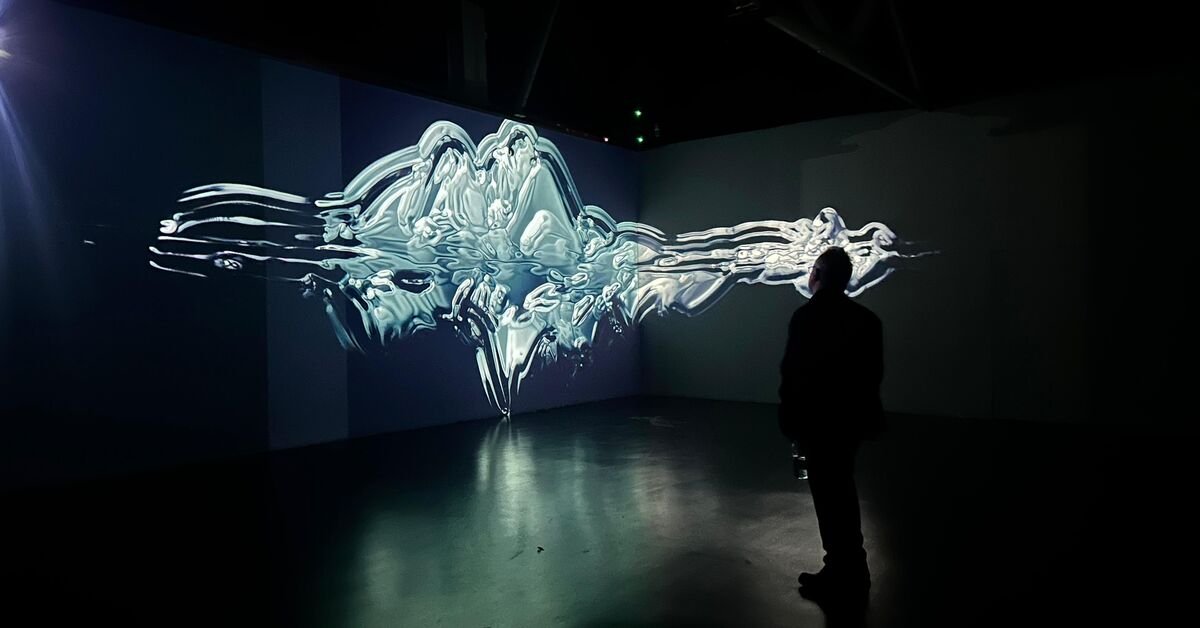
On May 5, at the height of Ankara’s Europe Day calendar, the Delegation of the European Union to Turkey opens a dual digital exhibition at CerModern’s Flow. The evening, led by the head of the delegation, brings together Ecem Dilan Kose’s “Becoming Matter” and “Residue” by Bilkent University’s “COMD Iz Studio” under Andreas Treske.
The works run consecutively on a continuous loop, each taking over the space in turn. Kose’s 20-minute “Becoming Matter” is structured as a controlled progression: image, sound and code move in tandem, in brilliant color and form. Trained in interior architecture, she treats digital media as something to be built and tested. She writes her own code, composes her own sound and keeps the process visible in the work. Her position is clear: “What we call artificial is also part of nature, because it has emerged from it.”
When “Residue” takes over, the focus shifts from transformation to what remains. Iz, named after the Turkish word for “trace,” works with fragments: salt formations, data, glitches and recorded sound. The project draws on research that extends from Tuz Golu to laboratory imaging, translating physical and digital processes into visual form. Its central line is blunt and effective: “Data, rendered visible, is residue. Salt is residue. Glitch is residue.”
Both works return, in different ways, to nature, not as scenery but as a system. The EU’s curatorial choice reads as a quiet nod to the European Commission’s Green Deal agenda, with a glance toward Turkey’s role as host of COP31. The EU’s new head, Aivo Orav — who previously served as the Estonian ambassador to Ankara a dozen years ago — may be one of the few diplomats whose first public act is a cultural one.
[ad_2]
Source link