[ad_1]
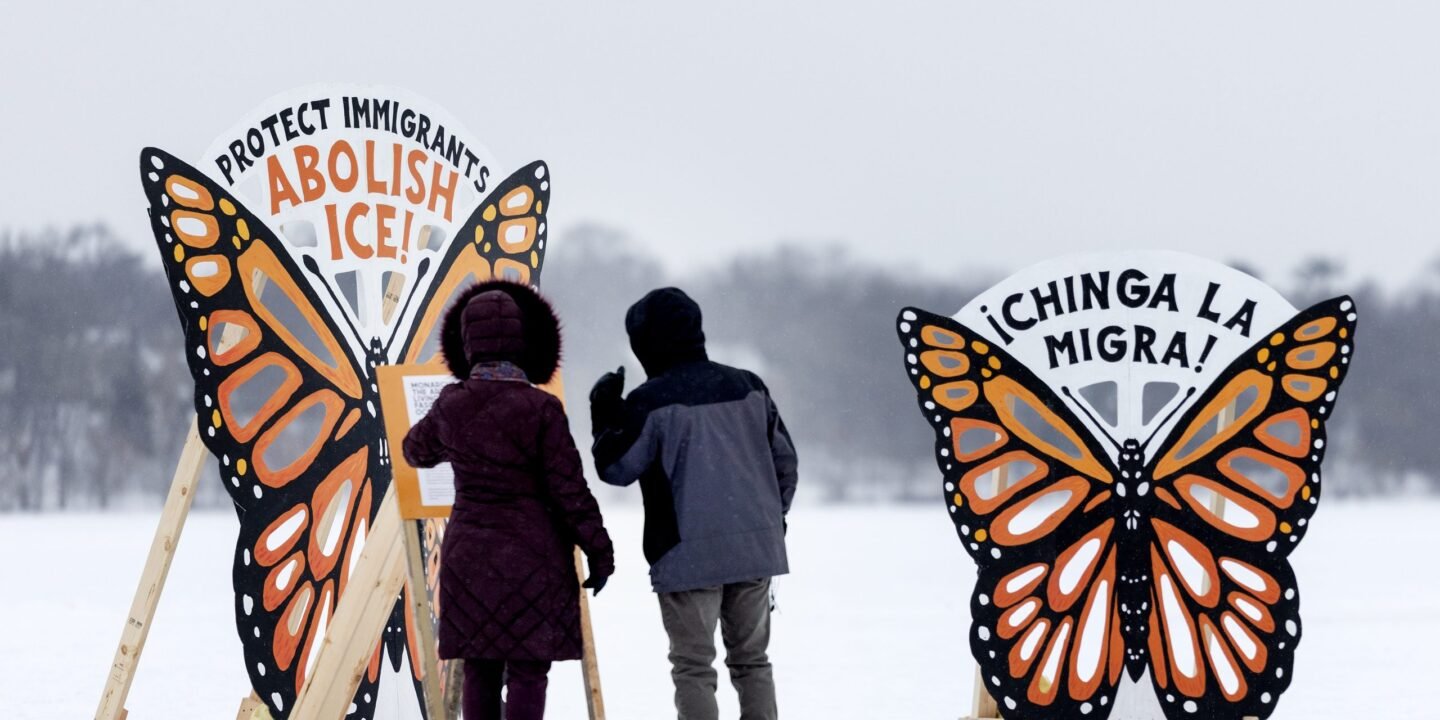
As protests grow in the U.S. over the increasingly violent tactics of Immigration and Customs Enforcement (ICE), craft has become a seemingly unlikely tool for activism. Public school students are making origami rabbits for a five-year-old boy detained by ICE, and there’s been a run on red yarn for “Melt the ICE” hats—two projects rooted in historical examples.
From quilts to puppetry to nail art, seemingly non-threatening forms of creative expression are being used to deliver pointed, sometimes obscene, messages of resistance to the policies of President Donald Trump. And these creative protest strategies, which blend tactical frivolity and absurdity—see inflatable frogs—with serious messaging, stand in stark contrast to the increasing proliferation of A.I.-generated artwork created with basic prompts in a matter of seconds.
These objects are made by hand, born of real human emotion, in response to the unprecedented events of Trump’s second term, especially his campaign to deport undocumented immigrants. The latest enforcement action by ICE, Operation Metro Surge in Minneapolis, has seen federal agents detain thousands of residents and kill two U.S. citizens.
But the current moment of politically charged “craftivism” is also part of a longstanding tradition dating back to before the founding of the U.S. that has seen generations of activists embrace craft.
The Successor to the Pussyhat?
On January 15, Needle and Skein, a yarn shop outside Minneapolis, announced plans to host a “resistance knit-in,” where participants would be invited to knit a new $5 pattern the shop had dubbed the “Melt the ICE” hat. The proceeds would go toward local nonprofits supporting the immigrant community.
The expectation was that a handful of people might come to the event, but the hat has exploded in popularity, recalling the pink Pussyhat that became the visual symbol of resistance against Trump during the 2017 Women’s March on Washington. To date, the shop has sold over 65,000 patterns, and raised over $600,000. (Local yarn dyers have been struggling to meet demand.)

“Melt the ICE Hats” on display at Needle and Skein. Photo courtesy of Needle and Skein, St. Louis, Minnesota.
The tasseled red beanie design was developed by shop employee Paul Neary, based on a red hat worn in the 1940s in Norway as a sign of protest against the Nazi occupation. (Minnesota has the U.S.’s largest Norwegian population.) It was called the topplue or nisselue—roughly translated as Santa hat. It was so popular the Nazis outlawed it, and examples are displayed in Oslo’s Resistance Museum.
“To see our friends and neighbors being dragged out of their houses and being taken away in dark vans, it’s hard not to draw the parallels between World War II and now. That’s something that affects me because I’m Jewish,” shop owner Gilah Mashaal said in a phone call. “We felt we had to do something.”
The shop’s first round of donations of $125,000 each went to the St. Louis Park Emergency Program and the Women’s Foundation of Minnesota’s Immigrant Rapid Response Fund.

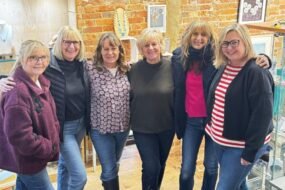
The resistance knit-in making “Melt the ICE Hats” at Needle and Skein. Photo courtesy of Needle and Skein, St. Louis Park, Minnesota.
Like the pussy hat before it, the Melt the Ice Hat has already experienced backlash from both sides of the political spectrum—Mashaal has gotten calls from conservatives accusing her of supporting immigrant “rapists,” and from liberals who think political knitting is little more than virtue signaling. But she thinks the money raised speaks for itself.
“We just keeping pushing forward on what the message is,” she added. “We are raising money to help families, our friends, and our neighbors who are being deeply affected by the actions of the federal government.”
‘Yo Soy Conejo’
Another activist-minded knitting and crocheting project gaining in popularity is a blue winter hat with bunny ears, like the one worn by five-year-old Liam Conejo Ramos when ICE detained him last month on his walk home from school in Columbia Heights, Minnesota. A widely shared photograph showed the small boy wearing a Spider-Man backpack and the bunny hat, a clever play on his last name—conejo means rabbit in Spanish.
The government released Conejo Ramos and his father, Adrian Conejo Arias, from a Texas detention center over the weekend, and the two returned to Minnesota. (A federal judge ruled their detention unconstitutional, as the family had entered the country legally and is in the process of seeking asylum, and ordered their release.)

Five-year-old Liam Conejo Ramos being detained by ICE in Minneapolis, wearing his blue bunny hat. Photo via Columbia Heights Public Schools.
But while Conejo Ramos was still in Texas, his local school district held a press conference at the state Capitol in St. Paul. Speakers called for Conejo Ramos’s release, and unveiled their efforts to make 1,000 origami rabbits in his honor, displaying a pink one on the podium. Their inspiration was Sadako Sasaki, who contracted leukemia from radiation exposure in the atomic bombing of Hiroshima. Before her death at just 12 years old, she folded 1,000 paper cranes as a wish, a Japanese folklore tradition known as senbazuru.
“I’ve been getting many emails where the entirety of the message is ‘Yo soy conejo,’” district superintendent Zena Stenvik said. “Columbia Heights Public Schools and our community, we’re working on our origami conejos.”
The History of “Craftivism”
“Crafting has always been, historically, a form of resistance, and will continue to be, because we will make sure it continues to be,” the popular knitting influencer Louise Dangit said in a recent video sharing strategies for channeling the power of craft into activist causes.
The concept of craft as a protest strategy goes back hundreds of years. In the colonial U.S., as tensions with the British crown rose in the late 1760s, Quakers in Boston launched the homespun movement, making their own textiles as protest against taxation on imports from England. This thread carries through American history, from the Abolitionist and Suffragist movements to the AIDS quilt to the present day (see the AntifascistKnitting subreddit).
Despite this history, such efforts are also met with a certain amount of skepticism, including accusations of performativity. But such crafts can be an accessible entry point for activism, and are helping bring people together in their opposition to ICE and other Trump administration policies and actions while amplifying activist sentiments.
On Reddit, users are sharing their anti-Trump quilts and “rage embroidery” with bold messages like “fuck this shit” and “riot in the streets.” Quiltmakers are offering tips on how to work quickly in response to current events, such as scaling down and using less time-consuming construction techniques that would be impractical for a quilt used as bedding.
Jennifer H., who asked that her last name be withheld, lives in Illinois but is originally from Minnesota. Now 31, she learned to quilt in home economics class in seventh grade. She’s gone to two No Kings marches and three protests at local ICE facilities with her “No Trump, No KKK, No Fascist USA” quilt, with that message and a white heart scrawled atop a patchwork American flag.

Jennifer H. shared her protest quilt on Reddit. Photo courtesy of the artist.
“Quilting is looked at as such a ‘domestic’ hobby and traditionally it’s something that feels so precious and even left unused to keep it preserved. It felt really similar to how people defend the use of the American flag and the huge response from people when the American flag is damaged or used in protests,” she said in a message. “I also added the heart because it’s with deep profound love for our neighbors and country that we fight.”
[ad_2]
Source link