
[ad_1]
Wind turbines are one of the heroes of the renewable energy revolution, but their giant spinning blades have a long-standing problem: they can be lethal to birds and bats that fly too close. Industry estimates suggest each megawatt of wind capacity is linked to roughly two to six bird deaths and four to seven bat deaths every year. In Australia, with more than 2,000 turbines spinning across the country, those numbers add up, particularly for vulnerable species like the wedge-tailed eagle and various microbats.
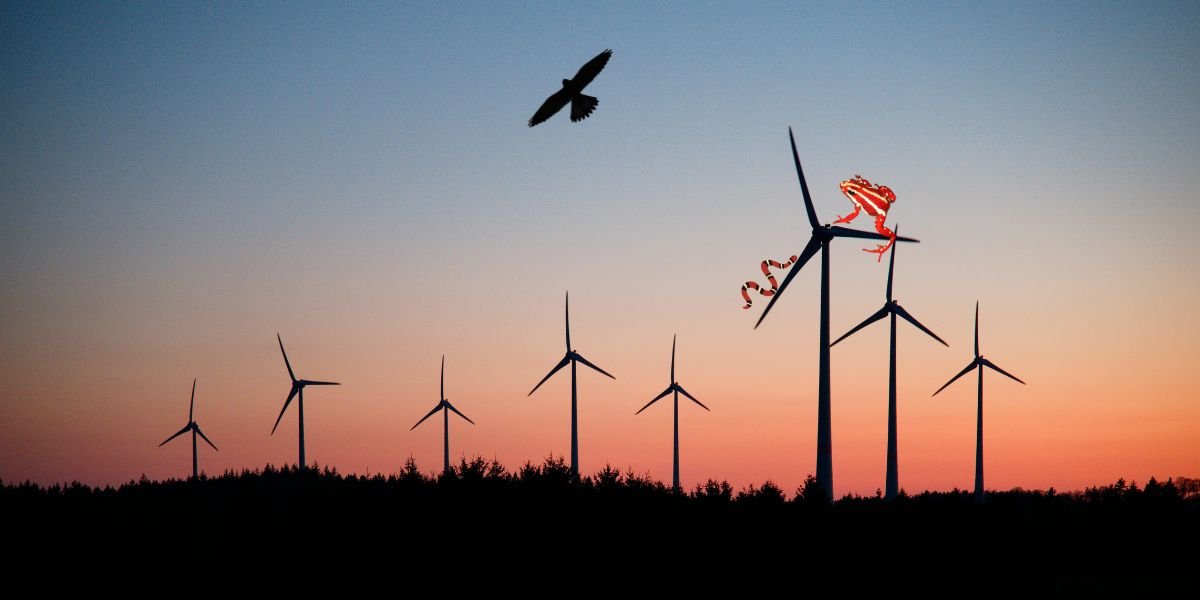
Now, researchers think they have found a surprisingly elegant fix, and it is inspired by some of the most dangerous animals on Earth. A new study published in the journal Behavioral Ecology suggests that wind turbine blades painted with the bright warning patterns seen on creatures like coral snakes and poison dart frogs can make birds far more likely to steer clear.
The international team, led by scientists from the University of Helsinki and the University of Exeter, ran a series of controlled lab experiments using a touchscreen designed specifically for birds. Test subjects watched video footage of turbine blades spinning at different speeds and in different colour combinations, including the classic all-white design used on most wind farms worldwide, a single black blade, red and white stripes, and a freshly designed red, black and yellow biomimetic pattern modelled on toxic animals.
Article continues after this ad
Advertisement
The results were striking. In almost every test, birds were happiest to approach plain white blades, the standard design seen across most wind farms. They were noticeably more cautious around any of the coloured variations, but the biomimetic warning pattern was the clear winner, scaring off the test subjects the most consistently.
According to Popular Science, study co-author Johanna Mappes from the University of Helsinki said “a relatively simple visual change could reduce bird mortality” linked to wind power. Her colleague George Hancock from the University of Exeter said the size of the avoidance response was remarkable, given how well documented this kind of warning-colour psychology already is across the animal kingdom.
The findings build on earlier research from Norway, where painting just one of a turbine’s three blades black slashed bird deaths at the Smøla wind farm by around 70 per cent over a decade-long trial. The new study takes that idea a step further by drawing directly on evolutionary cues that birds have been hardwired to recognise for millions of years.
If the lab results hold up in real-world field trials, the researchers say the implications could be huge, not just for wind farms but for other deadly hazards like power lines and reflective building windows. With Australia’s renewable energy rollout accelerating and wildlife groups raising concerns about turbine sites near migratory paths and raptor habitats, a relatively cheap can-of-paint solution could help wind power and wildlife share the sky a little more peacefully.
[ad_2]
Source link