
[ad_1]

Métiers d’art—which translates as “art professions”—refers to the highest levels of decorative craftsmanship used to create objects of beauty. In watchmaking, these techniques are miniaturized to the scale of a dial or even integrated into the movement itself, amplifying both their difficulty and their impact. The constraints of size demand extraordinary precision, patience and technical mastery from artisans.
Despite these challenges, watchmakers continue to push creative boundaries, translating centuries-old techniques into contemporary expressions. Nowhere is this more evident than at the annual Watches and Wonders fair in Geneva, the industry’s most important and largest global horology fair. The 2026 edition once again highlighted an array of artistic crafts—from enameling and marquetry to engraving and gem-setting—demonstrating that high horology is as much about artistic innovation as it is about mechanical ingenuity.
Let’s begin with enameling, a technique dating back more than 3,000 years to Mycenaean Greece, which involves fusing powdered glass to metal surfaces at high temperatures. Today, more than 200 variations exist, including cloisonné, champlevé, plique-à-jour, guilloché and painting. Each requires painstaking, multi-step processes that leave little room for error.
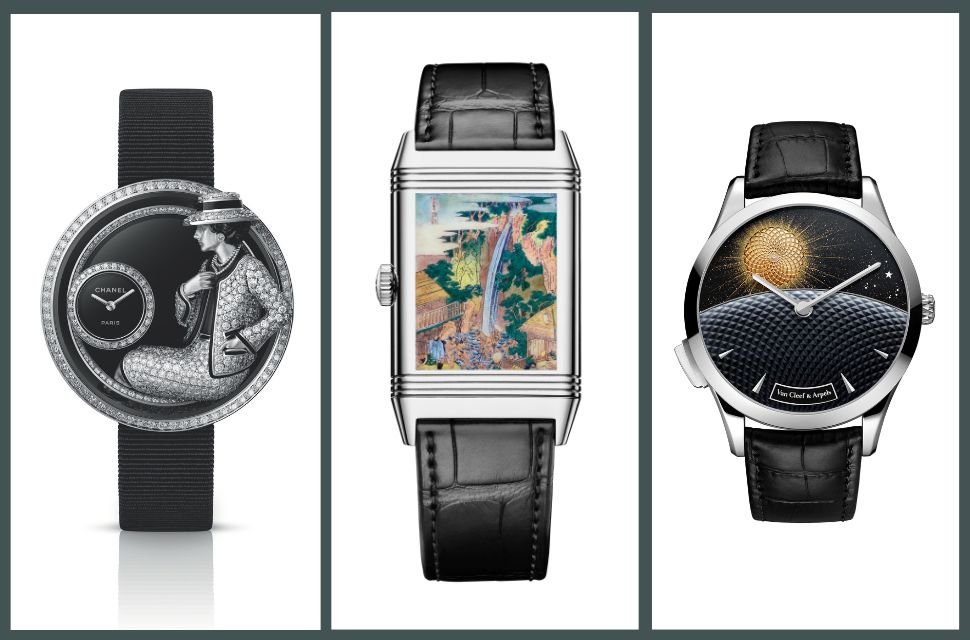
Jaeger-LeCoultre, Reverso Tribute Enamel Hokusai Waterfalls Series, Rōben Waterfall at Ōyama in Sagami Province

Few watches offer as compelling a canvas for miniature art as the Reverso. Originally designed in 1931 for polo players, its reversible caseback has evolved into a showcase for artistic expression. This final installment in Jaeger-LeCoultre’s Hokusai Tour of the Waterfalls of the Provinces. The limited-edition series features four miniature-painted grand feu enamel creations, each requiring at least 14 layers, each fired at approximately 800°C. The process demands roughly 80 hours of work. Reproducing Hokusai’s palette on a surface just two square centimeters in size requires exceptional skill, with even the smallest Japanese inscriptions rendered legibly. The scene itself captures the dramatic vertical cascade of Rōben Waterfall, complete with tiny human figures dwarfed by the scale of the waterfall.
The front dial complements the artwork with a hand-guilloché barleycorn pattern coated in multiple layers of translucent enamel.
Cartier, Tortue, Panthère Métiers d’Art

Cartier elevates champlevé enamel by extending the motif beyond the dial and onto the case, creating a dynamic portrait of its iconic panther in the rain. Artisans carve tiny cavities that are filled with translucent enamel and flecks of gold or silver to form raindrops, giving the scene depth and motion. Each piece incorporates more than 15 enamel tones and requires over 36 firings, totaling approximately 80 hours for the dial and 50 hours for the case. Even the gem-set eyes demand three hours of meticulous work. The result is both painterly and sculptural, underscoring enamel’s expressive potential. This model comes in two different color palettes: one in white gold with emerald eyes, the other in yellow gold with tsavorite eyes.
Marquetry was also on display in Geneva. Traditionally associated with furniture, marquetry involves assembling thin veneers of wood or other materials into intricate compositions. While the craft dates back thousands of years, its application in watchmaking is relatively recent—and rapidly evolving.
Hermès, Slim d’Hermès, Roaaaaar!

Inspired by a silk scarf design by artist Alice Shirley, this pocket watch transforms a roaring lion into a richly textured marquetry composition on its cover. Ten different wood species—including tulipwood, maple, and burl—are cut into minute fragments and assembled into a seamless image that preserves the vibrancy of the original artwork. Inside, the craftsmanship continues with a grand feu enamel dial in a herringbone pattern, fired repeatedly at temperatures exceeding 800°C to achieve a luminous, durable finish.
Chopard, L.U.C Quattro Spirit 25, Straw Marquetry Edition

Chopard applies straw marquetry—a centuries-old technique rarely seen in watchmaking—to striking effect. Using rye straw from Burgundy, artisans split, flatten and cut each strand into tiny pieces before assembling them into a honeycomb motif. Subtle variations in color and orientation create a natural play of light, enhanced by a final wax coating. The minimalist dial, featuring a jumping hour display and a single minute hand, allows the craftsmanship to take center stage, while the in-house movement delivers an impressive eight-day power reserve.
Often taken for granted, gem-setting is among the most technically demanding Métiers d’art disciplines. At its highest level, it transforms watches into sculptural works of light and color.
Bulgari, Serpenti Aeterna, single-wrap in rose gold

Bulgari reimagines its iconic Serpenti as a vibrant tapestry of gemstones. The sinuous form is set with 122 colored stones—ranging from rubellites and sapphires to Paraíba tourmalines—arranged in a dynamic composition that emphasizes both contrast and harmony. The piece required hundreds of hours of development, stone selection and setting, culminating in a dazzling, wearable sculpture.
Chanel, Gabrielle, Coco Game Collection

Chanel turns its founder into the focal point of a high jewelry timepiece. A sculpted figure of Gabrielle Chanel, rendered in white gold and set with hundreds of diamonds, sits beside the dial, transforming the watch into a three-dimensional tableau. The interplay of gem-setting, lacquer and onyx creates a striking contrast, while the overall composition blurs the line between watchmaking and haute joaillerie.
Finally, there are the poetic complications and examples of engraved mastery.
Van Cleef & Arpels, Midnight Jour Nuit Phase de Lune

Van Cleef & Arpels combines mechanical poetry with artisanal craftsmanship in a dial that depicts the passage of time as a celestial narrative. A rotating disc reveals a guilloché sun and a mother-of-pearl moon beneath a shimmering aventurine sky, while enamel and miniature painting enhance the scene. The artisan work continues on the caseback with an engraving in white gold representing the Moon’s topography. The Earth is represented in enamel tracing on the sapphire crystal on top of the oscillating weight. This earth is surrounded by three miniature paintings of planets. The result is both technically sophisticated and visually evocative.
Rolex, Oyster Perpetual 36, Jubilee

Rolex is celebrating 100 years of the waterproof Oyster case in its typically understated way. However, this watch does stand out for its colorful typographic dial. At least 10 colors are applied individually by hand, requiring precise alignment to maintain the integrity of the design—proof that artistry can exist within even the most understated frameworks.
Grand Seiko, Masterpiece, Mystic Waterfall Edition

Grand Seiko brings engraving to the forefront with a detailed depiction of Japan’s Tateshina Waterfall across both dial and case. The interplay of hand-engraving and Zaratsu polishing creates dynamic reflections, emphasizing texture and depth. Powered by a Spring Drive movement, the watch seamlessly integrates traditional craftsmanship with modern horological technology.
More in watches

[ad_2]
Source link