[ad_1]

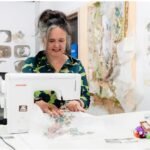
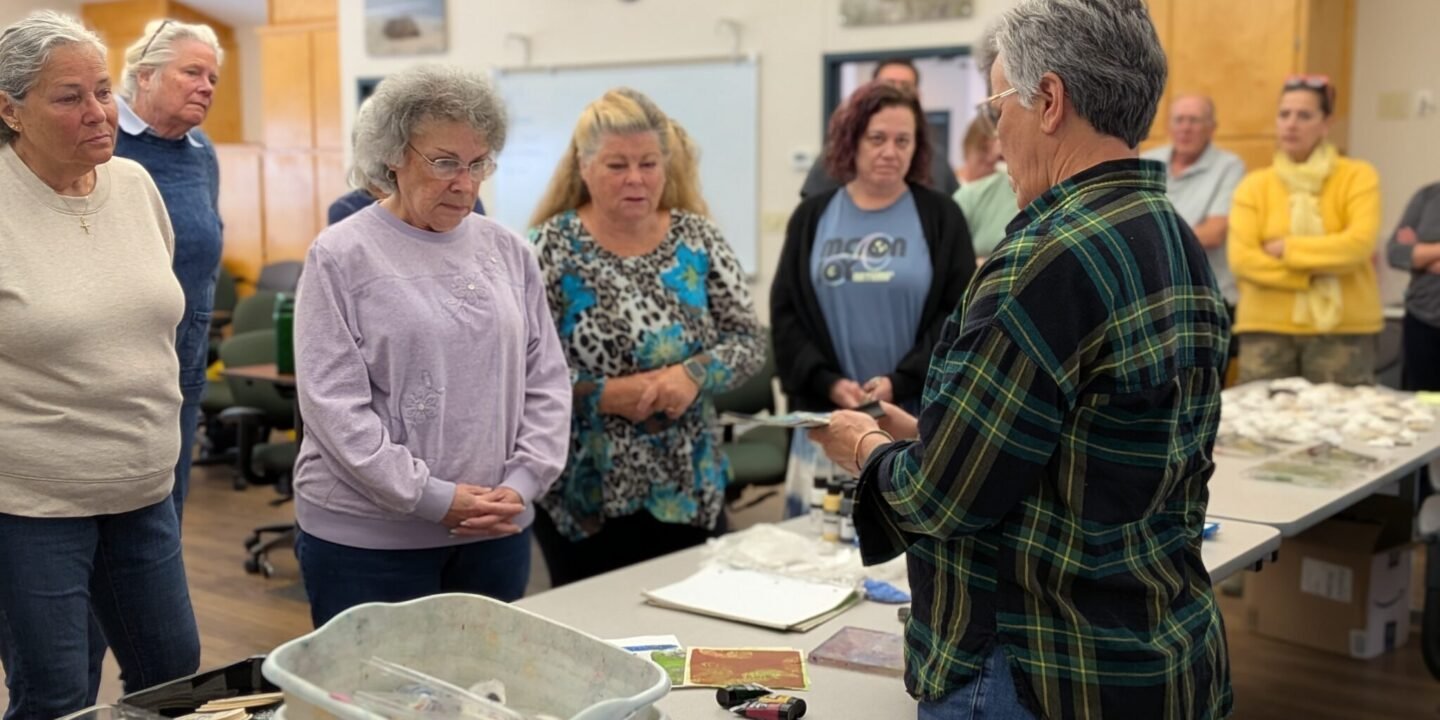
ART ON THE HALF SHELL: Artist, educator and oyster farmer Diane Driessen shows workshop participants how to create monoprints. (Supplied Photos)
Earlier this month, the Barnegat Bay Partnership and the Jacques Cousteau National Estuarine Research Reserve came together to present another installment of their Art x Science series, which features workshops “designed to spark creativity through science by pairing environmental education with artistic expression,” said BBP Associate Director of Outreach Nina Sassano. They “provide a space to learn, create and reflect on the importance of different ecosystems, organisms and ongoing research in the Barnegat Bay region.”
The May class, “Oyster Ecology Meets Printmaking,” was led by Lisa Calvo, a retired Rutgers University researcher and owner of Sweet Amalia’s Market and Kitchen and Oyster Farm in Newfield, N.J., and artist, educator and oyster farmer Diane Driessen. Calvo and Dreissen explained both the ecological and economic value of oysters while participants monoprinted using oyster shells from the Rutgers University Haskin Shellfish Lab.
Calvo, who has more than 30 years of experience as a marine biologist – focusing on shellfish biology and ecology – also “shared her journey from the university to the salt marsh as she transitioned her career into owning Sweet Amalia’s,” Sassano stated. “The market serves as a link between the farm and the community, providing a space where consumers can enjoy an authentic ‘tide to table’ connection.”
 According to Sassano, “A central theme of the workshop series was the role of oysters as keystone species and ecosystem engineers. Oysters are critical to estuarine environments, providing water filtration; important nursery habitat for fish, crabs and other invertebrates; and shoreline stabilization, among other roles. Oysters are also economically important, generating an impact exceeding $26 million in New Jersey alone.”
While the state’s oyster industry was booming 100 years ago, it was thereafter harmed by declining water quality, overharvesting and shellfish disease. Oyster farming, though, is now making a comeback.
“Modern aquaculture has led to a rise in the oyster industry,” said Sassano.
She added, “While oysters grow into adulthood in the bay, the journey of an oyster from the environment to a dinner plate begins in a hatchery. A hatchery is an indoor facility that controls every aspect of the oyster’s early life, spawning ‘broodstock’ and raising juvenile oysters from their larval stage to ‘seed.’ Oysters move from seed to farmers (with) several weeks of growth, and farmers raise the oyster for the remainder of their maturing life (one to three years) in the environment.”
Also during the workshop, Driessen introduced the group to her work as an artist, and allowed everyone to get hands-on in creating their own monoprint oyster art. This technique captures the intricate, organic textures of an oyster shell, which appear as fine, topographic lines on the paper once the printing is complete.
“Diane’s work is inspired by close observation and deep connection to the natural world,” Sassano noted. “Her current subject matter, the landscape, presents a stark contrast between the awe-inspiring beauty inherent in nature and the underlying destruction that can result from human interaction with these elements. Diane generally works on paper using pastel, monoprinting techniques and collage.”
The 2026 series has two Art x Science workshops left: “Birding x Brushstrokes” on June 6 and “Pine Barrens Primer x Basket Weaving” on July 11. Course locations vary. To reserve a spot for these workshops, visit lp.constantcontactpages.com/ev/reg/eg3w7hr. —J.K.-H.
[ad_2]
Source link