
[ad_1]
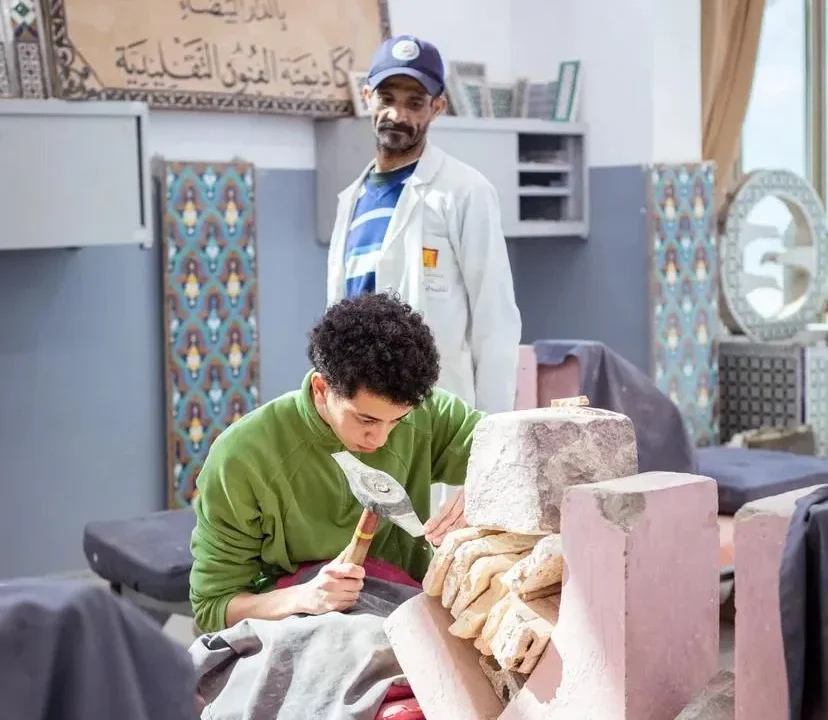
In one of Marrakech’s alleys, where the scent of wet clay mingles with the sound of the «manqash» carefully shaping pieces of zellige, Abdelouadoud Manhir found himself immersed in a world he had known nothing about just a few years earlier. A 25-year-old graduate in civil engineering, he chose to step away from the traditional career path awaiting him. Instead, he enrolled in an academy specializing in crafts in Casablanca, diving into the intricate world of an ancient art form that captivated him from the very beginning with its colors and geometric designs.
For him, zellige was not merely a manual craft, but a path toward self-discovery. Speaking to Yabiladi, he explained that his decision to enter the field was driven by curiosity and fascination, despite having no prior connection to the craft before joining the institution. While many viewed his move toward craftsmanship as a step down after years of university education, his parents saw it differently. They supported his choice, believing in the popular saying: «A craft, if it does not make you rich, will at least protect you».
«Education and Craftsmanship Complement One Another»
In the workshops, Abdelouadoud quickly encountered the deeply rooted stereotype that craftsmen are uneducated. He, however, rejects that perception, believing it belongs to another generation. According to him, earlier generations combined education with mastery of a craft. He believes craftsmanship cannot «evolve without education». «I believe that the more educated a craftsman is, the more they can develop their tools and vision and add their personal touch».
.jpg)
This perception was not always easy to maintain in the professional environment. He recalls that when he first started interacting with craftsmen craftsmen without formal schooling, some did not appreciate the idea of someone with higher education choosing to learn zellige.
«They noticed the difference in the details, in the way of working, and in the new touches that a young person from my generation was trying to introduce to traditional designs. Only then did the initial judgments change».
Despite this, he acknowledges that some craftsmen still refuse to accept him in the field, while others seek his help and encourage him, something that fills him with pride. What matters most to him is that he learns from them as well, as he believes the relationship in the workshop should be based on the exchange of knowledge, not conflict. He rejects the famous saying, «Your fellow craftsman is your enemy», because the real goal, in his view, is to preserve and develop this heritage, far from selfishness.
The first piece he worked on was a zellige table, an experience that remains etched in his memory because it made him realize the precision and patience this craft requires. As he explains, the making of zellige begins with clay that is kneaded and spread, then goes through the «farina» stage, followed by painting and glazing in the «pottery house». The pieces then move to the «work house», where the design is drawn, followed by the breaking, mixing, and «emptying» or «spreading» stages, until reaching the final phase of the craft.
An Ancient Craft Facing the Risk of Disappearance
Amid all these stages, simple local tools, including the «manqash», come to the forefront, yet they require expert hands and great patience. Abdelouadoud therefore emphasizes that every stage of zellige making is difficult and demands immense focus and precision.

As much as he lives the details of the craft daily, he also carries an awareness of its history. For him, the oldest zellige in Morocco is found in the Koutoubia Mosque in Marrakech, the city he belongs to and which seems ever-present in his artistic choices and professional identity.
This passion recently led him to participate in an international tile competition, where he managed to win third place after presenting a new zellige design, an experience he considers recognition of his ability to innovate within a craft fundamentally rooted in traditional heritage. However, behind this achievement, Abdelouadoud carries genuine concern for the future of the profession.
«The craft is gradually fading, with many young people reluctant to learn it. Also, some clients who understand the effort and precision involved in making zellige still ask for work at low prices, which is disheartening».
Despite all this, the young craftsman remains deeply attached to his passion. He describes himself as a «disciple» (Mtaalem), the same name he chose for his social media accounts, refusing to be called a «Maalam», believing that a person remains a student for as long as they live.

The impact of the craft was not limited to mastering zellige alone, but also extended to his personality and outlook on life. He says it taught him constant curiosity, that every day is an opportunity to discover something new, and that self-development is a never-ending journey, both inside and outside the workshop.
[ad_2]
Source link