
[ad_1]
Panel:
Ruth Lang Architect and associate professor at the London School of Architecture (LSA)
David Knight Director of DK-CM and a module leader at the LSA
Cristina Monteiro Architect, filmmaker, and director of DK-CM
Daniel Stilwell Architect and architectural historian at Charles Holland Architects
Neal Shasore Historian of the built environment
Hugh Strange Director of Hugh Strange Architects, writer, and teacher at the LSA
In our work as architectural designers, teachers and historians we have all felt very keenly the resonance of the Arts and Crafts ‘movement’.
Ruskinian thought, the principles of William Morris, the mores of Edward Carpenter, and the innovation of WR Lethaby have been hotly debated in our WhatsApp group Nerds from Nowhere – a nod to Morris’ novella News from Nowhere – at a time when that interest has felt almost taboo within the context of architecture schools. Nevertheless, at a moment where the profession – and indeed the wider sector – is having to shift its practices fundamentally, returning to those sources and picking up some of these ideas feels urgent.
Going back to first principles
It is instructive to revisit concepts that were formative in the systems in which we operate, to understand where they came from, and useful to re-engage with the louder voices like Ruskin and Morris, as well as the people who began to reconcile those prophetic precepts with the realpolitik of their day.
We don’t hold these ideas up as perfect, or fully coherent. There was no manifesto of the Arts and Crafts movement, which was a heterogeneous mix of responses to some common questions and critiques.
Instead, we are interested in the ways in which its values – a sociopolitical critique of labour and the division of tasks, a set of attitudes to place, history and memory, and a formal sensibility closely tied to construction and craft – might act as ‘provocations’. How might these prompt new thinking about our contemporary approaches to architecture?

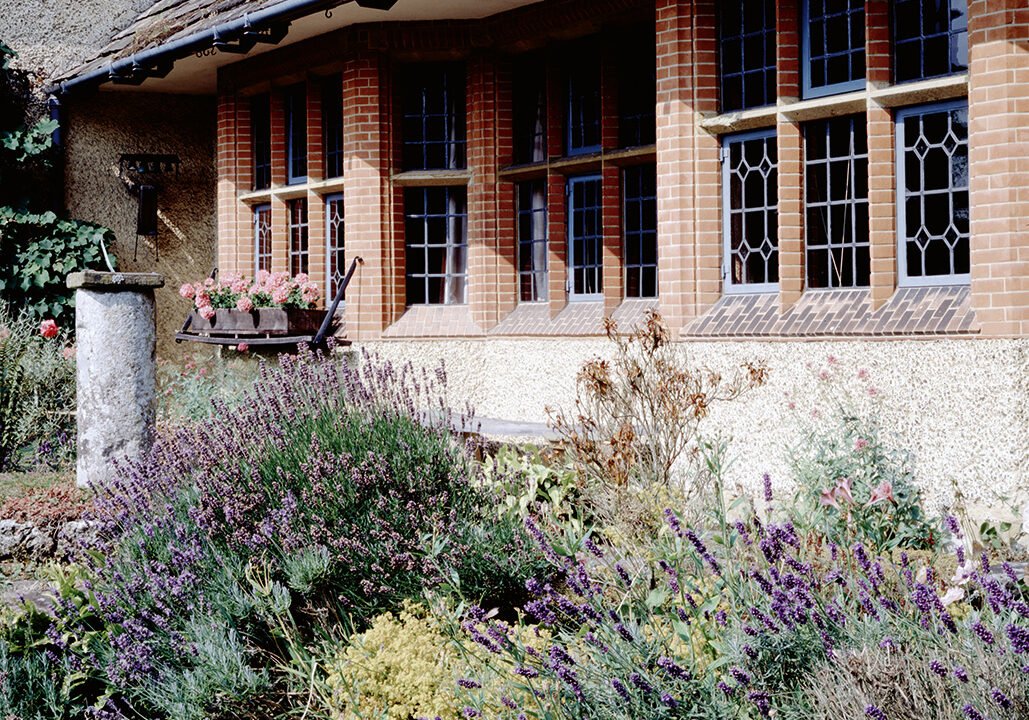
Terracotta frieze at craftswoman Mary Seton Watts’ mortuary chapel at Compton Cemetery, Surrey (1901). | Credit: Martin Charles, RIBA Collections

Detail of The maker’s marks at Tigbourne Court, Surrey (1901), by Edwin Lutyens. | Credit: Frederick MacManus, RIBA Collections
How can we root learning in making?
The first concerns education. “If you want to learn architecture, you must study architecture,” wrote Lethaby in The Builder’s Art and the Craftsman (1892). “That is, architectural construction, not the gymnastics which will overlap the building act. You must pry into material. You must learn the actual ‘I know’ of the workman. Work manually at a craft – if you begin with one you will end with many – not with a view of gaining what is called ‘practical experience’, but to gain the power of real artistic expression in material.”
How could our educational system be reimagined to root design in making? We’re interested in a new model in which distinctions between trades and professions, ‘apprentices’ and ‘masters’, makers and designers are much looser or more flexible, with a free exchange of knowledge and skills.
During the late 19th and early 20th centuries this was not high-faluting theory: these were the principles that informed experimental ways of learning that quickly scaled. At a time when municipal government had responsibility for technical education, Lethaby was active in advising the London County Council about its provision for design, craft and construction, first as head of the recently established Central School of the Arts and Crafts, and then in the foundation of what became the multidisciplinary Brixton School of Building.

The maker’s marks at Tigbourne Court, Surrey (1901), by Edwin Lutyens. | Credit: Janet Hall, RIBA Collections
Today, despite the efforts of individual units and the rhetorical claims of faculties, our educational system militates against this approach. But the opportunity is there.
We need a significantly expanded workforce to meet the housing target, the backlog of retrofit, the national infrastructure pipeline, and the demand for commercial space. We need ways of working together that are more responsive to scarcity and unpredictability. Could a return to those founding ideals of the Central School and School of Building reinvigorate both building crafts and design?
Rethinking contemporary construction
The advocates of the Arts and Crafts also offer useful provocations in rethinking contemporary approaches to construction. For them, the building site was an intrinsically important place for architects, craftspeople and builders. Today that relationship is altogether different and more procedural – dominated by ideas around safety and efficiency, built upon the overwhelming imperatives of risk and liability.
The movement was concerned with fulfilling labour rather than mere toil, and with conscious production rather than alienated automation. How might we look at today’s sector in the same light, but without nostalgia?
It might seem that approaches such as modern methods of construction (MMC) are antithetical to the spirit of the Arts and Crafts. But if they improve the conditions of the labourer – taking away large parts of the backbreaking type of work – as well as making construction more efficient, then they must be taken seriously.

What is ignored by most advocates for speed and efficiency, however, is the need for joy in labour. So how could processes such as MMC be mobilised to foster that?
What might contemporary construction look like if, using precision engineering and mechanisation to work with enduring and regenerative materials, we created time and space for enrichment with craft? What if we built in cycles of care and repair to create and maintain jobs, rather than the prevailing practice of seeing construction through the lens of facilities management, which ‘de-risks’ and ‘designs out’ idiosyncrasy and serendipity?
Thinking again about the process of making could see the craftsperson’s hand return as a desirable presence in buildings and public spaces, and begin to bridge the gap between the pursuit of efficiency and an alternative tradition founded in ethical concerns around the production of buildings.
The Art and Craft of planning
We can turn to the Arts and Crafts, too, for provocations on urban design – not least because members of those circles were hugely influential in the nascent fields of town planning and development control. They were able to connect ‘the house beautiful’ to a broader conception of the ‘city beautiful’, not through a top-down control over design “from city to spoon”, as modernist architect Ernesto Nathan Rogers put it, but through a balance of the organic and individual with the coordinated and communal.
“[The planner] should remember that it is his function to find artistic expression for the requirements and tendencies of the town, not to impose upon it a preconceived idea of his own,” declared Raymond Unwin in his 1909 book Town Planning in Practice.

At Hugh Strange’s Farmworker’s House in Cornwall, architecture emerges from the process of construction. | Credit: Jason Orton

Traditional timber framing is mixed with offsite manufacture at DK-CM’s Camber Sands Welcome Centre (2025). | Credit: Mitsi Moulson
The careful interrelationship of visual, physical, political and economic aspects of planning has – for complex reasons – become both overly centralised and increasingly siloed. Unwin, who gave the Garden City ideal its form and aesthetic, was deeply rooted in the Arts and Crafts tradition, and combined those values with a progressive political agenda inherited from figures like Edward Carpenter and Patrick Geddes. He started as a marginal figure, but fairly soon was in Whitehall driving state housing schemes.
The movement’s contribution to the origins of planning serves as a reminder of those values, and also that there is an art and craft of planning, just as much as anything else. These architects saw creating the built environment as more than the technical agglomeration of individual buildings; it is a profound collective act needing complementary but different skills to architecture.
It’s striking that recent governments have sought to revive the ideal of the Garden City, though often very superficially. The Arts and Crafts is now treated as a safely popular historical style, shorn of its radical intent.
But its ideas and practices have never gone away: they have alloyed to other intellectual traditions, melded with different political traditions, manifested in multiple cultural contexts. They’re there very explicitly in the radicalism of the New Left, and are woven into feminist critiques in the work of Jane Darke and the feminist collective Matrix. They are in the foundations of the Fearless Cities and municipalist movements, and underpin Sergio Ferro’s bold analysis of architectural production.

Working drawing by Lethaby for Avon Tyrrell, a calendar house in Hampshire (1891). | Credit: WR Lethaby, RIBA Collections

| Credit: RIBA Collections
Looking back to look forward
One of the knottiest traps of our current architectural paradigm is a fetish for ‘newness’ and originality versus the perceived conservatism of ‘traditionalism’. But just as in politics, where old certainties about class and voting, left and right are recalibrating, so too are a small ‘p’ political positions within the built environment.
Modernism, still the prevailing educational paradigm and canon of precedent, has been increasingly questioned in education and practice, along with the wider Western European conception of ‘modernity’. Architecture’s implication in extractivism, ecocide and social inequalities requires a rethink of how we work.
The ‘provocations’ of the Arts and Crafts provide tools to do so. Looking back allows us to look forward again. As William Morris himself put it in The Arts and Crafts of To-day (1889): “If in the future that shall immediately follow on this present we may have to recur to ideas that to-day seem to belong to the past only, that will not be really a retracing of our steps, but rather a carrying on of progress from a point where we abandoned it a while ago.”

| Credit: RIBA Collections
[ad_2]
Source link