[ad_1]
In a community housing scheme set in a leafy corner of Lewisham, London, architects Metropolitan Workshop have quietly reinterpreted the language of the 19th-century Arts and Crafts movement – a celebration of artisanship, pattern, and honest materials – to fit 21st-century needs, pairing ornamental references with rigorous environmental performance. No mean feat, considering that nowadays, in an era of mass production and tight profit margins, we’re faced with the strange conundrum of how newbuilds can genuinely speak to traditions rooted in the handmade.

(Image credit: Fred Haworth)
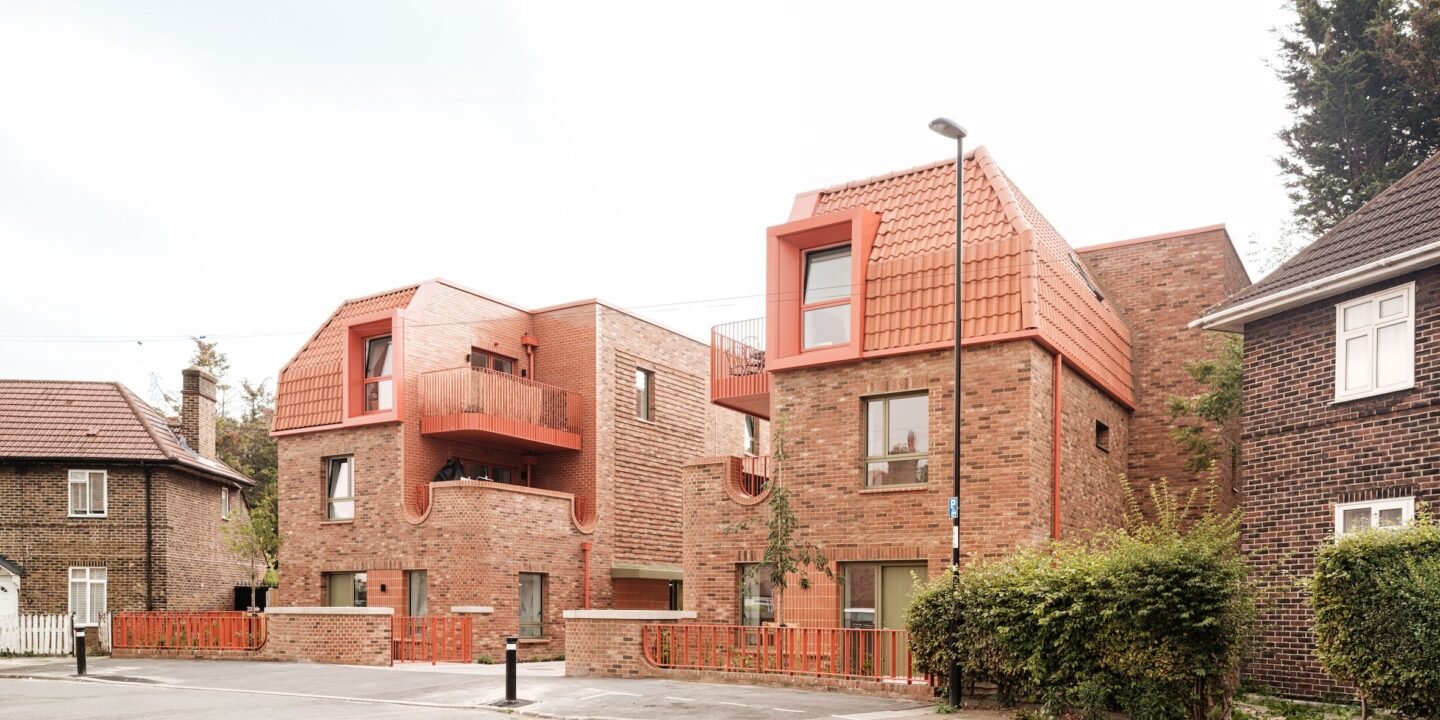
Located on the Bellingham estate, managed by Phoenix Community Housing, Farmstead Road sits in a neighbourhood of 2,600 homes, many of which are Arts and Crafts designs originally built during the post-First World War era. Taking on a small 1,970 sq m infill site, architects have stitched in 24 new homes built to impressive Passivhaus standards. They include 18 London Affordable Rent homes and six available through shared ownership.
At street level, the scheme maintains the surrounding estate’s characteristic low-rise suburban feel. Its three-storey volumes are carefully composed to appear visually smaller from the street. Leading into the site, two symmetrical wings of the building hug the site’s edges, forming a central communal courtyard. Inside, a semi-exposed staircase acts as the central spine from which gallery walkways branch off to residences, creating a soft sense of communal quarters shared by residents, not just dead circulation space.

(Image credit: Fred Haworth)
Ascending the building, large arched openings provide views across the site. Inverted arches and scallops bring a playful twist to balconies and façades, with curved motifs repeating throughout. Meanwhile, lift shafts and technical kit visible from the street are disguised as oversized chimney shafts, clad in dogtooth brick detailing – adding a distinct Arts and Crafts character to the very practical requirements of multistorey housing.
In achieving Passivhaus credentials, the building is designed to maximise volume and reduce heat loss. Homes are also fitted with triple glazing, super-insulating walls and MHVR systems, which mechanically ventilate homes, keeping residents warm in the winter and cool in the summer – an approach that will reduce energy consumption by up to 90 per cent.

(Image credit: Fred Haworth)
With mounting pressure to quell the UK’s housing crisis, and a pressing global need to build energy-efficient homes, project manager at Phoenix Community Housing, Anthony Kelly, remarks, ‘It’s less about ownership and more about stewardship.’
Though going for Passivhaus is more expensive than conventional construction, he continues, ‘it’s about longevity, it’s easier, better for us as landlords that these buildings last and take care of themselves, so it’s worth the investment’.

(Image credit: Fred Haworth)
In revisiting a quintessentially English typology in ways that respond to global needs, new builds can be playful in their interpretation of ‘new’. While Passivhaus developments are still few and far between, Farmstead Road embraces an unconventional marriage of craft and ornament with technical energy efficiency, proving that seeming opposites can, in fact, attract.

(Image credit: Fred Haworth)
[ad_2]
Source link