
[ad_1]
WEAVING is slowly becoming a dying art as younger generations are reluctant to carry it forward.
After all, clothes are readily available with fast fashion dominating today’s market.
However, fast fashion brings its share of environmental problems, especially mounting waste in ecosystems.
For Kelsey Merreck Wagner, an artist and anthropologist from the US, her fascination with weaving began when she embarked on her PhD dissertation in anthropology in Thailand.
“Thai artists use art as a form of expression to protest or talk about environmental issues.
“When I visited Chiang Rai, the women shared how their weaves tell stories, blending motifs of people and nature.”
Inspired by local weaving traditions, Wagner deepened her craft with a North Carolina community before evolving into a social-practice artist.
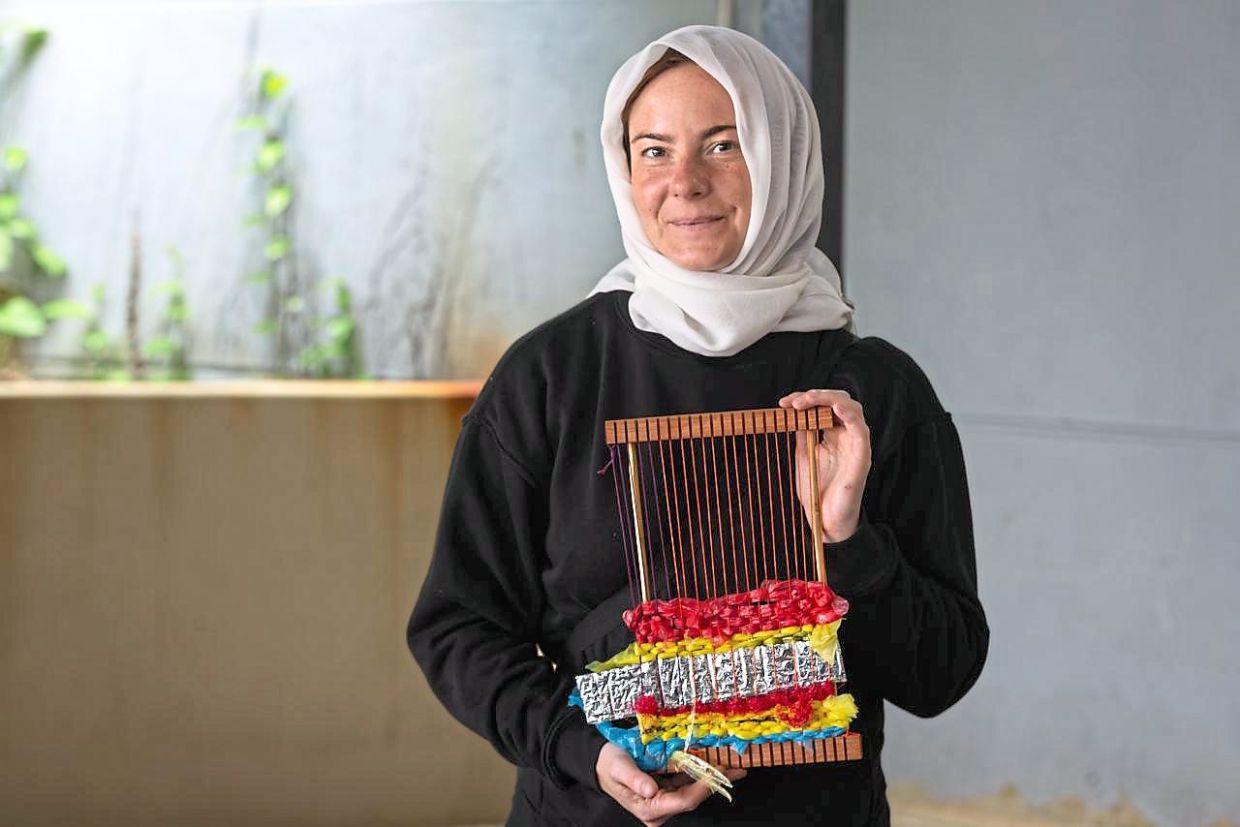 Wagner showing a weaving with plastics work in progress.
A social-practice artist uses art to engage communities and confront social issues.
Today, she collaborates with artists, educators and residents through research, workshops and public art projects.
Wagner is also a curator with a history of exhibits focused on socio-cultural-environmental issues.
As part of her cross-Asia project – Threads of Change – Wagner brought her Trash Weaving Workshop to Malaysia.
She led a workshop for public housing communities under Think City’s Kita-Untuk-Kita (K2K) programme held at the Seri Kota Public Housing (PA) in Kuala Lumpur.
“The North Carolina community grew cotton and made yarn from alpaca wool.
“They also used natural dyes derived from plants,” said Wagner.
During the Covid-19 pandemic, she ran out of yarn and refused to buy mass-produced options sold online.
“I try my best to support small businesses and used to buy yarn from small cottage industries.
“During the pandemic, many of these businesses shut down due to restrictions and a lack of manpower,” she said.
“That was when I came across a YouTube video of people crocheting with plastic, and these pieces could be used as mats or even worn by the homeless.
“I liked the idea and began recycling plastic into yarn or what is known as plarn.”
Wagner said her family and friends started giving her their unwanted plastic bags and she began weaving with them.
“This gave me the idea of raising environmental awareness through this concept of recycling plastic,” she added.
In addition to weaving, Wagner partners with university students on clean-up drives along rivers and coastlines.
Discarded items are then turned into artwork as part of her awareness campaign.
“I hope people won’t be so quick to discard reusable items like old clothes,” she said.
“We should look into repurposing them and I want people to see the importance of sustainable fashion.
“We need to be mindful of our plastic consumption. Creativity must be part of sustainability.
“We need new solutions for our old bad habits.”
She emphasised the importance of community.
“It is important to engage with our communities, and build solidarity to help protect the environment,” said Wagner.
K2K programme director Dr Shahridan Faiez Mohideen Abdul Kadeer said the initiative was a pilot effort to develop deeper insights into Malaysia’s public housing communities.
“We have four types of programmes under K2K – social platform, social spaces, social champions and social network.
“This weaving workshop falls under the social platform initiative which aims to identify community projects that can align with Think City’s goals.
“Through this project, we can address the high waste concentration issue in PA communities.
“The potential for recycling and reusing waste is still largely unexplored,” said Shahridan.
Izan Ismail, 59, a workshop participant, said she enjoyed the session and plans to use her new skills to make floor mats.
Participant Zubaidah Mat Daud said she had accumulated a lot of leftover fabric and would put it to use with her newly learned weaving skill. — By SHEILA SRI PRIYA
[ad_2]
Source link