[ad_1]
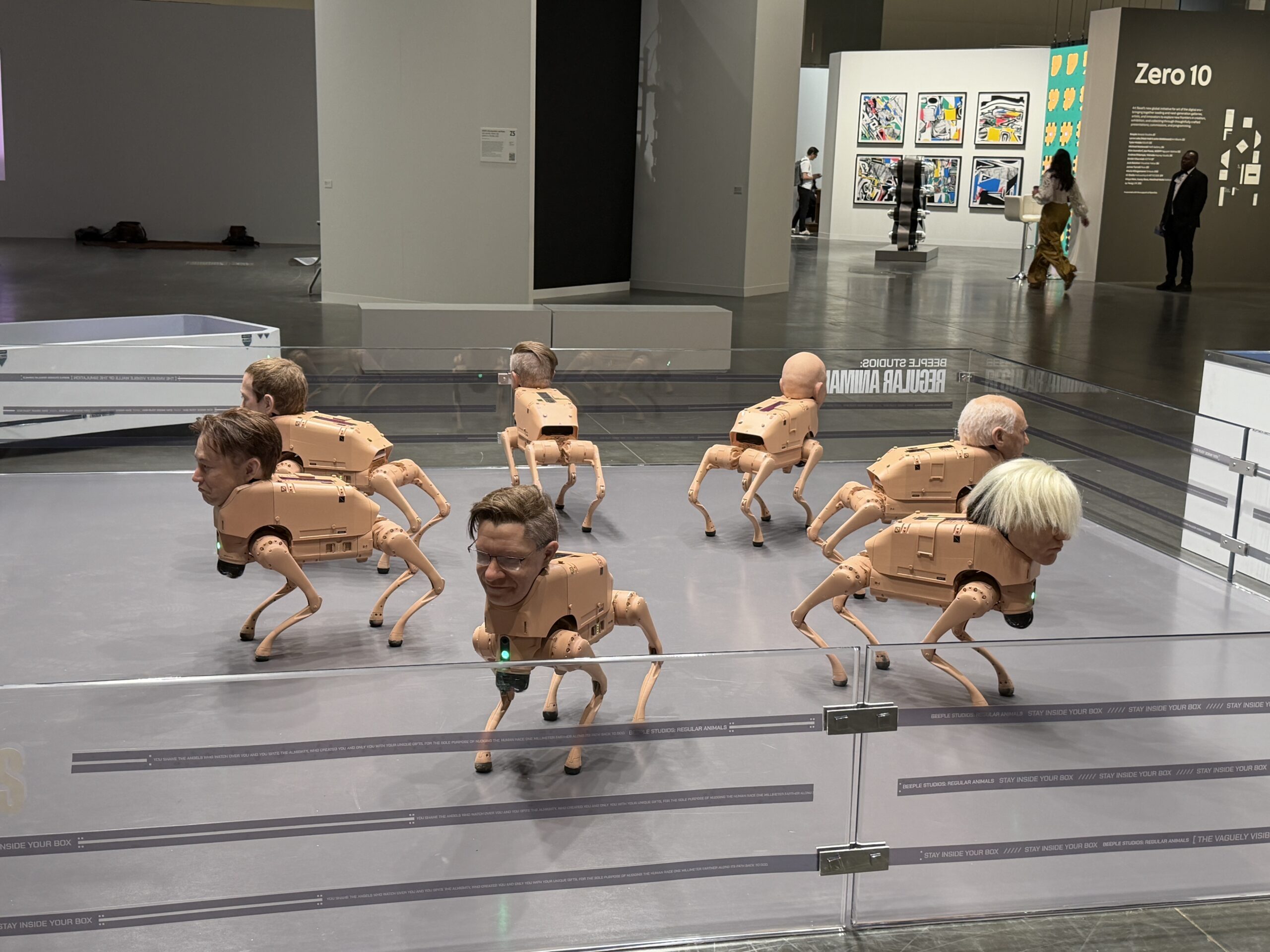
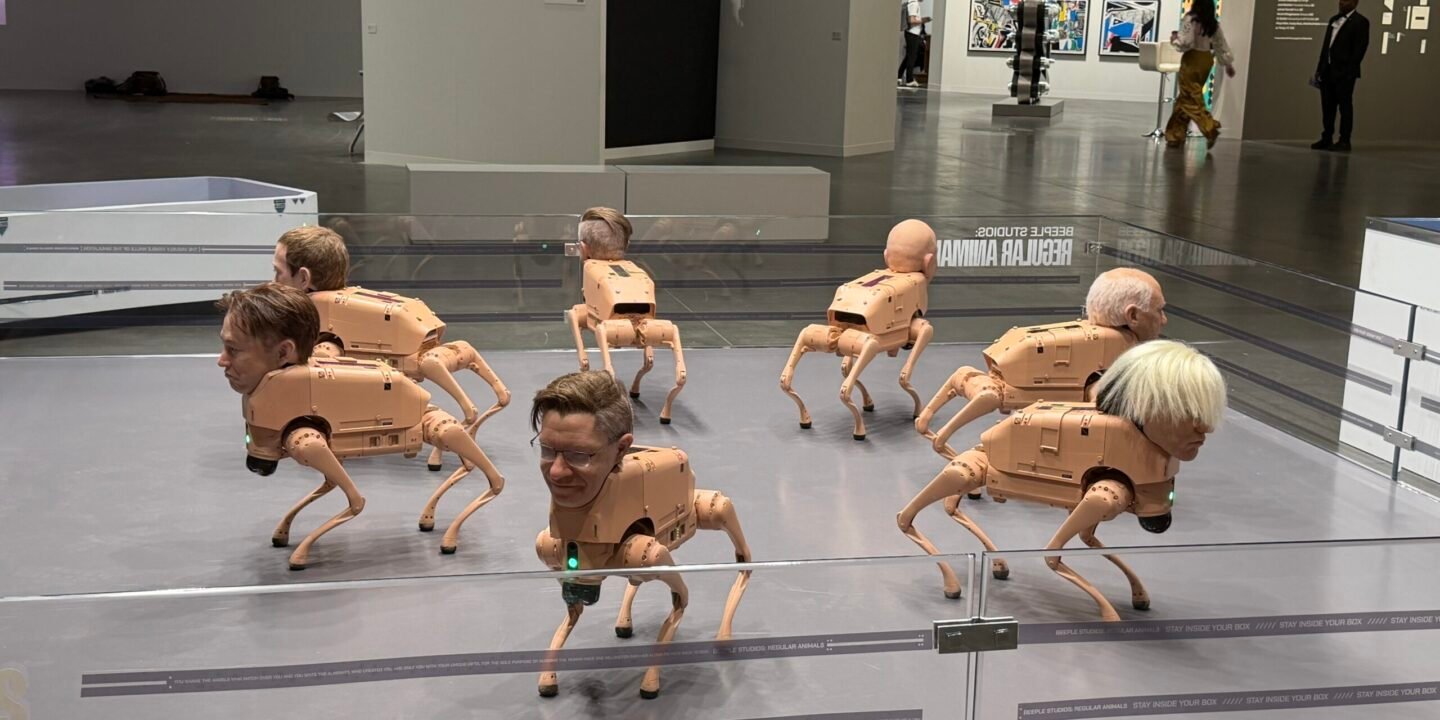
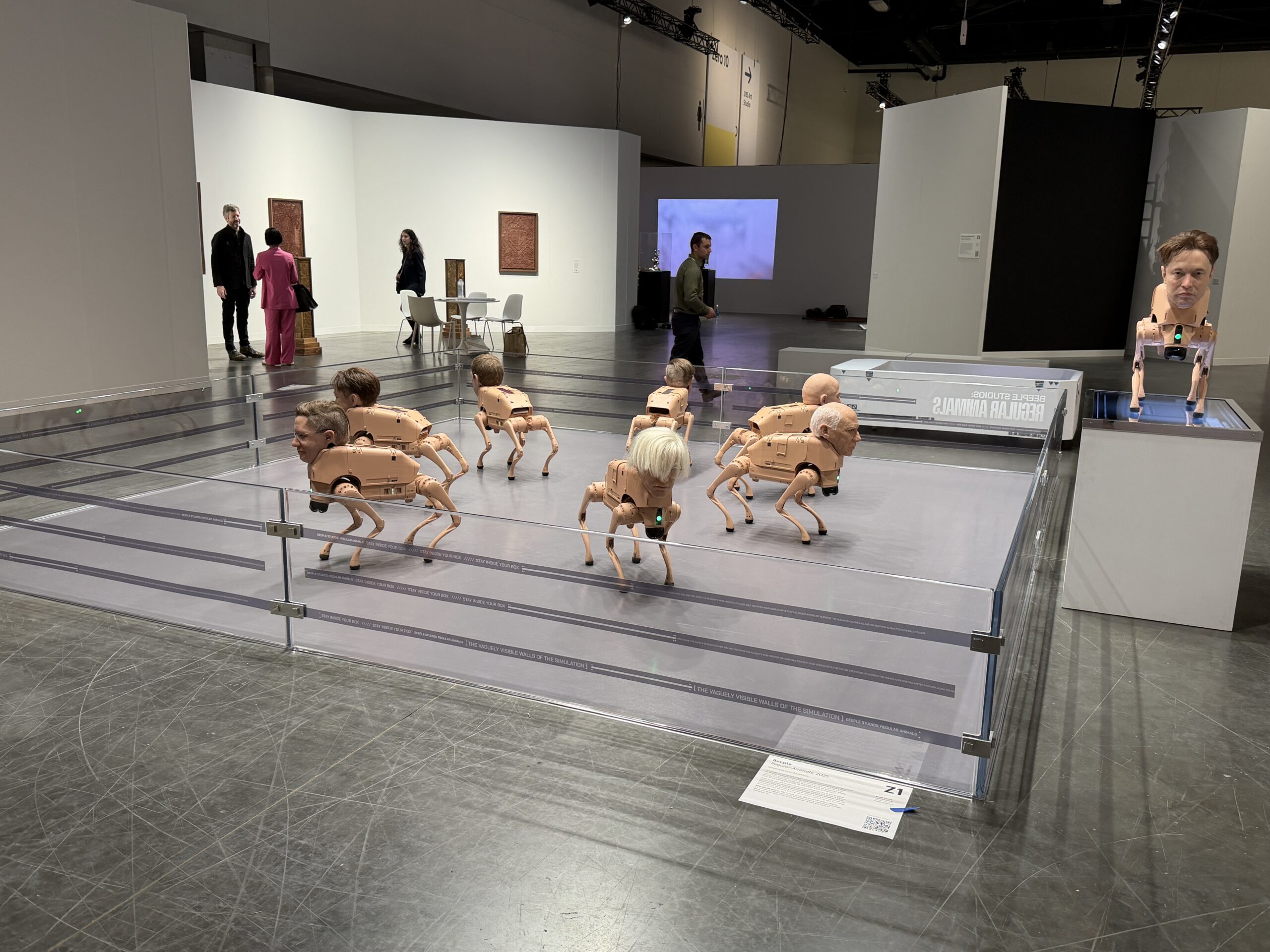
For two weeks in April and May, visitors to the Neue Nationalgalerie will encounter an enclosure of canine-human hybrids fitted with the hyper-realistic silicone heads of Elon Musk and Mark Zuckerberg. These tech billionaires, roaming alongside blue-chip art-world avatars, document their surroundings before defecating AI-generated prints. Absurd and faintly menacing, the setup is typical of Mike Winkelmann, better known as Beeple, whose lurid, meme-saturated images are helping to define a new, digital, visual culture. Beeple first became known in the art world in 2021 when his landmark NFT-based digital artwork ‘Everydays: The First 5000 Days’ sold at Christie’s for $69 million. Since then, he has moved beyond the screen, staging increasingly physical works that explore how technology shapes perception and power.
Your sculptural installation Regular Animals caused quite a stir when it was first shown last year. What’s all the fuss about?
It’s because people haven’t seen anything like it before. That’s the biggest thing I’m trying to do – and that’s hard on a deeper conceptual level. Every seminal artwork was the first time somebody did something. At first people are like, what? And then they see how it moves the needle forward. That’s what I’m attempting to do with all the artworks I make.
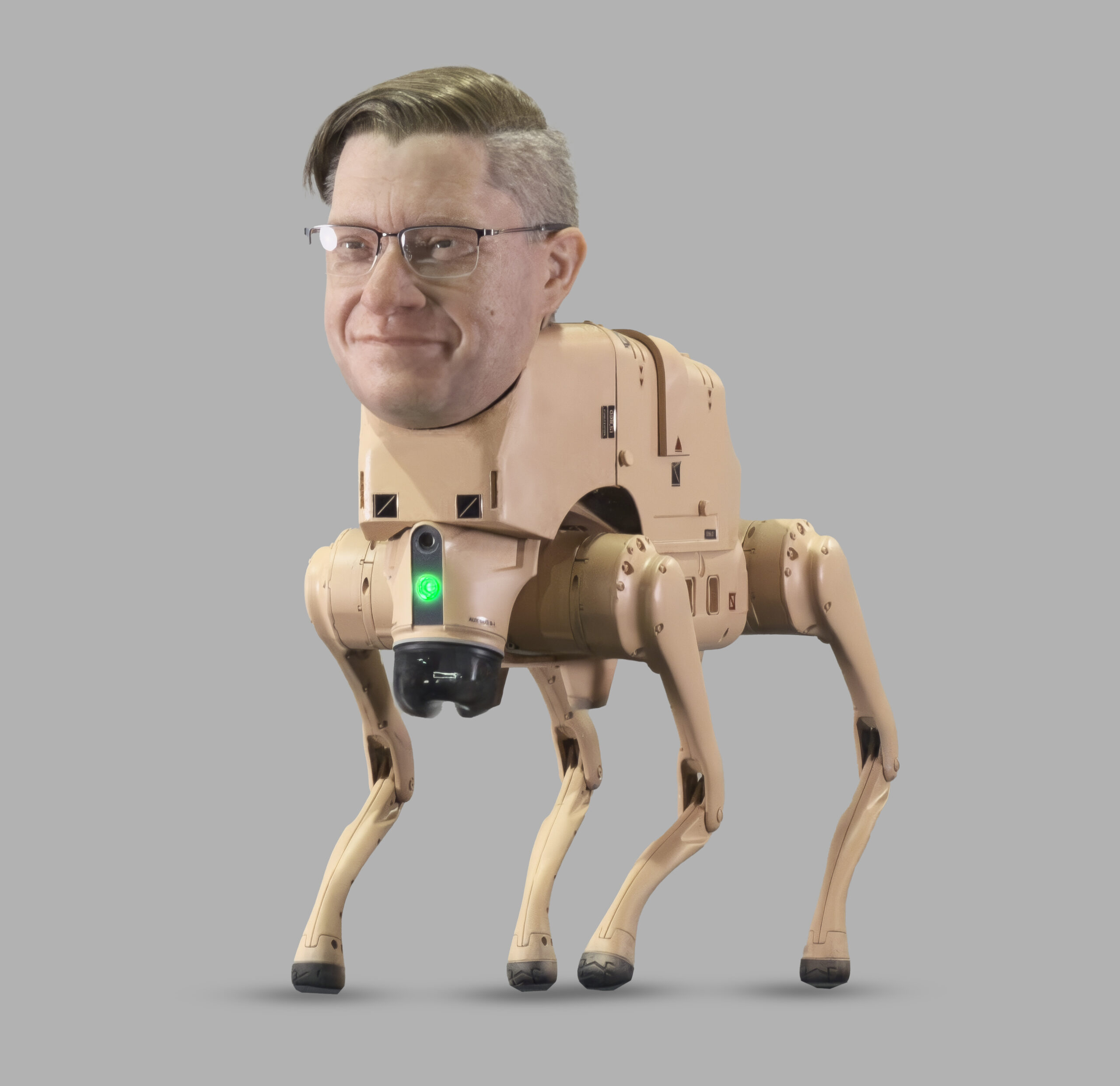
Each mechanical dog has a famous person’s hyper-realistic head attached to it, but they’re doing something else as well…
They take pictures, rank them with algorithms, reinterpret them with AI, then poop out a print.
Well, the dogs are walking around autonomously and taking pictures of things. Then they reinterpret those images using AI through the lens of each character. So the Picasso ones look like Picasso, the Warhol ones like a Warhol print, the Zuckerberg ones like the metaverse, the Elon ones like schematics and blueprints – and then they poop out those prints.
So they’re defecating visual culture…
We don’t know what they’re going to see, what they’re going to take pictures of or what they’re going to produce. To me, that’s analogous to how things have changed. In the past, artists shaped how we saw the world. Picasso and Warhol changed how we understood culture. Now, tech billionaires shape perception through algorithms that decide what we see and what we don’t. If we’re getting a view of the world through social media, we’re already looking at it through their lens. That was the idea behind those specific people.
You’ve also included yourself as one of the dogs. Is that a form of self branding?
That was a self-portrait, to make it clear it’s not an indictment of anybody. A lot of people thought I was making fun of Elon or Zuckerberg. But look, there’s me. I’m one of the dogs too. And at a higher level, we’re increasingly anthropomorphising technology and AI in ways that are going to lead us to some weird places. You hear people say, “AI has no soul.” Of course it has no soul – it’s a computer program. I’ve never heard someone say Windows has no soul. Or my refrigerator has no soul. It’s a fucking machine. But people say that about AI because it seems so much like a person. These half-human, half-machine figures point to a future where we’ll have bizarre conversations about machines getting human rights. Seen as people, treated as people – with feelings and emotions. What is consciousness? Are these AIs feeling emotions? They’re so good at mimicking. So that was also part of the reason I put myself in there.
It’s also all men. Was that a conscious decision?
Yeah. Very conscious decision. Do you think I would put a woman on a dog body?
One of the reasons it attracted so much attention is its ambiguity; you’re not sure whether it’s a joke, a mocking provocation or a serious warning about the future.
It’s not a joke. It’s meant to be weird. The reason it’s called Regular Animals is because I strongly believe this will be normal, with dogs walking around – a pack of them fucking in your bushes and it’s like, “Get out of here, you stupid Elon dogs!” Do I think this is five years away? No. But 50 years away? Maybe. The things that seem weird and bizarre now will be regular in the future. So it’s trying to get people to talk and have conversations around AI, robotics and things that are going to be hugely influential and disruptive.
The printouts that people can take away – are they linked to an NFT?
Only if you claim it. Some will have a code you could scan to unlock an NFT. We’re trying to show that the idea that things are either digital or not digital is just not how the world is. This artwork is a sculpture, but it moves, so there’s choreography and programming. They have screens, they play video, there’s sound design. They take pictures, rank them with algorithms, reinterpret them with AI, then poop out a print. So it’s photography, printmaking – and some prints are NFTs, so it uses blockchain. It’s about making works that play in many different mediums. That’s exciting for me as an artistic practice.

Has there been any response to the artwork from Musk or Zuckerberg?
We’ve heard some stuff through their people. But honestly, I think that question shows how much people don’t recognise how much fucking power these people have. Zuckerberg and Musk are making humanity-level decisions that affect billions of people every fucking day. Zuckerberg could wake up and think, “I don’t think people need to see that much about this war in Iran,” tweak a couple knobs in the algorithm and suddenly the war in Iran just kind of goes away. Elon could decide they don’t need satellites over some country and turn off [Starlink]. Suddenly, you don’t have internet. They have an immense amount of power. The fact that they would give any shits about this fucking art project – I would hope not, actually.
The art world is still coming to terms with the impact of ‘Everydays: The First 5000 Days’, a monumental digital collage of 5,000 images that sold for $70 million in 2021, making you the third-most expensive living artist of all time. How did you cope with all that attention?
It was hard in the moment, because things were happening so fast – to appreciate how much of a what-the-fuck moment it was for the traditional art world. I didn’t understand that world at all. I truly didn’t know the difference between a gallery and a museum. I didn’t know galleries sold work and museums exhibited work, so I wasn’t aware it would make people mad.
And I’m still like: you can turn over a fucking urinal and call it art, or tape a banana to a wall, and nobody questions that, but I sit at a computer for 13 years making images with ideas, colour values, craft, intention, and people question whether that’s art? I still don’t get that.
And you’re still doing one work every day?
Yeah and on May 1, it’ll be 19 years.
How long does one artwork take you?
About two hours. But now it’s almost too fast. With AI you can make something in two seconds. The possibilities are almost too easy, which makes it harder, because there are no constraints. Before I had limits. Now it’s like: what do I even do?
Do you worry that AI has the potential to undermine the role of the artist?
I don’t think it undermines the artist as long as we’re directing the machines. It’s still a tool. When we’re not needed anymore, then we have much bigger things to worry about than art. I’m nuanced about AI. There are things I’m worried about – it’ll be extremely disruptive – but I’m also inspired by the possibilities. It’s like a new paintbrush. It’s not black or white; it’s pretty grey, but it could have some bad outcomes too.
Many see digital art, like street art in the 1980s, as a new form of expression, challenging the elite art world. Is that something you consider?
I don’t think it’s important to me, necessarily. My art isn’t really trying to undermine anything; it just has its own distribution channels. Normally, if you want your work shown, you have to get a museum or a gallery to agree to show it, versus with social media, where I don’t need anybody’s permission. If people like it and want to engage with it, they can do that without any intermediary. That’s just how I’ve always operated. Until the NFT thing, I wasn’t even aware of the art world, to be quite honest.
There’s no necessity for you to have a gallery?
We’ve worked with galleries in the past, but not now. None of the galleries operating at the level we’re working at have shown huge interest in digital art. And we can self-fund projects, like spending half a million dollars on robot dogs and bringing them to Art Basel Miami! So besides the Rolodex and validation a gallery provides, there’s not a huge logistical need.
Digital art still makes some people uneasy. I was listening to your Artnet podcast and the host suggested, not necessarily negatively, that your work has a kind of ‘brain rot’ quality…
I think people label anything they don’t like as ‘brain rot’ now. It gets thrown around too much. But I understand where he’s coming from. I’ve made design considerations to make the work more viral and effective on social media. That means it’s more punchy, because I have a very small amount of time to make an impression, so I’ve consciously made choices to make the work accessible to a wider group of people. That’s not in vogue with the intellectual Illuminati of the art world. Don’t make it so the average mouth-breathing idiot can understand it!
I was going through the archive on your website, looking at your old works, and above them you’d written: “If you actually take the time to look at these please murder me, then murder yourself!”
There really is some terrible, terrible work in the archive. But that does sound like the kind of thing I would say.
But you seem to take a refreshingly sceptical approach to your own work.
It’s not scepticism. I just can’t lie and say something’s good if I think it’s not. I actually hate most work other artists do. I think it’s crap. When they say it’s the greatest thing ever, it feels like a sales pitch. I have to put out a picture every day. I’m not under the illusion I’ll make 365 bangers a year. Some are just – I ran out of time. It is what it is.
Regular Animals, Apr 29-May 10, Neue Nationalgalerie
[ad_2]
Source link