[ad_1]
Phantasmagoria at the Henry Moore Institute in Leeds is a major group exhibition that directly confronts how digital technologies are reshaping the physical boundaries of contemporary sculpture.
The show explores a massive cultural phenomenon: the unexpected collision between ancient folklore, occult practices and modern digital networks. By fusing traditional storytelling structures with tools like artificial intelligence, 3D printing and video game mechanics, the exhibition aims to show that the immaterial internet is inherently tied to a physical apparatus of devices and server farms. Sculpture, the exhibition argues, is uniquely equipped to bridge our virtual and material realities.
The title refers to the late 18th century theatrical spectacles that used smoke, lenses and projected light to conjure ghostly apparitions for audience entertainment. Later, Karl Marx and Walter Benjamin used the term to critique the seductive, deceptive illusions of commodity capitalism. The artists collected here are similarly attuned to the modern enchantments of digital technology.
Phantasmagoria – quick links
Digital folklore
This thematic framework is established before you even enter the building. Emblazoned on the institute’s black granite facade is Cazimi (2026), a collective sigil by Joey Holder featuring elements from every exhibiting artist. In astrology, a cazimi – when a planet passes through the exact heart of the sun – signifies a rare moment of clarity and materialisation. Timed precisely for the Mercury cazimi during the show’s opening on 14 May, the work’s triptych structure echoes a traditional altarpiece designed to open a threshold to a supernatural realm.
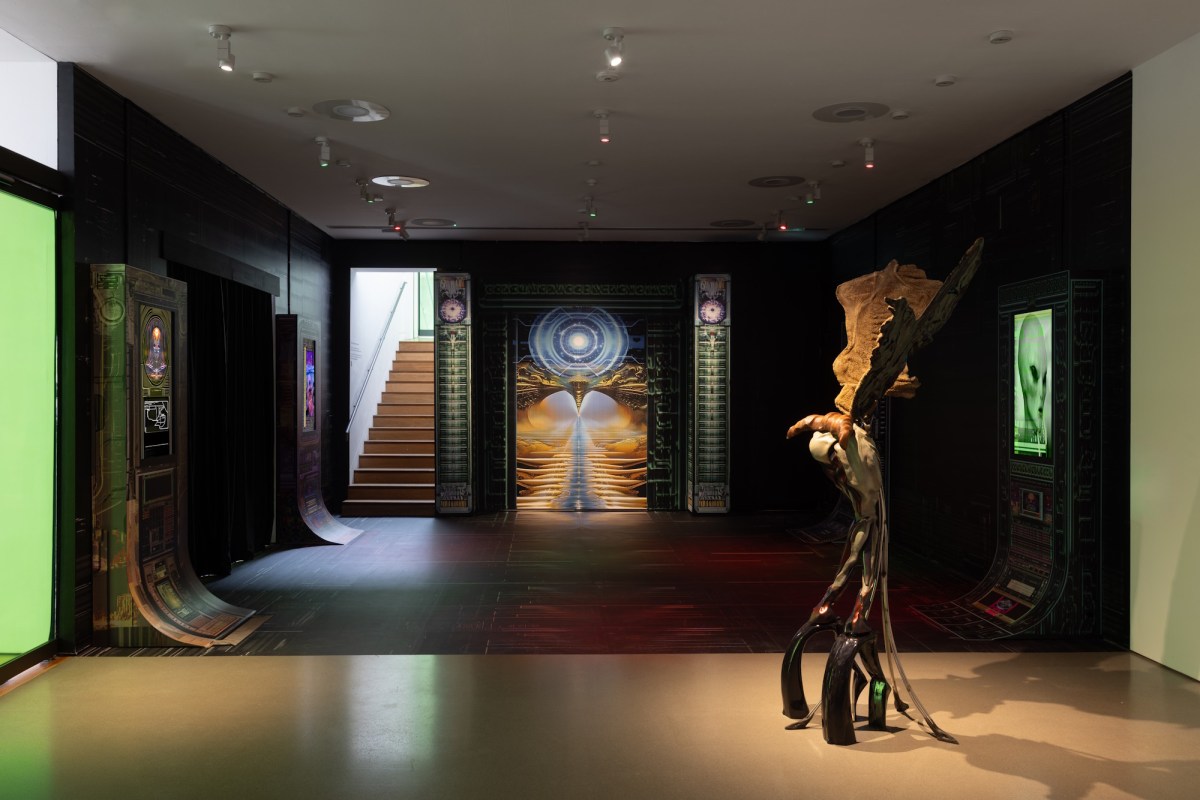
Once inside, visitors plunge into Holder’s immersive installation, The Woosphere. The space is transformed into a dark, narrow corridor wrapped in digitally printed vinyl and wallpaper, vibrating with the sharp neon palette of 1990s internet and rave subcultures.
Four arcade-style video game consoles sit positioned opposite one another. On the screens, four distinct characters – philosopher Jean Baudrillard, an alien intelligence named LAM, a lab-grown synthetic brain and the Golem of Jewish folklore – speak over one another in a discordant loop.
Holder organizes this architecture to mimic the physical impact of a Gothic cathedral or a pagan stone circle. It functions as a direct satire of modern digital networks; rather than producing a unified global consciousness, the work forces the body into a fractured, chaotic echo chamber of online dogmas and internet memes.
ArtsHub: Katharina Grosse review: painting as an explosion at White Cube
The exhibition shifts from information overload to an eerie material stillness with Jürgen Baumann’s work. His Piggod or the Lernaean Serpent – a three-piece deep drawing relief made from clear polystyrene glazing – is the perfect counter to the exhibition’s many screens.
Formed using heat and vacuum suction, it hangs in the gallery like the translucent hull of a cathedral window. The curved polystyrene warps the gallery walls behind it. The molded figures of monsters, grinning faces and skewed walls are barely visible – you must watch the slow reflection of the gallery lights bend across the clear surface to understand the form.
Screens as talismans
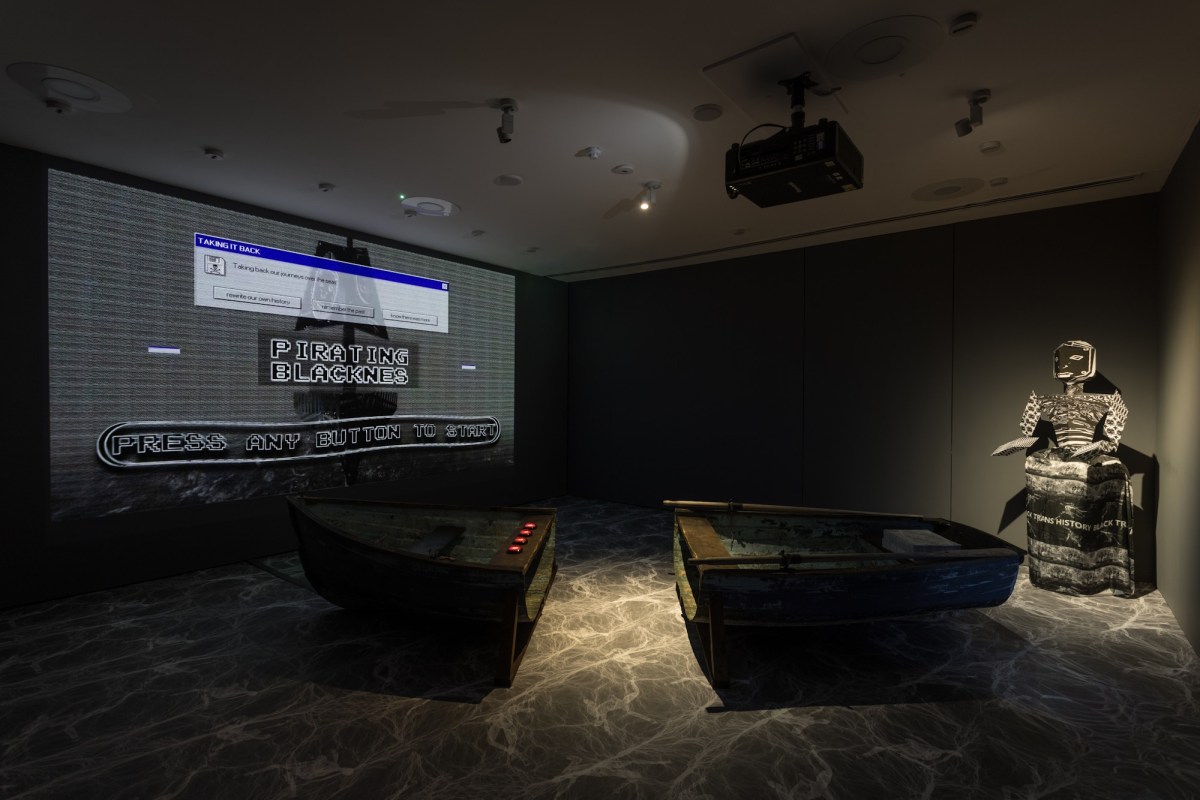
The climax of the exhibition is Danielle Brathwaite-Shirley’s PIRATING BLACKNESS (also known as BLACKTRANSSEA.COM). The installation centers on a medium-sized fishing boat that has been cut completely in half, outfitted with four interactive buttons.
The visual language taps directly into the current, ultra-trendy resurgence of Y2K and early 90s 3D graphics, using a low-fi, muted palette of black and white with sudden highlights of visceral red. The work treats folklore as a living archive, asking what the ocean would say if water held the memory of the slave trade.
When you approach the console, the game forces a choice: you must select whether your ancestors carried people across the ocean or were carried across it. Your progress through the game is entirely determined by this choice, making the viewer explicitly responsible for the narrative that unfolds.
Brathwaite-Shirley deliberately strips the work of easy aesthetic comfort. You are blocked from leaving with a passive appreciation of a beautiful object; instead, you leave carrying an intimate, confrontational ‘I’ statement about your own positioning in history.
Stepping back out onto the Leeds streets past the black granite façade, the ordinary world feels temporarily flattened. Phantasmagoria succeeds because it moves past the standard cliches of digital art. By emphasising the heavy, sculptural presence of these installations, the exhibition demonstrates that our screens are not windows into an empty virtual void, but physical talismans that actively resurrect ancient ghosts and enforce historical reckoning.
Phantasmagoria: Folkloric Sculpture for the Digital Age is at the Henry Moore Institute, Leeds until 31 May. Entry is free.
The writer travelled to Leeds with the support of the Henry Moore Institute.
Discover more screen, games & arts news and reviews on ArtsHub.
[ad_2]
Source link