[ad_1]
The project is also the latest expansion of the Evanisko Project, a long-running partnership between Penn State’s Department of Graphic Design and the University Libraries, which was created to showcase student creativity while solving real campus challenges, increasing visibility of the libraries.
Joel Priddy, head of the Department of Graphic Design and one of the faculty members involved in developing the Evanisko Project, said the initiative began in 2021 when donors Mike and Cynni Evanisko approached the Libraries about gifting a single artwork. Priddy and Professor of Graphic Design Phil Choo suggested a broader concept that would continually feature student design work, calling it a “process.”
That process sends students into real environments to observe how people interact with spaces, information and services before designing solutions that improve those experiences.
“Externally, the Evanisko Project is an ongoing display of the creative work of Penn State students in library spaces,” Priddy said. “Internally, it is an experiment in scaffolding a single project throughout a student’s entire bachelor’s degree education.”
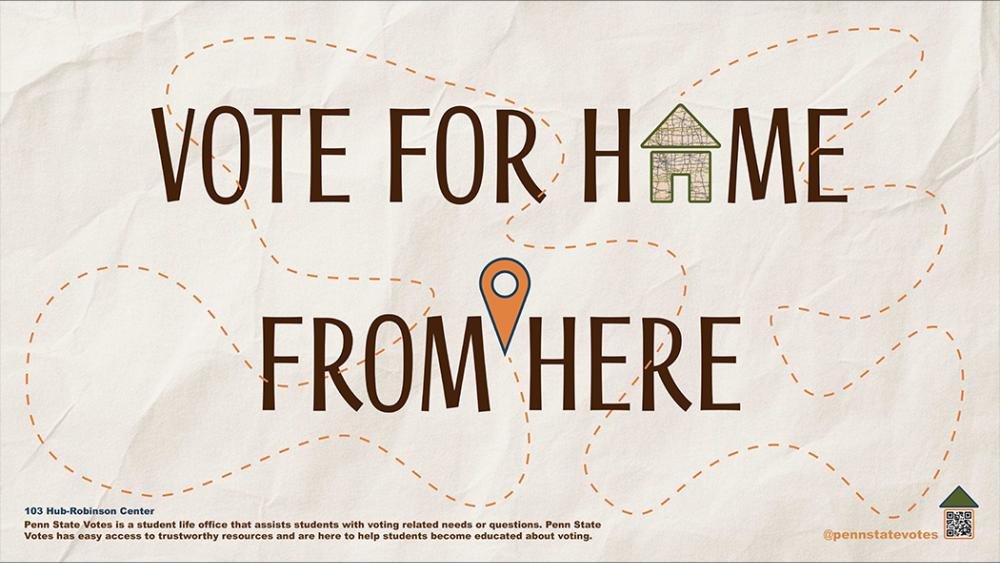
This year marks an expansion of that model through outside partnerships, with Penn State Votes serving as the first major collaborator with the Evanisko Project. Rather than focusing solely on library spaces, students explored information about voting and what obstacles they encountered.
Brooke Hull, assistant professor and the instructor of GD107, said the assignment is part of the course’s second major project, which introduces students to human-centered design.
Students first met with Mainzer, the Penn State Votes representative, to learn about the organization’s goals and audience needs. They then selected a narrow Penn State demographic — different from their own — based on Penn State Votes’ needs and conducted research through interviews, physical visits and user persona development.
Using human-centered design, an iterative design process that focuses on creating solutions that are rooted in the behaviors and needs of the audience, students compiled their findings and used that research to create digital advertisements tailored to their selected audiences. Hull said that the partnership gives students an opportunity to apply design methods in an authentic setting.
[ad_2]
Source link