[ad_1]
Until recently, few people had seen the only self-portrait Gustav Klimt ever painted up close. Height, not exclusivity, has been the constraint: it hangs 60 feet up in the air, hovering above the red-carpeted staircases of the Burgtheater in Vienna. Klimt is young and handsome, wearing a voluminous ruff and an intense expression as he takes in William Shakespeare’s Romeo and Juliet as performed for Queen Elizabeth at the Globe Theatre. His brother, Ernst stands nearby in red doublet, as does the painter Franz Matsch.
In the late 1880s, the three artists created 10 ceiling paintings for the stairwells of the new Burgtheater, a Neo-Baroque building that along with the Opera, Parliament, and Kunsthistorisches Museum formed part of Emperor Franz Joseph’s grand civic project in the heart of Vienna. The works would establish Klimt’s name.
The paintings were recently painstakingly restored with cotton swabs and purified water following water damage. Now, for the first time, members of the public can admire the brushwork of the brothers Klimt and Matsch at close range by clambering up the scaffolding (the theater advises visitors wear sturdy footwear). If you can get a reservation that is. All available tickets for the guided tours are currently sold out.

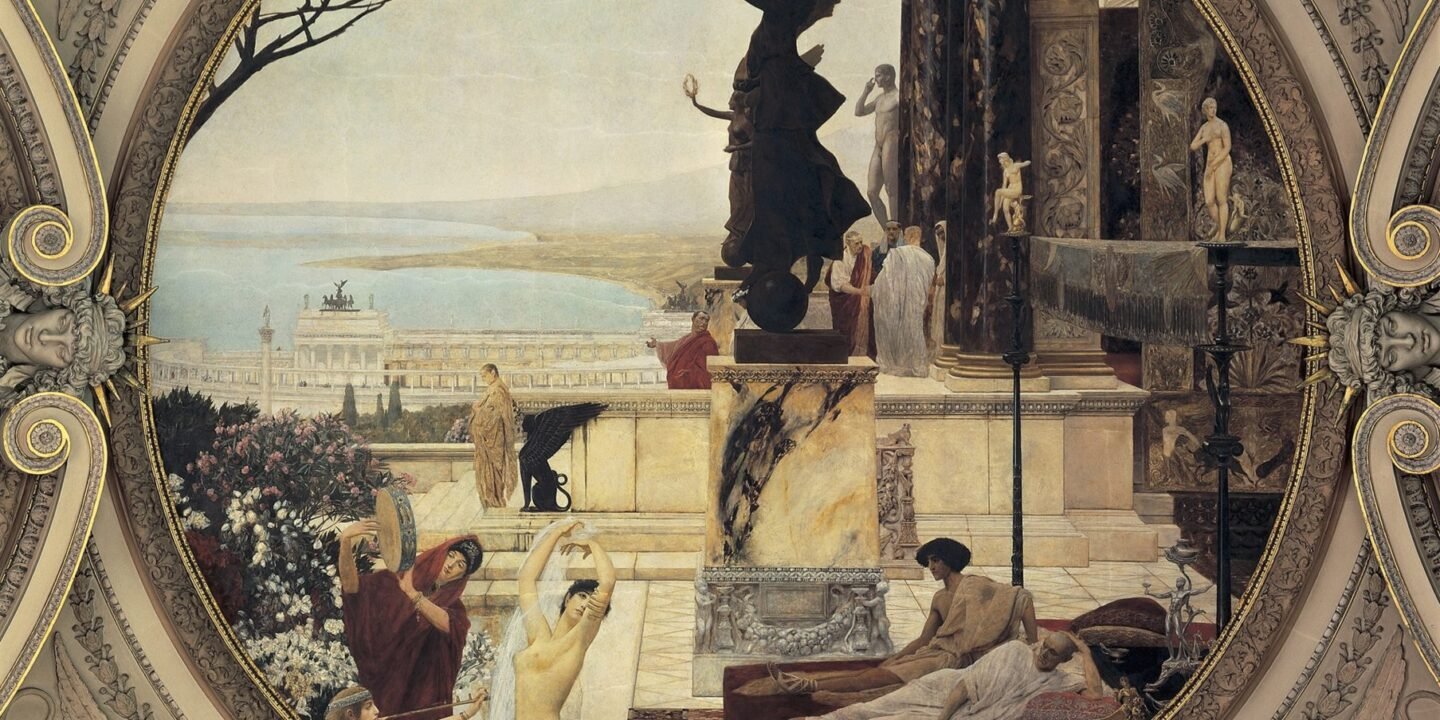
Gustav Klimt’s Altar of Dionysus from study for the ceiling painting of the Burgtheater, Vienna, 1886. Photo: Fine Art Images/Heritage Images via Getty Images.
As dictated by the commission, the paintings trace the arc of Western theatrical history from the Ancient Greeks through to the 19th century. Gustav Klimt captures the mythical beginnings of Greek theatre with a scene of Thespis, the “inventor” of tragedy, in white plaster makeup and stood on his cart that was supposedly lugged around Attica, modern-day Athens. Matsch offers a scene from Sophocles’ Antigone at the Theatre of Dionysus in Athens with the title character beseeching King Creon to allow for the burial of her brother. Ernst Klimt captures the 17th century playwright Molière performing to Louis XIV in an opulent room of heavy drapery and chandeliers. Elsewhere, there are depictions of a Medieval mystery play and a clown gesticulating on a fairground stage.
Unlike the ornamentation and abstraction that would be become the hallmarks of the Vienna Secession style he would champion beginning in the late 1890s, Klimt here is working within establishment traditions. They are naturalistic and historically accurate paintings that tell an immediately legible story (if you have excellent eyesight that is).

Interior of Historic Burgtheater (Court Theatre) at the famous Wiener Ringstrasse. Photo: Shutterstock.
Prior to breaking out on his own, large-scale public paintings had been Klimt’s bread and butter. He had studied architectural painting at the Vienna Kunstgewerbeschule and in 1883 opened a studio with his brother and Matsch that specialized in painting for theatres. The Burgtheater commission, however, was by far the trio’s biggest commission. Pitching themselves as fast, high quality, and affordable, they dazzled Viennese high society with the Emperor awarding Klimt the Gold Cross of Merit for the project.
Late last year, an easel version of one of Ernst Klimt’s ceiling paintings sold at Sotheby’s London for £2.2 million ($2.8 million). It depicts Hanswurst, a buffoonish character in German-language theater regaling a crowd in a Bavarian town and was completed by Gustav Klimt following the unexpected death of his brother at the age of 29.
[ad_2]
Source link