[ad_1]
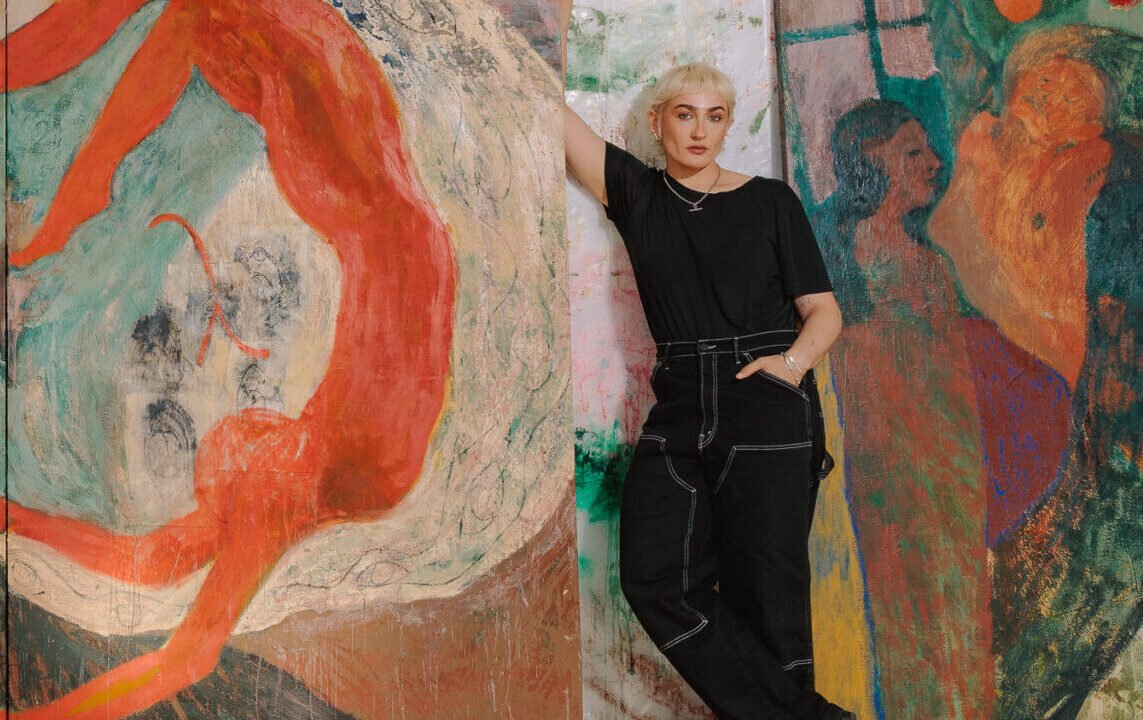
Chloe and Emma Fineman would argue that crafting a painting is just like cracking the perfect joke. The Berkeley-native sisters may have followed different paths professionally, but they’re still the first person the other calls when she’s blocked up creatively. Chloe, who is three years older, spends her weeks workshopping sketches and wearing out wigs as a cast member on SNL, while Emma moved to London to pursue visual art. One art form is stereotypically loud, the other, quiet. One takes place onstage; the other on walls. But if there were only one word to distill the sensibility that the two share, it might be “levity.”
Emma’s first solo show at Alexander Berggruen gallery in New York, on view through June 24, takes the joy of self-actualization as its subject. Much of it is rooted in the artist’s own journey towards self-acceptance as she slowly came to grips with her queer identity. She found that as she embraced her sexuality, her paintings got lighter too, fusing in streaks of vermillion over inky umbers and swathes of Phthalo green.
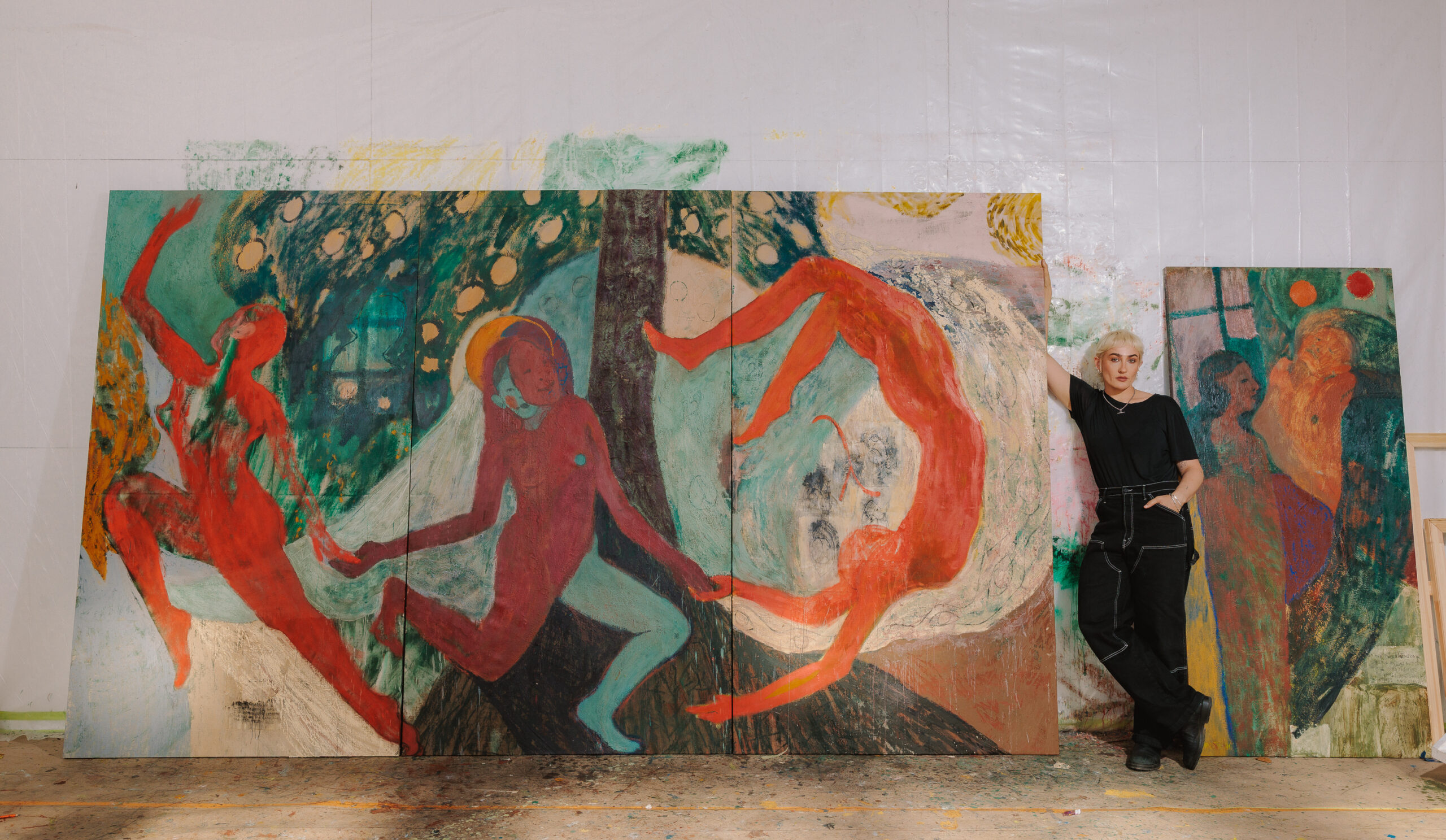
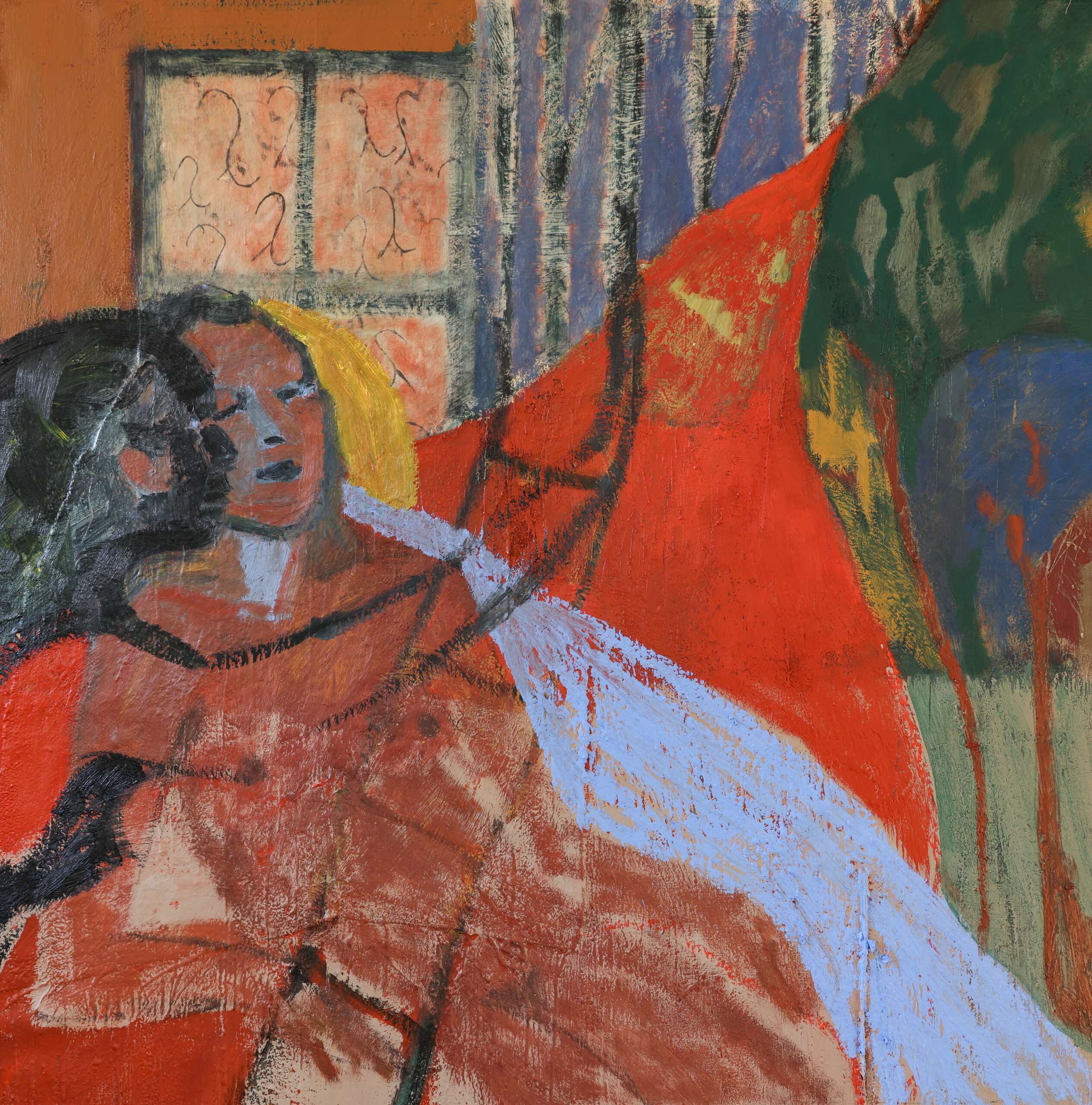
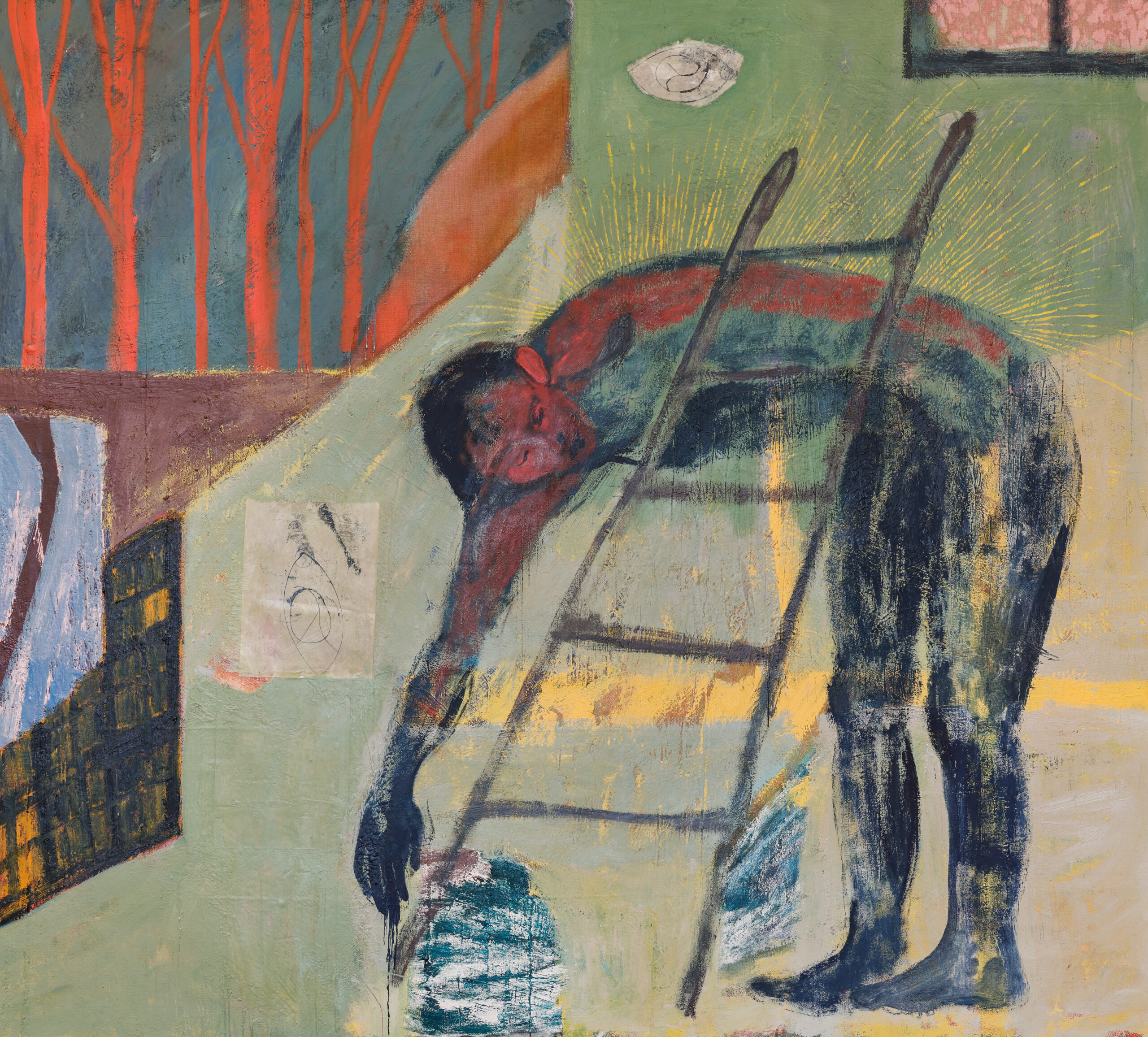
Although she was raised Jewish, Emma draws liberally from Christian mythology, particularly the Book of Genesis, to explore her own form of (self) creation myth, one in which women are not spurned for their desires, but celebrated. The resulting 18 paintings find bodies embracing, levitating, and bleeding into the warm color fields around them. Lambda (RYB), which takes its name from the Greek letter and a longstanding symbol of gay liberation, evokes Matisse’s The Dance with its frolicking bodies beneath a ripe fruit tree. In Ark, a figure and her shadow sit cheek-to-cheek in a moment of repose.
Philosophically, the sisters share a goal: They want to invite their audience in. They want you to be in on the joke, in on the fun. They laugh easily, even about their own moments of creative angst. If the principal tenet of comedy is “yes and,” then Emma’s paintings have an improvisational feel, iterating with glee on the queer visual histories that have come before. Below, Chloe and Emma get together before the show to talk about creative processes, late-in-life lesbianism, religious mythology, and prosthetic breastplates.
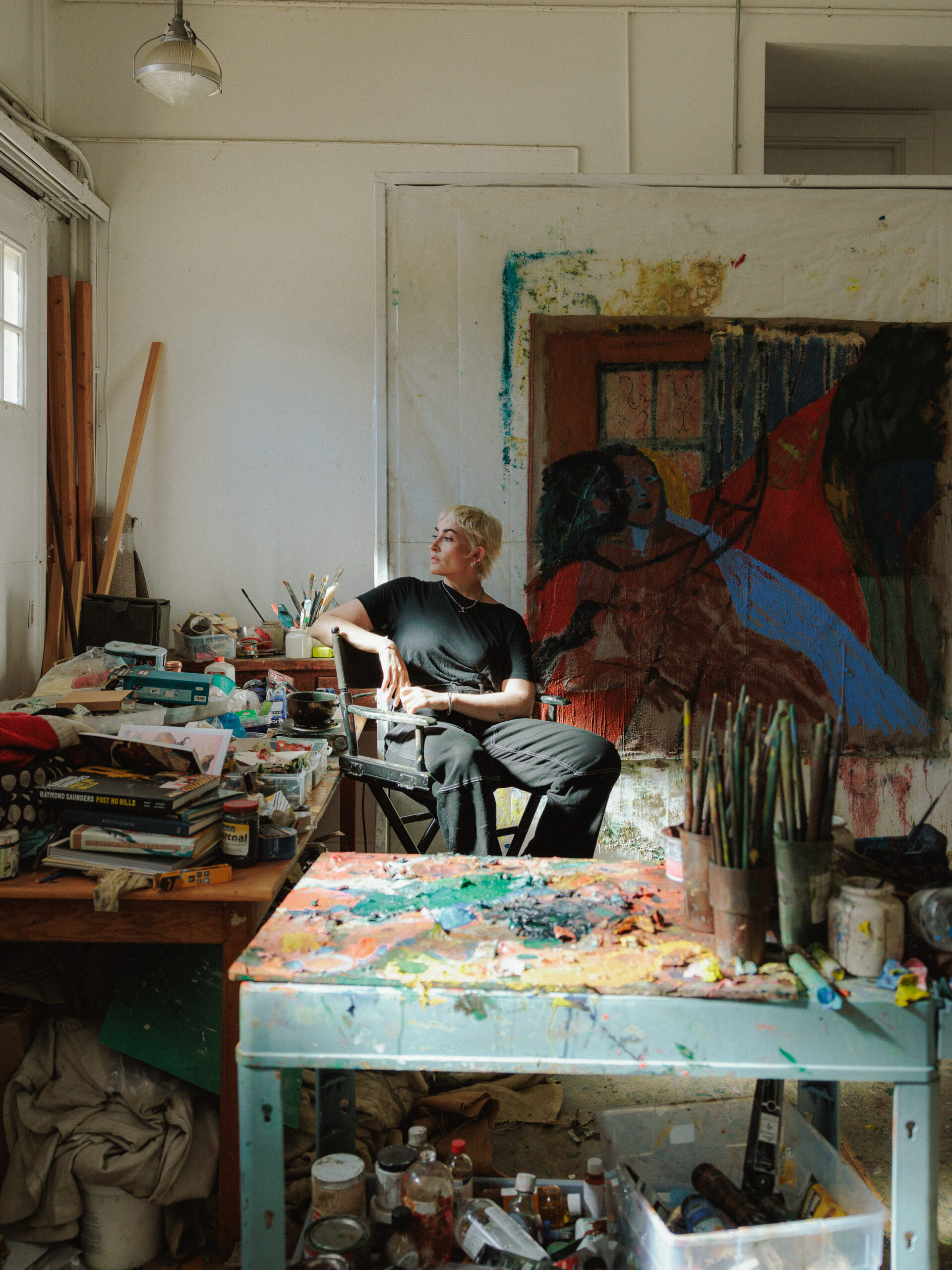
Chloe Fineman: You had your first show with Alex a little bit ago, right?
Emma Fineman: We did a group show with Alexander Berggruen in 2021, and it was awesome. It had Sholto Blissett’s work and Madeline Peckenpaugh. It was the first time I was invited to exhibit sculpture.
I was really excited to work with Alexander’s gallery because of their history with his dad’s gallery in San Francisco and growing up going to that gallery. I loved Alex’s program.
Chloe: And for our family, it’s very convenient because I have the last SNL show of the season, everyone stays in town, then we go see your show. This show feels very special because what I like about our sisterhood is that we’re both in the arts. And while it is extremely different, there’s an overlap of the creative process. When we hit walls, we turn to each other for help. What was the creative process like for your first show?
Emma: One of the things that happens all the time is I will be in the middle of working on something and get to a sticking point, and I’ll literally text you pictures of the painting and just write, “Is this hell?”
Chloe: “Is this hell?”
Emma: That’s a really good me impression. We love a good hell chat.
Chloe: We both have very fine-tuned artistic eyes. We’re both hyper-aware, some would say anal.
Emma: Growing up in our house, the fact that Mom was a painter, her father was a painter, and then our dad’s mom was a painter, we’ve been surrounded by constant conversations about painting. I actually really rely on and believe in your feedback. Something that’s really important for me when I’m making is understanding how someone else who hasn’t been trained in art might perceive something.
The same thing works vice versa when you’re working on any kind of impression or character, or you have ideas for things like that because I grew up watching you and dad do improv.
Chloe: I don’t know if you saw Gigi Hadid at the Met Gala where they asked her about art and then she was like, “The best advice I ever heard was that art should confuse you.” Which, to me, makes absolutely no sense. But I do think it’s important to widen your audience, and I think that it’s a really healthy thing that we can turn to each other because I can go to jaded SNL writers and you can go to jaded painter friends, but to have fresh virgin eyes for what you’re trying to make is so helpful.
Emma: The whole concept of being confused, I think, means being invited to ask a lot of questions, maybe.
Chloe: You should be her publicist because I feel like that’s probably what the quote was supposed to be.
Emma: It’s not a matter of being disoriented. I actually think that a lot of what we talk about is how you create a conversation where someone feels… invited. There’s enough familiarity. There’s enough beauty. There’s enough that you recognize in this, that you want to participate in it. Not just being slapped in the face and told you don’t know enough. And in that invitation, that there’s enough to grip you—a dialogue. It makes you want to look at it longer and really sit with it, and not just be told straightforward, “This is what this is about.”
I have a message behind what I’m doing, and there’s things that I absolutely am investing in the work that I’m making, but at the same time, I’m not here to hold your hand and tell you word for word what you’re supposed to take from it.
Chloe: What is your message for this show? What were you trying to convey?
Emma: This is my first show since coming out fully as a queer person, and specifically as a lesbian.
Chloe: I call you a LILL: late in life lez.
Emma: I’ve been out. I was out as a bisexual since 2014, but only these last two years did I really come to terms with what it means to fully just be a lesbian. I had been working on this whole project called “The Genesis Project,” which was about reframing the story of Genesis, where Eve is not the creator of the fall, but rather an icon.
Chloe: “Creator of the fall,” what does that mean?
Emma: Basically she took the fruit of knowledge, and people are like, “That’s the slut who bit the fruit. You’re a damned whore.” And actually, I think that the opposite is true. Pursuing desire and really attuning oneself to your core intuition—what your gut is saying that you want—and your relationship to the natural world, all of these things are so important.
Chloe: So for me, the dumbest woman alive, you’re saying that you reframed it where it’s not that she made this evil mistake, it’s about desire.
Emma: Eve isn’t the villain. She’s the victor. She’s the one that shows you how you can follow desire to understand your inner truth, and that is knowledge.
So this is my very first body of work since coming out, and I really wanted to create work about following my truth, my desire, my inner core, my gut, my intuition. I wanted to make a show that talks about the relationship of divinity to queerness because I think so much language separates those two things. Religion can ostracize queer people and separate that conversation. There is no more divine experience than the total encompassing love required to find and actualize yourself through the journey of queerness and share that love with another person. I really wanted to make a show speaking to that.
Chloe: There’s something very universal about your show. First of all, there’s way more color. I call it gay red in your paintings.
Emma: My favorite color, vermilion.
Chloe: That’s a new introduction in your work, which is so joyous. But I do feel like devotion to who someone is as a person—
Emma: —is such a universal thing. Definitely. It’s not just a show for gay people. In a lot of ways it is, but anyone can go on a journey of self-reckoning. Anyone can have a moment where you have to really sit with your shadow self and understand what it’s trying to tell you, and not necessarily hate it, but honor it, respect it. What are the things that your gut is telling you that you need to pay attention to, and how do you really stay true to that within yourself?
Where does creative magic happen in that world? Creativity is such a beautiful and spiritual experience because it’s where anything can be possible. There are certain ways that we box ourselves in as artists. But you are whatever you determine for yourself. I have such a strong commitment to self-determination. I really want people to understand that, regardless of how you identify, you have the power to create your life.
Chloe: That’s been a really cool thing we’ve shared in our sisterhood: constantly evolving alongside each other.
Emma: You remember you literally called me on the phone one day. You had been studying Chekhov and intensive theater and like really emoting from this hard, difficult place. Then you came to California, you went to some comedy classes, and you were like, “I wanna commit my life to making people laugh. I want to bring joy to people.” This phase of my painting is realizing how important and radical an act that actually is, and you’ve been so inspiring in that.
I want this show to be a celebration, not just a painful acknowledgement of all of the hurt, because there’s so much of it. The Trump administration is taking the gay flags off of the Stonewall Monument, which is right by where you live. But actually celebrating queer joy and liberation and dance with these gorgeous colors.
Chloe: Levity is a big thing both of us have tried to find in our work. I mean, I had to delete the news app. I’m completely out of touch, of course.
Emma: I think it’s a privilege to be.
Chloe: Yeah, it’s a question of, how do I help at this time? How do I contribute?
Emma: There’s also a part of it which is about radical self-love as well. It’s joy, and it’s also love. That love comes from a place of authenticity, regardless of what people will think. That was literally you creating the account @chloeiscrazy. You’re like, “Call me crazy. I don’t care. Say that I’m cringe for this. I’m gonna stay truthful to who I am.” And I really look up to that.
Chloe: What is your favorite painting of the show, and what’s a painting that really surprised you?
Emma: Lambda felt like a really important one because that was one where I finally allowed myself to use certain iconography to connect with my community. Instead of feeling like, Who am I to speak on behalf of queer issues? If I’m not, as a modern gay person, able to repurpose or recontextualize some of these really important motifs, then it means that I’m also disconnecting myself from my community.
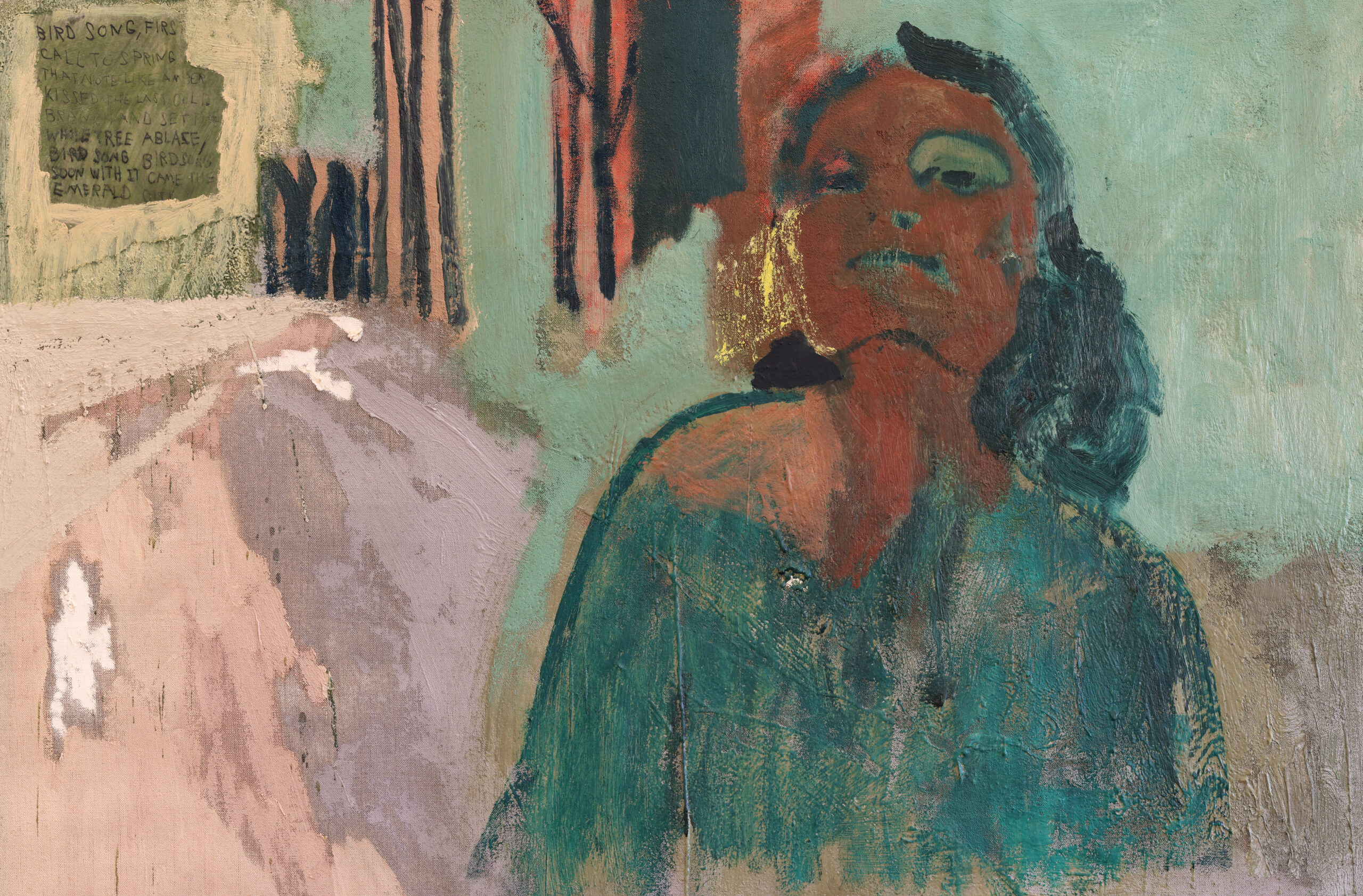
There’s also a portrait in the show called Birdsong. That painting is definitely one of my favorites. There’s a moment sometimes when you’re painting where you really feel like the work is making itself through your hand. That’s something that Philip Guston talked about in an interview with Hauser & Wirth years ago. It’s a real thing where you start channeling, and I felt like that portrait, her conviction, this kind of cocked expression and the confidence that comes through it just shot through in this insane, trance-like state.
There’s some text that’s written in the painting and this glimmering light catching her cheek. It’s that feeling after a long winter, after being closeted, after dealing with all of this feeling of loss, of shedding the former self, there is this extreme joy when you hear that first bird song that just tells you there is so much coming for you.
Chloe: How perfect that the show’s in spring too. What surprised me was the painting where you asked, “Is this hell?” actually turned into a wonderful painting that I really love.
Emma: Ark? That one was a struggle until the end. It went through so many transformations. At one point, the colors were very muddied and muted. And I had this moment of being like, “There’s so much life that’s missing from this. And then the whole composition shifted.”
Chloe: I love that. I’m laughing to myself because we really have such different paths. My weekend, we were having a real creative difficulty in the size of the prosthetic boobs that I had to wear.
Emma: How do I make my little A cuppies look like D cuppies? [Laughs]
Chloe: My creative journey!
Emma: I’ll be reading about how Poussin’s painting relates to Matisse’s The Dance and how to incorporate that into my work—
Chloe: —and we’re like, “The dress isn’t low-cut enough.” It’s 10 of us staring at these prosthetic, Sydney Sweeney boobs. [Laughs] It’s all relative, all different forms of creativity.
Emma: It’s about gender, about how we present ourselves.
Chloe: I’m technically wearing a chest plate, so it’s almost like drag.
More of our favorite stories from CULTURED
The A.I. Revolution Has Come For Next-Gen Jobs. Jodi Kantor Sees a Way Forward.
72 Hours in Venice: Palazzos, Protests, and a Biennale on the Brink
Air de Paris, a Radical Stalwart of the French Gallery Scene, Is Closing
Who’s The Next Obsession? 12 European Collectors Reveal How They Discover New Talent
For His Next Act, Kareem Rahma Is Going Beyond Hot Takes
Sign up for our newsletter here to get these stories direct to your inbox.
[ad_2]
Source link