[ad_1]
Anonymous artist SHL0MS turned a Monet Water Lilies painting into a viral performance artwork by posting it on X as AI-generated and asking viewers to explain why it was inferior to a “real” Monet. Thousands responded. Painters, critics, AI skeptics, and internet users dissected brushstrokes, composition, and aesthetics without realizing they were critiquing an actual Monet.
The work is also a reflection of the current AI zeitgeist. By presenting a real Monet as AI-generated, SHL0MS turns the audience’s own assumptions into the artwork. The provocation exposes shifting perceptions of AI, authenticity, and aesthetic judgment, from questioning whether image models can produce convincing images at all to debating whether they possess something more elusive: soul, intention, or authorship.
In conversation with Anika Meier for SLEEK, SHL0MS reflects on Inferior Image, conceptual art, virality, anonymity, misinformation, and why the internet itself should be understood as an artistic medium rather than merely a distribution channel. Together they discuss performance art after social media, online identity, NFTs, and what it means to make art in an era shaped by algorithms and artificial intelligence.
Anika Meier When I first saw your Inferior Image tweet a few days ago, my first reaction was: strong one-liner. How would you describe what you did with this artwork?
SHL0MS I posted an image of a Monet Water Lilies painting, said I generated it using AI, and asked the audience to explain why it was inferior to a “real” Monet. Thousands of people did, which then spawned a fairly dense series of recursively unfurling layers of discourse. I consider the entire saga to be a part of my pseudonymous social media-based performance art practice. It went extremely viral. I’m not really sure how to describe the scale. Marc Andreessen tweeted about it maybe 30 times, my favorite being: “A brief history of modern art. In 1917, Duchamp presents the porcelain urinal as art. In 2026, an X post from @SHL0MS finally succeeds in scandalizing the bourgeoisie.” A lot of people framed similar comparisons as a critique: “Well, this is nothing new. This is what Duchamp did in 1917.” Yes, and our world is different now. I do think we need to raise similar questions in relation to our increasingly complex world. That is not to say I actually agree that this was particularly Duchampian in form, but on a historical-context basis I understand the impulse to compare them.
AM What did people critique about the image they believed was an AI-generated Monet painting?
SHL0MS Just about anything you can imagine. It looked better upside down, the lilies were crudely drawn, the image was hideous and incoherent. There were people slinging pejoratives, as well as actual painters and art critics providing extensive critiques of all the compositional details that were clearly incorrect. The initial layer of people critiquing this Monet painting turned into a densely layered discourse. People replied to the tweet with different levels of knowledge about the work or about who I am. At the same time, I replied in different threads, trying to guide people toward making a constrained aesthetic critique under the assumption that we were talking about a Monet JPEG versus an AI-generated JPEG. It became this almost spatial tree: the original provocation, the replies beneath it that satisfied the criteria, and then the meta-commentary that followed, which was extensive and, frankly, exhausting.
AM And then you minted the JPEG.
SHL0MS I minted the Monet itself as an image. That raised another set of questions: what was actually the artwork? What happened on Twitter? Or was it the NFT? This is not new in my practice. I consider most of my art to be difficult-to-describe things I do on the internet, and have been doing for maybe nine years now. Every once in a while—actually, fairly infrequently—I mint an NFT related to it. I do not think this is particularly interesting, but it did become controversial in NFT circles, mostly because it sold for a relatively large amount during a dry period. I was also accused of money laundering, which is the standard NFT-world response to any sale someone does not understand. I do not know much about money laundering, but I feel like it would be a bad idea to do it through a viral artwork with millions of views and to use a public, immutable ledger to do so.
AM How do you describe your art practice to people unfamiliar with your work?
SHL0MS The practice itself is difficult to describe, whether in interviews or to people unfamiliar with it. The internet creates an interesting possibility for an extended identity-performance artwork. I am not the only person doing this, but I would like to think I am a serious practitioner of it. The internet allows you to spend one hundred percent of your time in a specific space and to use social media in a spatial way, as an extension of identity or character. In my case, it is a little bit of both. There are performance artists whose entire physical presence in the world becomes performance art, but that is rare. At some point, you still have to drop your kids off at school, spend time with your mother-in-law, and go grocery shopping. You have to drop the facade and become a normal person.
AM I live in Berlin, but I had just been to Munich and went to the Alte Pinakothek to see the Monet because of your performance. Did you choose it for a specific reason? Were you looking for something in the image that you thought would make people think it was AI-generated?
SHL0MS I did not choose it for a very specific reason, although it worked out well. My main criterion was that I wanted a Monet that was not instantly recognizable. It turns out I do not know if that would have made much of a difference because many people replying seemed to have a vague idea of Monet in their heads but would not recognize a specific Water Lilies painting if they saw one. I wanted something that would be a little harder to find. You could reverse image search it, and it would immediately show up. I did not start this knowing it would go viral, become an artwork, and spark this whole discourse. The practice is really one of experimentation. I do not know what is going to be seen, which makes it very improvisational. I cannot spend months planning out a tweet when I do not know what the outcome will be. You can always rationalize things afterward. But in the moment, I am usually sleep-deprived, maybe sitting on the toilet or just going about my day. I have an idea, and I am very impatient. When something pops into my head, I usually just do it with as few blockers as possible. For everything I do like this that becomes successful, there are thousands of smaller provocations or experiments that get moderate engagement or that nobody really sees. My work is also mediated by an algorithm. Sometimes the algorithm does not like me, and maybe I do something brilliant and nobody cares.
AM I was surprised that people did not do a reverse image search.
SHL0MS I am a very skeptical person. I reverse image search everything I see that I have not seen before. If I am curious about a piece of information, it is very easy to do now. But people did not do that. When people decide they are looking at AI, the suspicion seems to replace the verification instinct. You do not reverse image search what you have already classified. Nor did they look closely at the (in my opinion) obviously real brushstrokes. It was a fairly high-resolution scan from Wikimedia. In fact, many said the brushstrokes looked extremely fake. Many people also insisted, once the facade fell away, that it was an inferior Water Lilies painting. That is suggestive in itself. There are Monet scholars who have their own rankings of what makes a better Water Lilies painting, but I actually quite like this one.
AM To what extent did you help amplify its virality? Was that baked into the concept from the beginning?
SHL0MS I have always been drawn to the obscure. Maybe it is the inner hipster in me, but I find something beautiful about a song nobody listens to or a website nobody knows about. I like exploring the internet and finding these strange little corners. But as an artist, of course, I would like people to talk about my work, think about it, be inspired by it, or hate it. Some people accused me of paying bots to retweet it and things like that. People fundamentally misunderstand how the algorithm works. I have been using Twitter (I still call it Twitter) for a long time. I would call myself an extreme power user in terms of familiarity with the product and its mechanics. I created a group chat with Twitter’s CTO and Head of Product, where I and other people give feedback, report bugs, and complain about the website. Twitter is, if not the medium itself, then the substrate for much of my artistic practice. I take it very seriously.
AM How do you use Twitter?
SHL0MS There are two Twitter power users who inspired me when I first started using the platform. They treated it more like a blockchain or an index graph. They constantly referenced old tweets by quoting them in threads. Instead of threads being linear, with one thought after another, they evolved over time. One thread would be dedicated to a subject, and, over the years, everything related to it would get added in. It became a public graph of thought. I have my own version of that. At the end of the day, it is all about the flow of information. One thing I did that really cemented the work was capturing responses to the critiques people were making. A lot of this was not simply people seeing a viral tweet and replying to it. People saw the tweet and then personally insulted me, made general comments about AI, or argued that it was not really a painting and therefore not comparable. I replied to them. Eventually, I developed responses that worked for the five to ten recurring objections people kept making. People saw what I was doing as if I were prompting the humans replying to me to get a response. I was trying to guide them toward what I wanted, which was a detailed aesthetic critique of the image in front of them, granting the premise that it was an AI image. When I finally got what I wanted—this final explicit critique—I would quote-tweet it with a screenshot underneath the replies to build a repository of these critiques of the Monet. That way, anyone discovering the work later could easily sort through them. All of these critiques were presented in one place, which made the exercise more legible and more structured than if it had simply been a tweet followed by people arguing in the replies. I was curating the results people wanted to see and structuring the flow of information. People then started to delete their replies, get angry, or reflect once they found out. A few deleted their accounts, which I felt sad about. A musician I have listened to for years, Jon Gomm, was quite classy about the whole thing. Others called me Hitler and sent death threats. The true gamut of the human condition.
AM If nobody argued under your post, would the artwork have failed?
SHL0MS If nobody had argued under my post, it would not have been much of an artwork. A work of performance art that asks a question is not very interesting if nobody answers it. We got a lot of people to answer the question, and that is what created the work. If you paint a bad painting, you still made a painting. But a work that inherently involves critique requires a certain volume of critiques to become interesting. I was also trying to expose this latent bias and the zeitgeist in a way that would not have worked if I had simply pointed at it; I needed to demonstrate it. If there had been only five people, it would not have proven anything. But there were thousands.
AM You mentioned that you have been working in this way on the internet for almost ten years now. People who know your work understand that there is provocation, performance, and conceptual art involved.
SHL0MS Somehow, many people who primarily know me for spreading misinformation (the rumor that Gmail was shutting down, et cetera) still took Inferior Image at face value. I even got people I consider online friends to critique the Monet, which surprised me. A lot of times, these things get neutered by people who already know my digital identity because they make it clear that it is a joke. That did not happen here. Maybe it is because image models remain such a subjective topic. People are genuinely confused about what they are capable of. If you looked at the image objectively and had a good understanding of the current state of image models, you should have been able to tell that the resolution and coherence of the brushstrokes were simply beyond what they were capable of. Some vocal AI proponents have called this a watershed moment because it so publicly revealed that we have switched paradigms. A year or two ago, we were still in what I would call the “six-finger paradigm.” The critique of AI was that it could never make a coherent image. It was always going to be Will Smith eating spaghetti, six fingers, and impossible wine glasses with incoherent splashes. Now, many of the replies effectively granted the assumption that AI could make a perfect one-to-one replica of a Monet but that it had no soul. So the critique shifted from a mechanistic critique (“AI cannot do the thing”) to granting capabilities it does not actually have. It becomes less about discernment. The viewer now assumes the image generator can produce any image but insists it lacks some innate quality, some soul, which it turns out they cannot reliably detect. I assumed we would first need to reach the point where image generators could make any image before people would grant them that capability. Apparently, you only need to get to ninety or ninety-five percent. At that point, people seem to give up on the idea that the system cannot do it. In the end, discernment fails. Our senses are subjective and mediated by context and emotion.
AM Earlier, you compared your practice to performance art and said that, unlike traditional performance artists who eventually have to step out of the role and return to everyday life, anonymity allows you to remain in character online. What role does anonymity play in your practice? Is it part of the artwork itself?
SHL0MS It is critical for my approach as an artist that I am anonymous and highly online. Many of my “audience” have been “following” me for a long time, but following is probably the wrong word because we are actually interacting. We might be in group chats together. I reply to them. We have conversations. To some extent, many of the people who have been following and interacting with my work for a while probably know me better than friends or family do, at least along certain axes. So they are not an audience; they are my friends. You do not really get that with Banksy or Damien Hirst. They present their work, and you see it online or maybe in person at some museum, and that is largely the extent of the relationship between artist and audience. Maybe you read an interview with them. Or with Hirst, maybe you watch a video of him pretending he paints. For me, it is completely different. The viewer has no idea who I am. I could be anyone. People are not sure what gender I am. They do not know my age, where I live, what my politics are, or what I look like. Am I beautiful or ugly? Do I have hair? A lot of people assume I am bald because of my profile picture. There are all of these assumptions. What race am I? Different people have different images of me. There is this abstract identity onto which people can project whatever they want, while the more ineffable parts of my personality and thoughts remain. I am not revealing anything about myself as a physical human being, and some even doubt whether I am a physical human being or a single person. Beneath all of this, there is a deeper set of ideas I am trying to express and a series of questions I am trying to answer. In order to execute this, I believe it is imperative for me to be an artist you can know deeply because they have withheld their identity while revealing everything else you could possibly know.
AM Do you think people in art and crypto overstate novelty?
SHL0MS When I was a fledgling artist, I was obsessed with being first, as was everyone around me. Part of that came from crypto. Suddenly, you had this technology where you could attach an artwork to a historical record of transactions. It almost invites you to be the first to do X or Y because everyone can go back and look at who did it first. But it has matured. And maybe we have all matured. I do not think I need to be first to ask a question anymore. Conceptual art has a handful of building blocks. By its very nature, there are only so many underlying philosophical moves one can make. What matters is the application: the ready-made, the empty image or referent, and the repurposing of existing ideas or images. I did not invent any of those things. But I like playing with them and applying them to the world we live in now, which is full of strange recursive internet phenomena, artificial intelligence, and these deep existential and ontological questions that were abstract one hundred years ago. I do not mind not having invented something completely new. I think it would be less interesting if I had. We live in a confusing moment that nobody seems to fully understand. The discourse is constantly dominated by arguments about the nature of art and creativity. What better moment to apply the ideas of Dada and conceptual art than one in which people are questioning whether human-made art will continue to exist?
AM It is not a ready-made, but I would argue that it is a durational performance. You constantly have to be online, comment, and engage. Artists like Maurizio Cattelan—or Banksy with Girl with Balloon shredding itself—still had a physical context. There was an art fair, an auction house, people were physically present, they took photos, and then the discussion moved online. Here, you do not even need an art fair or a physical auction house. You just need your Twitter account.
SHL0MS Maurizio Cattelan is institutionally accepted. Nobody questions whether he is an artist. An art fair is a place where capital-A Art is made. So he puts a banana on the wall, and everyone accepts it as art. Maybe people questioned it for a day or two, but it quickly became established in the public consciousness as an artwork. Of course, people who hate contemporary art might still call it sophistry or bullshit. But within the world that decides what art is, and ultimately writes the history books, it is unquestionably an artwork. With what I am doing, I do not think that certainty exists. Someone writing an art history book within the traditional fine art world might accept an NFT of mine as an artwork. They might accept that premise. Would they accept the idea that a tweet itself, from someone with no institutional credentials, could be a performance artwork? Probably not. There are people who would not consider me an artist at all, or would not consider some of the works I find most interesting to be art. It feels like I am searching for new ground where many assume that none exists. I am not creating new ideas. But I think I am, at least in some ways, exploring a new medium. I tweeted the other day, to paraphrase, that humanity spends trillions of hours every year on the internet, yet most people still think of it only as a distribution mechanism for art. The internet distributes images of art or videos of art. People still do not really think that art can exist on the internet itself. I find that funny because people might accept that a YouTube channel can be art. But even then, it has to be packaged. The artwork needs a clear form. If you are a new media artist and the YouTube video is the artwork, that is still a neat package. The same is true in the NFT world. The NFT is the artwork. In my practice, the boundaries begin to blur. Is a random tweet about feeling sleepy art? Maybe not. Probably not. But is a tweet that sparks enormous controversy and discourse around ways of seeing art itself an artwork? I think almost definitely yes. So there are a million gradations in between. It becomes a spectrum. And that brings us back to the banana. There are obvious comparisons, but I like that my work leaves open a harder question: whether it is art in the first place. I did not invent the question What is art? That question has existed for a long time. But today everyone accepts Fountain as art because it happened more than a century ago and we have reached consensus. The interesting question is no longer What is art? It is: What is art right now?
AM I actually think calling an artwork a “one-liner” can be a compliment. Take Maurizio Cattelan’s banana, Damien Hirst, or Banksy. At first, they are one-liners, but then people unpack the references, the context, the critique, and the layers underneath. I was thinking about this recently with the robot dogs in Berlin. A lot of reactions felt dismissive, almost as if people only saw the surface. But maybe that is also because there is a knowledge gap around AI, Silicon Valley, and the broader conversations happening right now. In your case, the work can also be reduced to a one-line description. But as we discussed at the beginning, there are many layers beneath it. So what makes something online important or relevant?
SHL0MS There are many things I do that could never go viral because neither the algorithm nor most people would understand them. They are really only relevant to a much smaller group. The one-liners are the things that go viral. That is exactly why I do not only consider the viral things to be artworks. What is interesting is everything around them. The farther out you move in the concentric circles of people who understand what I am doing, the more that changes. There are artists—not to get too deep into art world drama—who look down on what I do because what they see is what the algorithm shows them: the few times a year when I go megaviral. So they end up with a very superficial understanding of the practice. If those viral moments were the only things I ever did, I do not know if they would actually be very interesting artistically. I think they become interesting because of all the smaller, stranger, and harder-to-describe things that happened before them or in between them. I recently tweeted asking people to explain my lore. To anyone outside it, the replies would probably look like completely incoherent jargon. But to people who know the work, some of it makes sense, although no two people share quite the same context.
AM You mentioned artists who look at the work and dismiss it as superficial. But everything we have discussed suggests the opposite: there are layers, references, context, and a much larger practice behind it. What strikes me is that the skill seems to be condensing all of that into a one-liner and knowing how to execute an idea so that it reaches as many people as possible. You understand audiences, storytelling, and attention.
SHL0MS There is this common refrain around conceptual art: “My child could have drawn that.” And then the answer is: “Maybe they could have, but they did not.” I do not think this is that kind of situation. The could have but did not argument means that someone could physically make the thing. Here, anyone can save a Monet image and type the same words into a tweet. Physically, anyone can do that. But understanding the algorithm, knowing how to phrase it, when to do it, identifying the latent thing in the zeitgeist to expose—that is different. Even recognizing the potential that people would suddenly see a Monet differently because they had been told it was AI-generated. I actually think those things are very hard. And it is almost tautological because we live in a time where artists are rewarded for succeeding on social media. You make money if your tweet does well. Even if your art does not sell, you can still make money if the tweet performs. Everyone is trying to go viral. The Trump and Clinton fellatio image presented as a leak from the Epstein files, for example, probably reached one hundred million impressions across the internet, maybe even five hundred million if you include news articles and secondary circulation. The same happened with the Gmail stunt. It spread in real life too; I overheard people talking about it in cafés. We are talking about somewhere between one hundred million and a billion people encountering it. I think when the Gmail stunt happened, most adults in America heard something about Gmail shutting down. That is an insane scale for an artwork. I think that is on the level of Maurizio Cattelan. Maybe bigger. I actually think more people heard about the Gmail stunt than about the banana. The strange thing is that ninety-nine percent of them have no idea who I am and never will. But they saw the artwork. My work might be among the most seen art on the internet. That is probably a bold claim, but if we are talking in the range of billions of impressions, I think it belongs in that conversation. Of course, only the one-liners make it that far.

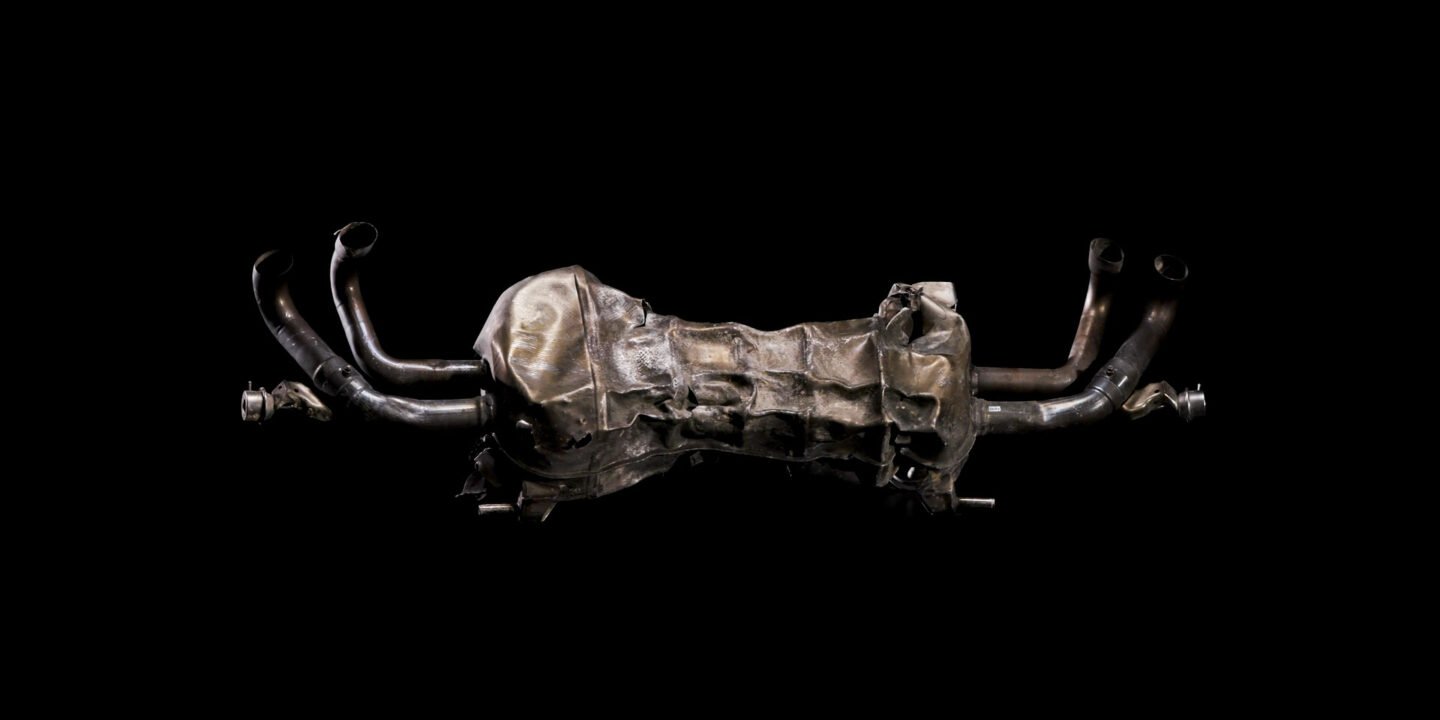
Still from rotating video of an exhaust muffler from a detonated Lamborghini Huracan.
AM Last question. The title Inferior Image raises an obvious question: inferior to what?
SHL0MS It depends on what you think the image is and what relationship you see between an AI-generated Monet, a digital scan of a Monet, and a Monet itself. The surface-level reading of the title is that it relates to the audience’s initial reflex. The rubric of inferiority was the rubric they brought to it, but the Monet was not inferior; the way of seeing was. But I do not think it is inferior to anything. It is a wonderful image.
[ad_2]
Source link