[ad_1]
Your series on boxers seems to have captured particular attention.
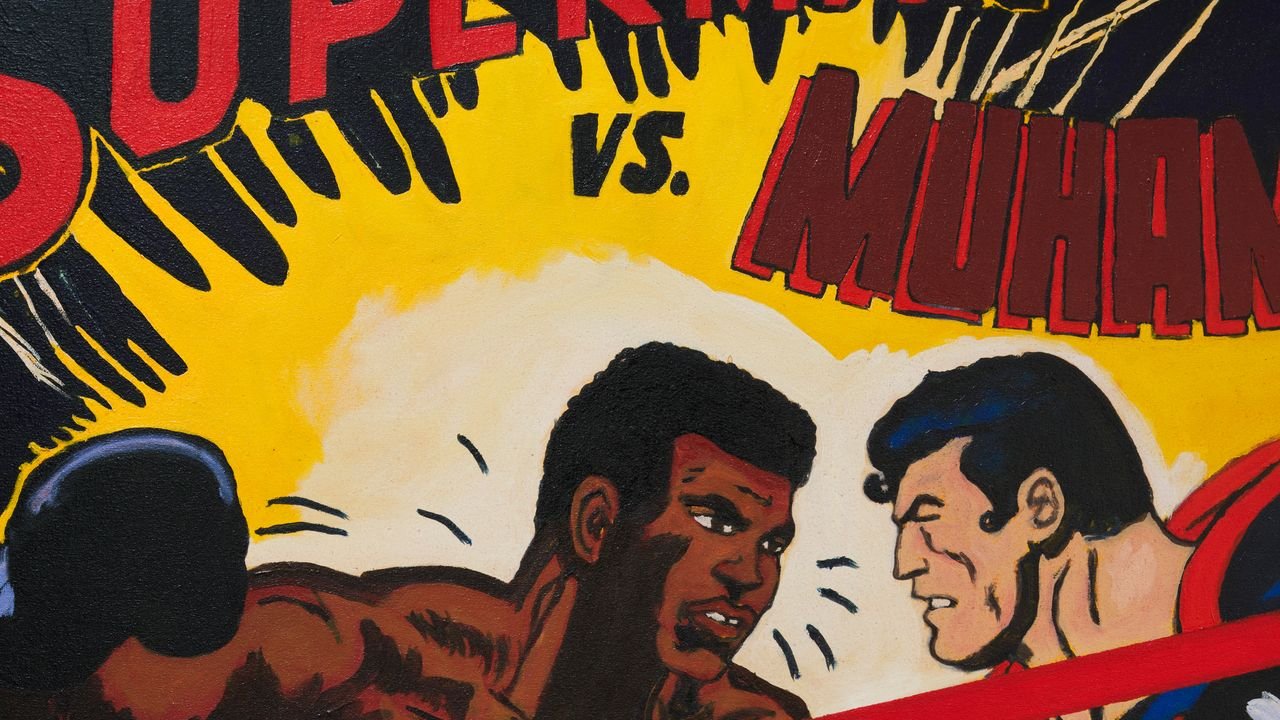
Boxing is a very interesting sport. It has its history in social practices – in America [it links] to slavery because the slave owners would get their biggest slaves to fight. Plantation owners would have a competition among themselves around who has the biggest slave. Sometimes, if one opponent got really good or won so many fights, then they could never gain their freedom. You had some characters like Tom Molyneux in the 18th century who came over here from America. He was a friend of Lord Byron’s. He fought here, was a pugilist, a bare-knuckle fighter. I came across these guys and their stories and I started to make paintings about them because they fascinated me. From Jack Johnson, then up to Mohammed Ali, to Mike Tyson and onwards. But I’m not making boxing pictures to talk about slavery. Boxing is an art in itself. Boxers are like ballerinas. I love the skill, the art of self-defence, the art of not being hit. You’re constantly moving to and fro.
Boxers are quite vulnerable in these moments, though, aren’t they?
That’s another point which is really important. One of the other things I discovered about all the boxers, from Tyson to Ali to Johnson, it’s all about male vulnerability. Because the bigger and stronger you’re supposed to be, everyone’s afraid of you. And often you hear them say that they go into the ring terrified. But they don’t show it. You know, you’re supposed to be the fiercest man in the world, the strongest man in the world, the most powerful man in the world. But you’re scared. So how are you hiding that? Where do you show your vulnerability? And then often, I think psychologically, mentally, they often tend to go beyond their best days. That’s because of the fear of not fighting. The fear of not being powerful and not being strong.
How do you try to capture this vulnerability in your paintings?
That’s why I decided to make them almost like a saintly figure, in the style of that religious iconography, because the saints are martyrs to their belief and faith and similarly, the boxers put their lives on the line. So, ultimately, that’s where your vulnerability is, the fact that you could die each time you’re in the ring.
Would you say you’re mythologising the sports figures?
Absolutely. Because mythology is part of that religious experience, it’s myth-making.
What’s going through my head at the moment is how the modern celebrity is its own form of modern myth-making.
Especially now that we have this [pointing at phone], you can myth-make as you walk on the street, what you’re eating, what you’re doing. You can create your own mythologies instantly. We’re in a cult of mythology. Before, you had to go into a church or a wealthy person’s house to see a painting, then we had museums and galleries and now we have this [gestures at phone] that’s the new space.
You were really good friends with Koyo Kouoh, the curator of this year’s Venice Biennale, who sadly passed last year.
Most of my work wouldn’t have been here without my relationship with Koyo. In fact, the last time she was in my studio, I was making works, some were for a show in New York. She sent me a text after she left my studio saying, ‘Oh G, those were some amazing works I saw, they were compellingly beautiful.’ Subsequently, when I finished the work, the commercial gallery in New York cancelled the show. I don’t know if it was too politically charged for the gallery. I was devastated. Koyo called me afterwards, and she just said, ‘Don’t worry about it.’ She gave me advice on what to do. ‘You’ve done it. You move on. Don’t worry, the work is fine.’ And lo and behold, three of them [the cancelled paintings] were selected for Venice. But I don’t think she made the selection because she didn’t talk to me about Venice. So I don’t know whether that’s serendipity? Is that spiritual? Is that her? Is that her energy coming through? Or is that my mythology that I’m creating?
[ad_2]
Source link